
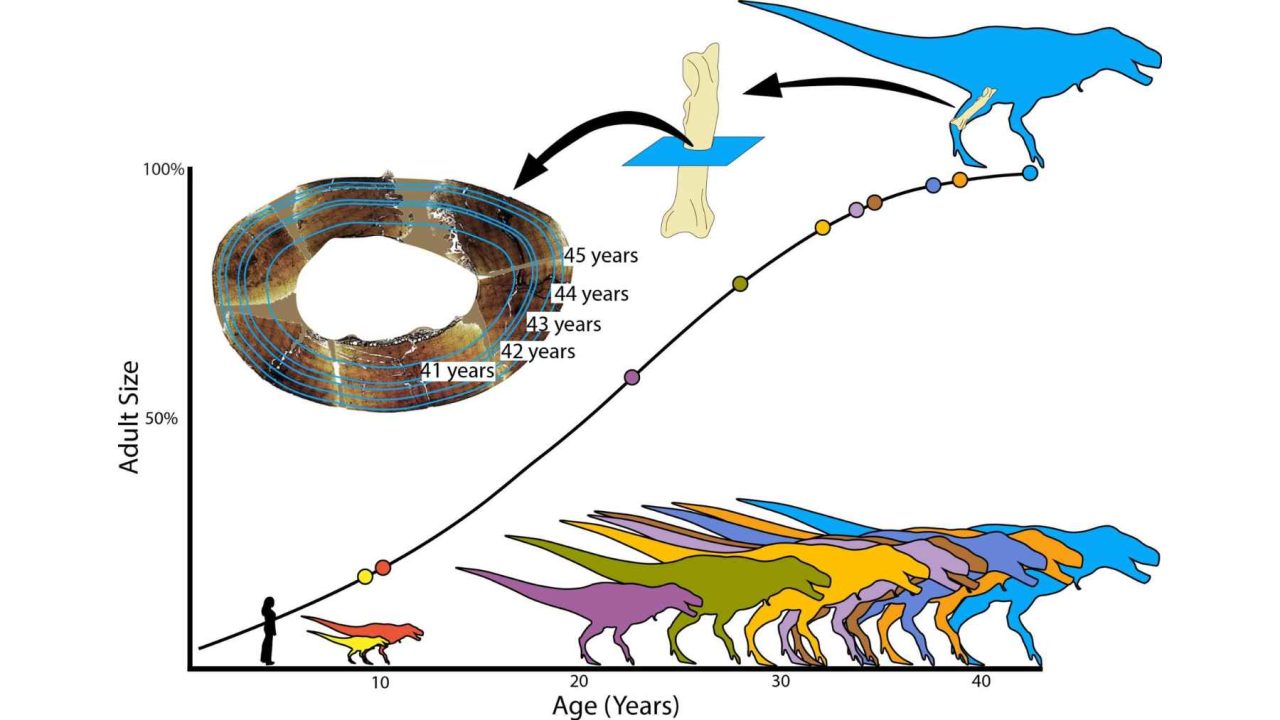
Everything you thought you knew about how big Tyrannosaurus rex got — and how fast it got there — may need a serious update. A new scientific study published in 2026 has found that T. rex didn’t stop growing at around age 25, as decades of research had suggested. Instead, the most famous predator in fossil history kept adding size and mass until it was nearly 40 years old.
That single finding reshuffles a lot of what paleontologists thought they understood about the life history of this animal. And for anyone who grew up watching the towering tyrannosaur stomp through the rain in Jurassic Park, it raises an uncomfortable question: was that iconic creature actually as big as the movie suggested it should have been?
The answer, according to researchers, is almost certainly no.
How Scientists Read a Dinosaur’s Age Like a Tree
The method behind this discovery isn’t new, but the scale of it is. Scientists examined thin cross-sections of leg bones taken from seventeen T. rex fossils — specimens that ranged from relatively small individuals all the way up to massive adults. Inside those bones, preserved across millions of years, are microscopic growth rings. Much like counting rings in a tree trunk to determine its age, paleontologists count and measure these rings to reconstruct how an animal grew year by year.
What makes this study stand out is the sample size. This is described as the largest analysis of T. rex growth conducted so far. With seventeen fossils to work from, researchers had enough data to build a detailed picture of the animal’s growth curve — and what they found contradicted the prevailing view.
Rather than reaching physical maturity in its mid-twenties, T. rex appears to have continued growing well into its late thirties. That’s a lifespan and growth trajectory that no one had fully accounted for before.
What the Bone Data Actually Showed
The key evidence came from carefully measuring how much each growth ring differed from the ones beside it. In younger animals, the rings are spaced further apart, indicating rapid growth. As the animal aged, those rings compressed — but crucially, they didn’t stop forming nearly as early as scientists had assumed.
The fossils studied ranged from small individuals to the largest known adults, giving researchers a continuous record of how the species changed across its lifespan. By piecing together growth rates year by year, the team concluded that T. rex was still putting on size at an age that earlier studies had marked as the end of its growth phase.
| Previous Understanding | New 2026 Findings |
|---|---|
| T. rex stopped growing around age 25 | T. rex continued growing until nearly age 40 |
| Growth studies based on smaller fossil samples | Largest analysis yet — 17 fossils examined |
| Leg bone rings used in previous studies | Same method, significantly expanded dataset |
| Mature adult size reached in mid-twenties | Full adult size not reached until late thirties |
The implications are significant. If T. rex took nearly four decades to reach its maximum size, then any individual fossil younger than that age would have been noticeably smaller than a fully grown adult — something that affects how scientists interpret and display specimens in museums around the world.
Jurassic Park Gets It Wrong Again
The 1993 film Jurassic Park has been corrected by science more than once over the decades — famously on feathers, on posture, and on the behavior of other species depicted in the franchise. This new finding adds another entry to that list.
The giant T. rex depicted in the film is presented as a fully realized, maximum-size predator. But if the animal didn’t reach that scale until nearly 40 years old, the film’s portrayal implies an age that the new research suggests would still have been a growing animal — not yet at its physical peak.
That doesn’t diminish the cultural power of the movie. What it does is underscore how rapidly and dramatically our understanding of these animals continues to evolve, even decades after their bones were first studied in detail.
Why This Finding Matters Beyond the Movies
For paleontologists, the revised growth timeline changes how they classify and compare T. rex specimens. A fossil previously assumed to represent a mature adult might now be reclassified as a still-growing subadult, which affects estimates of maximum body size, population structure, and even how the species competed for resources.
It also raises broader questions about longevity in large theropod dinosaurs. If the most studied dinosaur on Earth was still surprising researchers in 2026, the growth histories of lesser-known species may be even further off than currently understood.
- Seventeen T. rex fossils were examined, making this the largest study of its kind
- Growth rings in leg bones were measured microscopically, similar to reading tree rings
- The fossils ranged from small individuals to the largest known adults
- Previous research had placed the end of T. rex growth at around age 25
- The new data suggests growth continued until close to age 40
The findings were published in 2026 and represent a meaningful shift in how scientists model the biology of one of the most studied animals in the history of paleontology.
What Researchers Will Be Looking at Next
This study opens up several follow-on questions that researchers are likely to pursue. If T. rex grew for nearly four decades, what does that mean for how the species reached sexual maturity? Did it reproduce before it stopped growing, the way many large animals do today? And how does this extended growth period compare to other large predatory dinosaurs from the same era?
The bone-ring method used here — technically called skeletochronology — is already being applied to other dinosaur species, and the expanded T. rex dataset may serve as a benchmark for future comparisons. Each new fossil studied adds another data point to a picture that, as this research shows, is still very much being painted.
Frequently Asked Questions
How did scientists determine T. rex’s age from its bones?
Researchers examined microscopic growth rings preserved inside thin cross-sections of leg bones, counting and measuring them in a process similar to reading the rings inside a tree trunk.
How many fossils were included in this study?
Seventeen T. rex fossils were examined, ranging from small individuals to large adults, making it the largest analysis of T. rex growth conducted so far.
What did scientists previously believe about T. rex growth?
Earlier studies suggested that T. rex stopped growing at around age 25, which the new 2026 research directly contradicts.
How long did T. rex actually keep growing, according to the new findings?
The new research indicates T. rex continued growing well into its late thirties — close to age 40 — rather than stopping in its mid-twenties.
What does this mean for the T. rex depicted in Jurassic Park?
According to the new findings, the film’s giant tyrannosaur would have been noticeably smaller at the age implied on screen, since full adult size wasn’t reached until much later in the animal’s life.
Does this change how museums classify T. rex specimens?
It potentially does — fossils previously assumed to represent fully mature adults may need to be reassessed as still-growing individuals if they fall below the new estimated age of full maturity.

Leave a Reply