
What if the secret to surviving deep space radiation was already hiding inside one of Earth’s most indestructible creatures — a microscopic animal that can survive the vacuum of space, extreme temperatures, and doses of radiation that would kill any human? Scientists have been chasing exactly that idea. And a new study suggests the answer is far messier than anyone hoped.
Researchers have long been fascinated by the tardigrade, an eight-legged micro-animal barely half a millimeter long that produces a remarkable protein called Dsup — short for Damage Suppressor. In lab experiments, Dsup has been shown to shield DNA from radiation damage. The logical leap was tantalizing: what if human cells could be engineered to produce the same protein, giving astronauts a kind of biological armor against the relentless radiation of deep space?
A new preprint led by Corey Nislow at the University of British Columbia has thrown cold water on that dream — and the findings reveal just how complicated the relationship between protection and harm can be at the cellular level.
Why Space Radiation Is One of the Biggest Obstacles to Mars
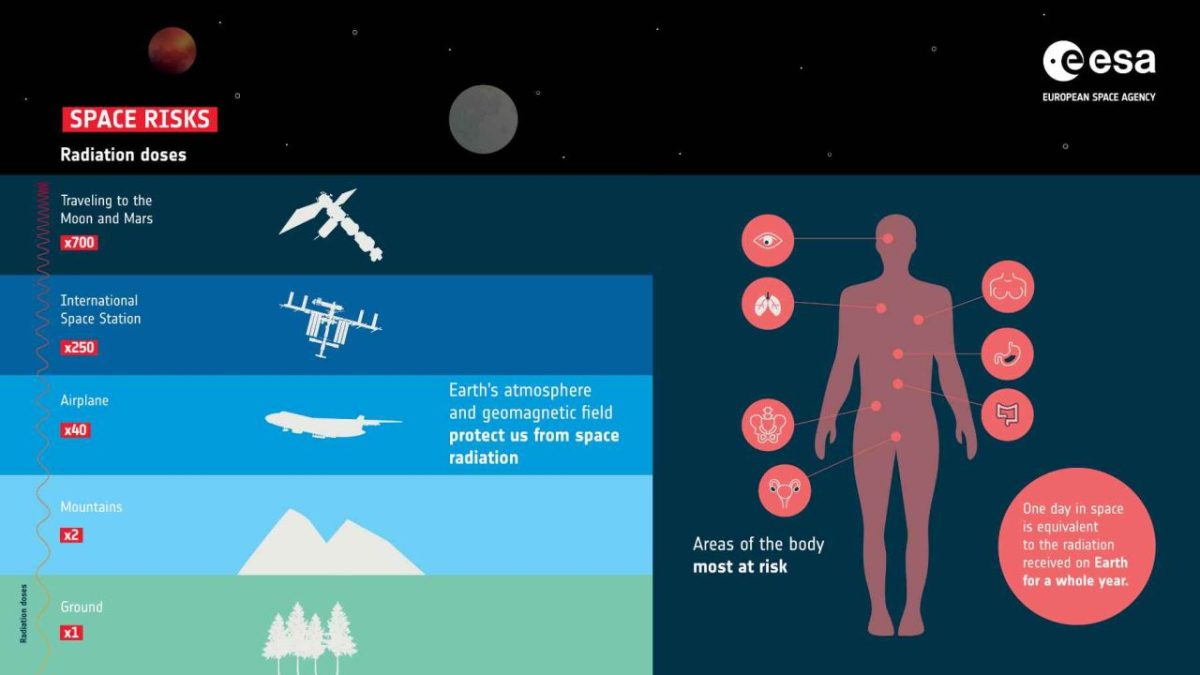
On Earth, we are largely shielded from the worst of space radiation by the planet’s magnetic field. In deep space, that protection disappears entirely. Astronauts on long-duration missions — particularly those headed toward Mars — face a constant bombardment of galactic cosmic rays and charged particles ejected by the Sun.
The exposure adds up fast. For a Mars-bound crew, total radiation exposure could easily reach hundreds of millisieverts over the course of a mission. To put that in perspective, most people on Earth receive only a fraction of a millisievert per year from background radiation. The difference is stark, and the health consequences are serious — long-term elevated risks of cancer and other diseases caused by DNA damage in virtually every organ of the body.
Heavier physical shielding helps, but it comes at a steep cost. Every additional kilogram of metal or plastic shielding makes rockets more expensive and more difficult to launch. That reality has pushed agencies like NASA to look beyond hardware for solutions — including biological ones.
The Tardigrade Protein That Looked Like a Silver Bullet
Enter the tardigrade. These microscopic animals — sometimes called “water bears” — have been studied for decades because of their extraordinary resilience. They can survive the vacuum of space, near-absolute-zero temperatures, extreme dehydration, and radiation levels that would be instantly lethal to virtually any other organism.
Part of their secret is Dsup, a protein that physically wraps around DNA and appears to act as a shield, reducing the strand breaks caused by ionizing radiation. When researchers successfully introduced the Dsup gene into human cultured cells in earlier experiments, those cells showed measurably less radiation damage. The scientific community took notice. If it worked in a dish, could it work in a living human body?
That is the question Nislow’s team at the University of British Columbia set out to investigate more rigorously — and the answer they found was deeply complicated.
What the New Research Actually Found
The new preprint’s core finding is a difficult trade-off: while Dsup does offer measurable protection against radiation-induced DNA damage, it appears to come with a significant biological cost. According to the research, the protein can also kill cells — meaning the same mechanism that shields DNA under certain conditions may disrupt normal cellular function in ways that are harmful rather than helpful.
This is not a minor side effect to be optimized away. It points to a fundamental tension at the heart of the idea. Tardigrades evolved Dsup over millions of years alongside a suite of other biological adaptations that allow them to tolerate the protein’s effects. Human cells, operating under entirely different biological rules, do not have those same compensating mechanisms.
The research suggests that simply transplanting a tardigrade’s molecular toolkit into human biology is not a straightforward path to radiation resistance — and may introduce new dangers in the process of trying to prevent existing ones.
The Gap Between a Lab Dish and a Living Astronaut
One of the most important takeaways from this research is the reminder of how large the gap can be between promising early results and real-world application. Earlier experiments showing that Dsup reduced DNA damage in cultured human cells were genuine and significant findings. But cultured cells in a laboratory are a controlled, simplified environment. A living human body is vastly more complex.
| Factor | Earth (Ground Level) | Deep Space / Mars Mission |
|---|---|---|
| Radiation source | Medical scans, natural background | Galactic cosmic rays, solar particle events |
| Annual exposure (typical) | Low millisievert range | Potentially hundreds of millisieverts |
| Magnetic field protection | Yes — Earth’s field deflects most particles | None beyond the spacecraft structure |
| Primary health risk | Minimal long-term concern | Elevated cancer risk, DNA damage across organs |
| Dsup protein viability | Not applicable | Protective but potentially cytotoxic |
The new findings do not mean the search for biological radiation protection is over. They mean the field needs to understand far more about how proteins like Dsup interact with human cellular machinery before any application could be considered safe — let alone practical for a crewed spaceflight.
What Comes Next in the Search for Astronaut Protection
Research into Dsup and tardigrade biology will almost certainly continue. The protein’s protective mechanism is real, and understanding precisely how it works — and why it causes cellular harm in human cells — could eventually point scientists toward modified approaches that capture the benefit without the toxicity.
In parallel, NASA and other space agencies are pursuing multiple tracks: improved physical shielding materials, mission planning that minimizes exposure during solar particle events, and pharmaceutical interventions that might reduce radiation damage after the fact. No single solution is expected to solve the problem on its own.
For now, the tardigrade remains one of nature’s most impressive survivors. But borrowing its armor, it turns out, is not as simple as copying and pasting its genetic instructions into a human cell. Biology rarely works that cleanly — and this study is a sharp reminder of why.
Frequently Asked Questions
What is the Dsup protein?
Dsup, short for Damage Suppressor, is a protein produced by tardigrades that appears to physically shield DNA from radiation-induced damage.
Who led the new research on Dsup in human cells?
The new preprint was led by Corey Nislow at the University of British Columbia.
Why is space radiation so dangerous for astronauts?
In deep space, Earth’s protective magnetic field is absent, exposing astronauts to galactic cosmic rays and solar particle bursts that can damage DNA in every organ, significantly raising long-term cancer risk.
How much radiation could astronauts face on a Mars mission?
According to
Does the Dsup protein protect human cells at all?
Yes, Dsup does offer measurable protection against radiation-induced DNA damage in human cells, but the new research indicates it can also kill cells, creating a significant and unresolved trade-off.
Could this research still lead to a usable treatment someday?
This has not yet been confirmed. The findings highlight how much more needs to be understood about Dsup’s interaction with human biology before any practical application could be considered.




Leave a Reply