
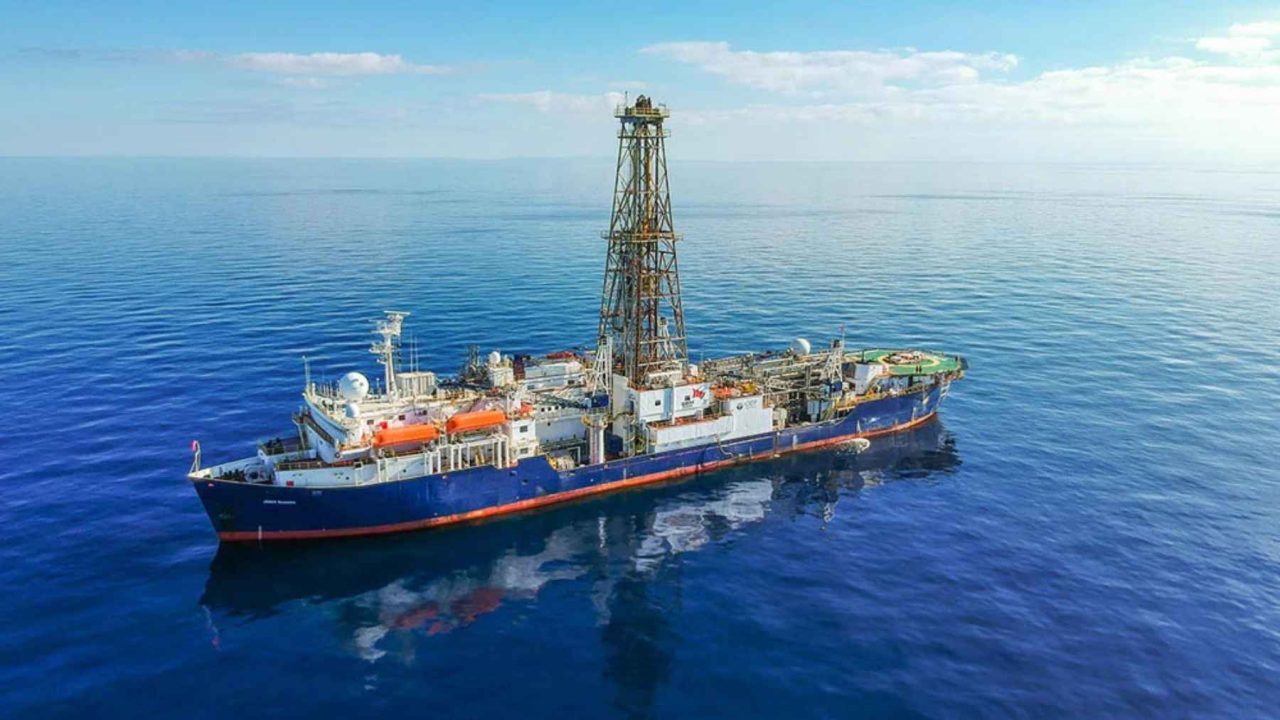
More than 4,100 feet below the seafloor of the Atlantic Ocean, scientists have pulled up something that has never existed before in a laboratory: a continuous, unbroken column of Earth’s upper mantle stretching 1,268 meters long. It is the deepest direct sample of mantle rock ever recovered, and it is already forcing researchers to rethink what they thought they knew about the hidden engine beneath our feet.
The achievement came from an international scientific team working aboard the research vessel JOIDES Resolution. They drilled into a geological formation called the Atlantis Massif, located near the Mid-Atlantic Ridge — a vast underwater mountain range running down the center of the Atlantic Ocean. What they brought back is not just a scientific trophy. It is a record of processes that shape everything from earthquakes and volcanoes to the chemistry of the oceans and, remarkably, the potential for life in extreme environments.
For decades, the mantle remained one of the most studied and least understood parts of our planet. That is now starting to change.
Why Drilling Into the Mantle Is So Difficult — and So Important
The mantle is the thick layer of rock that sits between Earth’s thin outer crust and its metallic core. It holds roughly two-thirds of Earth’s total mass and accounts for more than 80% of the planet’s volume. Despite its enormous scale, scientists have never been able to study it directly in any meaningful depth — until now.
The problem is access. On land, the mantle sits dozens of miles beneath the surface, far beyond the reach of any drill. Under the ocean, however, the crust is much thinner, which is why the Mid-Atlantic Ridge became the target. Even so, earlier attempts to drill into oceanic mantle barely scratched the surface before equipment failed or the project stalled.
Before this mission, researchers had to piece together an understanding of the mantle from indirect sources: ancient mantle slabs called ophiolites that were pushed up onto land through tectonic movement, rock fragments carried to the surface inside magmas, and chunks dredged from seafloor fracture zones. These samples are genuinely valuable — but they are disconnected snapshots, not a continuous record. Scientists describe it as trying to understand a novel by reading random sentences pulled from different pages.
The new core changes that entirely. For the first time, researchers can see how mantle rock actually changes with depth, layer by layer, rather than guessing at the transitions between scattered fragments.
What the Record-Breaking Core Actually Reveals
The 1,268-meter core was extracted from beneath the Atlantis Massif, a well-studied underwater massif near the Mid-Atlantic Ridge that has long been of interest to geologists because of the unusual rock types exposed at its surface. The location allowed the drilling team to reach mantle material that would have been inaccessible almost anywhere else on Earth.
The core provides a continuous, depth-ordered record of upper mantle composition — something that has never existed before. Researchers note that this kind of unbroken sequence is essential for understanding how the mantle behaves, how it interacts with seawater seeping down through cracks in the seafloor, and how those chemical reactions might support microbial life in environments with no sunlight and extreme pressure.
| Feature | Detail |
|---|---|
| Core length recovered | 1,268 meters (approximately 4,160 feet) |
| Drilling location | Atlantis Massif, near the Mid-Atlantic Ridge |
| Research vessel | JOIDES Resolution |
| Layer sampled | Upper mantle (deepest direct sample ever obtained) |
| Previous sampling methods | Ophiolites, magma fragments, dredged seafloor rocks |
| Earth’s mantle share of planet mass | Approximately two-thirds |
| Earth’s mantle share of planet volume | More than 80% |
The Connections to Life, Climate, and Energy That Most People Miss
It would be easy to file this story under “interesting science” and move on. But the implications run considerably deeper than academic curiosity.
The mantle is not an inert slab of rock. It is chemically active, and when mantle minerals come into contact with seawater — a process called serpentinization — they produce hydrogen and methane. Those chemical reactions are known to support microbial ecosystems in the deep ocean, entirely independent of sunlight. Understanding the scale and chemistry of that process, using a continuous core sample rather than isolated fragments, could reshape what scientists understand about where life can exist on Earth — and potentially on other worlds.
The connection to climate is equally significant. Mantle rock exposed at the seafloor interacts with dissolved carbon dioxide in seawater, locking carbon into minerals through a natural process. Researchers studying how to remove carbon from the atmosphere have pointed to this kind of mineral carbonation as a potential large-scale approach. A detailed mantle core helps quantify how that process actually works across depth and time.
The potential energy connections noted by researchers relate to the hydrogen produced during those same chemical reactions — a clean-burning fuel that forms naturally in mantle rock under the right conditions.
What Scientists Will Do With This Core Next
A core of this length and continuity will keep researchers occupied for years. The immediate work involves detailed geochemical analysis — mapping the mineral composition at each depth, looking for evidence of water infiltration, microbial activity, and the chemical gradients that drive reactions between rock and seawater.
The broader goal is to build the first real depth profile of the upper mantle: a reference record that future studies can use to test models of how the Earth’s interior works. Previous models relied heavily on computer simulations and indirect measurements. Now there is physical rock to test those models against.
The JOIDES Resolution has been central to ocean drilling science for decades, but this mission represents a genuine milestone — not just in the depth achieved, but in the unbroken nature of what was recovered. Scattered rock fragments can only tell you so much. A continuous core tells a story.
Frequently Asked Questions
How deep did scientists drill to recover this mantle core?
The team recovered a continuous core stretching 1,268 meters — approximately 4,160 feet — beneath the seafloor at the Atlantis Massif near the Mid-Atlantic Ridge.
What ship was used for the drilling mission?
The international scientific team worked from the research vessel JOIDES Resolution, a dedicated ocean drilling ship that has been used for major scientific drilling expeditions for decades.
Why is the Mid-Atlantic Ridge a good place to drill into the mantle?
The oceanic crust is much thinner under the ocean than under continents, making mantle rock far more accessible. The Atlantis Massif, near the Mid-Atlantic Ridge, is a particularly favorable location because mantle material is exposed relatively close to the seafloor.
What makes this core different from previous mantle samples?
Earlier samples — from ophiolites, magma fragments, and dredged seafloor rocks — were disconnected pieces. This core is a continuous, depth-ordered record that lets scientists see how mantle composition actually changes with depth for the first time.
Does this discovery have any connection to the search for life beyond Earth?
Researchers have noted that the chemical reactions between mantle rock and seawater can support microbial life without sunlight, which has implications for understanding where life might exist on other worlds with similar conditions.
Will the full findings be published soon?
This has not yet been confirmed in the available source material. Analysis of a core this size typically takes months to years before comprehensive results are published.




Leave a Reply