
Every year, without anyone noticing, the Moon quietly moves a little farther away from Earth — about 3.8 centimeters, or roughly 1.5 inches. That is approximately the same rate at which a human fingernail grows. It sounds trivial. But over millions of years, this slow drift is doing something remarkable: it is gradually erasing one of the most dramatic natural spectacles our planet has ever produced — the total solar eclipse.
The Moon is not wandering randomly. It is retreating in a measured, predictable way, and scientists have been tracking it with extraordinary precision for decades. What they have found tells us not just about the future of eclipses, but about the deep history of Earth itself — how our days have lengthened, how our tides have weakened, and how the relationship between our planet and its only natural satellite has been slowly, silently changing since the beginning.
This is not science fiction or distant speculation. The physics is well understood, the measurements are precise, and the consequences — for eclipses, for tides, and for life on Earth — are as real as the Moon itself.
How Scientists Know the Moon Is Moving Away
The evidence for the Moon’s retreat is not theoretical. It comes from one of the most elegant experiments ever conducted: lunar laser ranging, made possible by the Apollo missions.
When Apollo astronauts landed on the Moon, they left behind mirrored panels on the lunar surface. Today, observatories around the world fire short pulses of laser light at those reflectors and measure precisely how long the light takes to make the round trip. That journey — there and back — takes about two and a half seconds, and the timing is accurate enough to reveal the Earth-Moon distance down to the millimeter.
Over decades of these measurements, the data tells a consistent story: the Moon is moving outward at about 3.8 centimeters per year. Not dramatically. Not suddenly. Just steadily, year after year, in a slow gravitational waltz that has been playing out for billions of years.
Why the Moon Is Drifting — and What It’s Changing
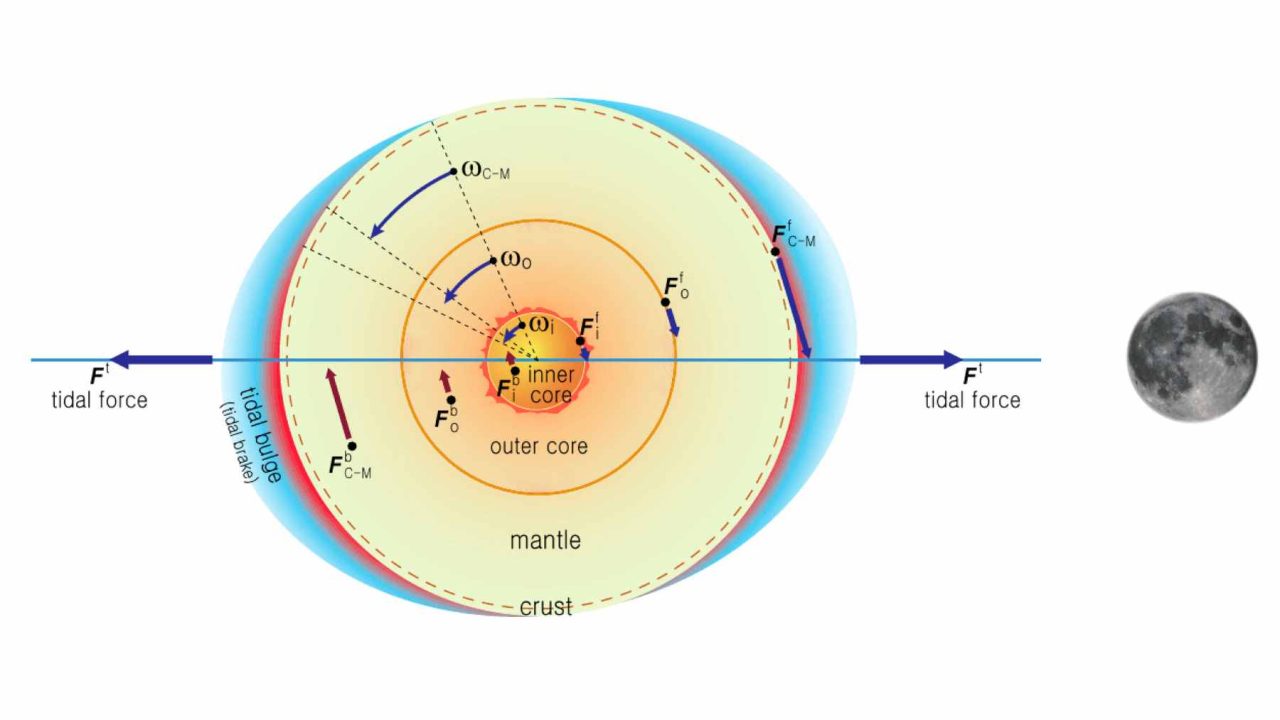
The force driving this retreat is tidal friction. Earth’s oceans respond to the Moon’s gravity by bulging slightly toward it — creating tides. But because Earth rotates faster than the Moon orbits, those tidal bulges are always pulled slightly ahead of the Moon’s position. That misalignment transfers rotational energy from Earth to the Moon, gradually pushing the Moon into a wider orbit.
The effects of this process reach far beyond the Moon’s distance. As the Moon moves outward, Earth’s rotation slows. Days grow longer — not by any amount you would notice in a lifetime, but measurably, over geological time. Ancient coral fossils and sediment records suggest that hundreds of millions of years ago, an Earth day lasted significantly less than 24 hours. The Moon’s retreat has been lengthening our days ever since.
The tides, too, are affected. As the Moon moves farther away, its gravitational pull on Earth’s oceans weakens slightly. Over millions of years, this means the tidal forces that stir the oceans — mixing nutrients, driving currents, and influencing marine life — will gradually soften.
The End of Total Solar Eclipses: What the Numbers Tell Us
Of all the consequences of the Moon’s slow retreat, the most visually striking is the eventual disappearance of total solar eclipses. Right now, the Moon and the Sun appear almost exactly the same size in our sky — a cosmic coincidence that allows the Moon to perfectly cover the Sun’s disk during a total eclipse. That alignment is not permanent.
| Factor | Current Reality | Long-Term Change |
|---|---|---|
| Moon’s annual drift from Earth | ~3.8 cm per year (~1.5 inches) | Gradual increase in orbital distance |
| Apparent size of Moon vs. Sun | Nearly identical — enables total eclipses | Moon will appear too small to fully cover the Sun |
| Effect on Earth’s rotation | Days slowly lengthening over geological time | Days continue to grow longer as Moon retreats |
| Effect on ocean tides | Tides driven by Moon’s gravitational pull | Tidal forces gradually weaken over millions of years |
| Measurement method | Lunar laser ranging (Apollo reflectors) | Ongoing — millimeter-level precision |
As the Moon moves farther from Earth, it will appear smaller against the sky. At some point — hundreds of millions of years from now — it will no longer be large enough to fully block the Sun. Total solar eclipses will give way entirely to annular eclipses, where a ring of sunlight remains visible around the Moon’s edge. The era of totality, which has defined dramatic sky events throughout human history, will simply end.
Why This Matters More Than It Might Seem
It is easy to dismiss changes measured in centimeters per year or consequences that unfold over hundreds of millions of years. But the Moon’s retreat is a reminder that the Earth-Moon system is not static — it is an evolving relationship with real consequences for how our planet works.
The tidal mixing driven by the Moon’s gravity plays a role in ocean circulation and the distribution of nutrients that support marine ecosystems. The lengthening of Earth’s day, driven by the same tidal friction that pushes the Moon outward, has shaped the pace of life on Earth over geological timescales. These are not abstract concerns — they are part of the physical story of how Earth became and remains a living planet.
For anyone who has ever stood in the path of a total solar eclipse and felt the temperature drop, watched the sky darken in the middle of the day, and seen the Sun’s corona flare into view — that experience is, in the longest possible view, a temporary gift. The geometry that makes it possible is slowly dissolving, one fingernail-width at a time.
What Comes Next for Eclipse Watchers and Earth Science
The good news is that total solar eclipses are not disappearing anytime soon by any human measure. The Moon’s retreat of 3.8 centimeters per year means the change is imperceptible across any individual lifetime, or even across recorded human history. Total eclipses will continue to occur for hundreds of millions of years before the geometry finally shifts beyond recovery.
In the nearer term, scientists will continue refining their measurements using the Apollo laser reflectors, building an ever-more-precise picture of how the Moon’s orbit is evolving. Each new data point adds to a record that stretches back to the early 1970s and continues to reveal the quiet mechanics of our nearest celestial neighbor.
The Moon looks the same tonight as it did last night, and as it will tomorrow. But the numbers say otherwise — and the universe, as always, is keeping count.
Frequently Asked Questions
How fast is the Moon moving away from Earth?
The Moon is moving away from Earth at approximately 3.8 centimeters — about 1.5 inches — per year, a rate comparable to the growth of a human fingernail.
How do scientists measure the Moon’s retreat so precisely?
Observatories fire laser pulses at mirrored panels left on the lunar surface by Apollo astronauts, then measure the round-trip travel time. The method is accurate to the millimeter level and reveals the Earth-Moon distance with extraordinary precision.
Will total solar eclipses really disappear?
Yes, eventually. As the Moon moves farther from Earth, it will appear smaller in the sky and will no longer be able to fully cover the Sun. Total solar eclipses will give way to annular eclipses over a timescale of hundreds of millions of years.
Is the Moon’s retreat affecting Earth’s tides right now?
The tidal effects are real but extremely gradual. The same tidal friction that pushes the Moon outward also slowly lengthens Earth’s day and, over millions of years, will weaken the Moon’s tidal pull on the oceans.
Should anyone be worried about the Moon drifting away?
Not on any human timescale. The changes involved unfold over hundreds of millions of years, far beyond any practical concern for current or future generations of people.
How long has the Moon been moving away from Earth?
The process has been ongoing for billions of years, driven by tidal friction between Earth’s oceans and the Moon’s gravitational pull. Ancient geological records suggest Earth’s day was significantly shorter hundreds of millions of years ago as a result of this long-running process.

Leave a Reply