
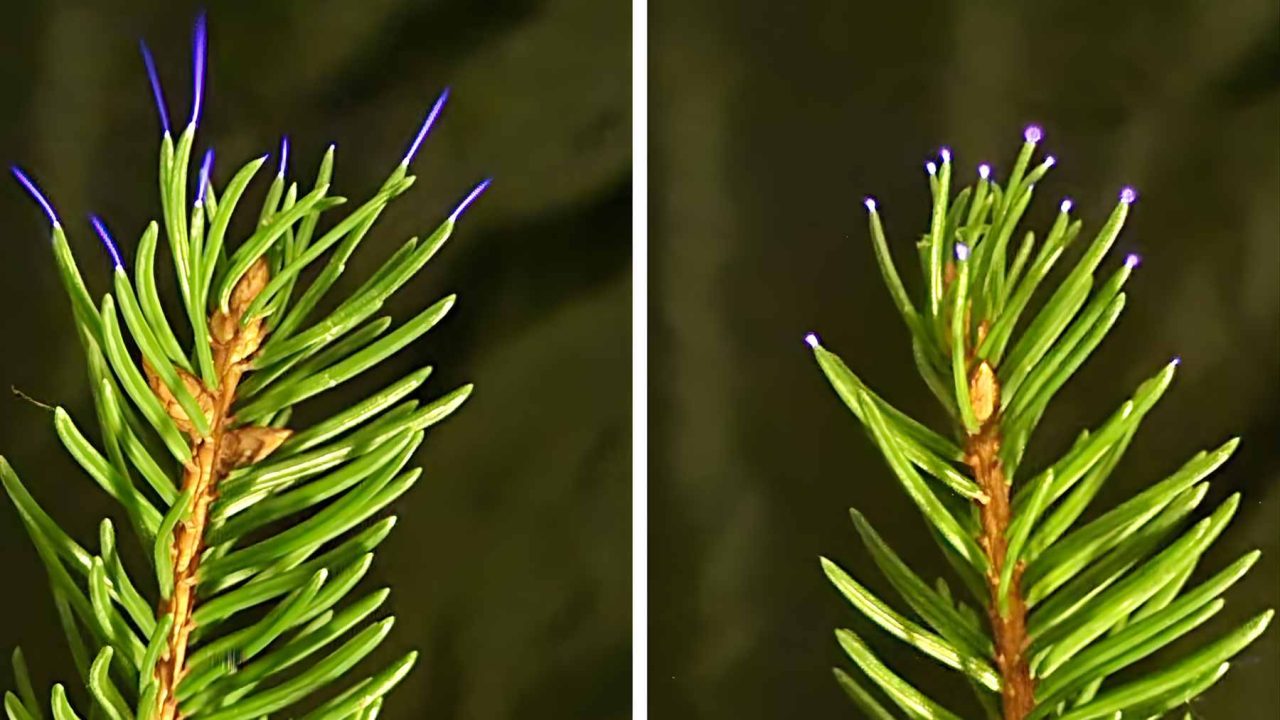
For nearly a century, scientists suspected something strange was happening in the treetops during thunderstorms — something invisible, silent, and entirely overlooked. Now, for the first time, researchers have captured direct evidence of it: faint electrical glows flickering across the leaves of trees along the United States East Coast, recorded during summer storms in 2024.
These ghostly discharges, known as coronae, are not lightning. They are not fire. They are weak electrical pulses that form when storm clouds overhead build up a powerful electric field, concentrating charge at the sharpest available points — in this case, the tips of leaves high in the forest canopy. And until now, no one had ever recorded them happening outdoors.
The find closes a gap that has lingered in atmospheric science since the early twentieth century, when researchers first theorized that trees might glow electrically during storms. What was once a suspicion has become something researchers can measure, study, and — perhaps most importantly — begin to understand.
What Electrical Coronae in Trees Actually Are
The word “corona” might call to mind the sun’s outer atmosphere or a type of virus, but in physics it refers to something more subtle: a localized electrical discharge that occurs when the electric field around a sharp or curved object becomes strong enough to ionize the surrounding air.
Think of it as the air itself briefly breaking down under electrical pressure — not explosively, the way lightning does, but quietly, at the microscopic level. The result is a faint glow of ultraviolet light that the human eye cannot detect at all.
That invisibility is precisely why it took so long to confirm. The research team did not spot these discharges by looking at trees during a storm. They used specialized ultraviolet detection equipment — instruments designed to capture light frequencies well outside the range of human vision. When they pointed that equipment at treetops during active thunderstorms along the East Coast, the coronae appeared across multiple tree species.
The fact that this occurred across several different species suggests the phenomenon is not tied to one particular type of tree. It may be a widespread, routine feature of how forests behave during electrical storms — one that science simply lacked the tools to see clearly until now.
Why This Discovery Matters Beyond the Science Lab
At first glance, this might sound like a curiosity — a faint glow on a leaf tip that nobody can see anyway. But researchers believe the implications stretch well beyond the visual spectacle.
According to the study, these electrical coronae may be doing several things simultaneously:
- Lightly singeing leaves — The discharge may be causing subtle, low-level burning on leaf surfaces, damage that would be nearly impossible to detect without knowing what to look for.
- Altering local air chemistry — Electrical discharges can produce chemical reactions in the air, potentially generating compounds that affect the immediate environment around the tree.
- Revealing a missing piece of storm science — The interaction between thunderstorms and forests has long been studied, but these coronae represent a mechanism that models and observations may have been missing entirely.
In other words, forests may be quietly participating in the electrical activity of storms in ways that scientists have not yet fully accounted for. That has potential consequences for everything from atmospheric chemistry research to how we understand forest health in storm-prone regions.
Key Facts About the Study and Its Findings
| Detail | What the Research Found |
|---|---|
| When recorded | Summer 2024 |
| Where recorded | US East Coast |
| Detection method | Ultraviolet detection equipment |
| Visibility to humans | Not visible to the naked eye |
| Tree species affected | Multiple species observed |
| First outdoor recording? | Yes — a scientific first |
| Suspected since | Nearly a century ago |
| Potential effects | Leaf singeing, air chemistry changes |
The study marks the first time these discharges have been captured in a real outdoor environment. Previous knowledge of corona discharges came largely from laboratory conditions, where scientists could control the electric field and observe the effect artificially. Seeing it happen naturally — in living trees, during real storms — is a fundamentally different kind of confirmation.
The Part of This Story Most Reports Are Missing
What makes this discovery particularly significant is not just that the coronae exist, but that they may be far more common than scientists previously assumed. The researchers noted this directly: now that the detection method has been demonstrated outdoors, the effect could be happening across forests throughout storm-prone regions without anyone having noticed.
Every thunderstorm that passes over a forested area could potentially be triggering these faint electrical discharges across thousands of leaf tips simultaneously. If that is the case, the cumulative effect on forest ecosystems — on leaf health, on air chemistry, on the electrical environment of the lower atmosphere — could be meaningful in ways that current scientific models simply do not capture.
It also raises a practical question for forest researchers and ecologists: if leaves are being lightly singed by electrical activity that leaves no visible mark, could that contribute to stress in trees over time? Could it affect how forests respond to drought or disease? Those questions remain open, but they are now worth asking in a way they were not before this study.
What Researchers Will Likely Focus on Next
The immediate next step in this line of research is almost certainly broader observation. Now that a working method exists for detecting outdoor coronae — ultraviolet equipment trained on treetops during active storms — researchers can apply it across different geographic regions, different forest types, and different storm intensities.
The goal would be to establish how widespread the phenomenon truly is, whether certain tree species or leaf shapes are more prone to producing coronae, and what measurable effects the discharges have on the trees themselves and on the air around them.
The chemistry angle is particularly intriguing. Electrical discharges in air can produce reactive molecules, and if coronae are happening routinely across large forest areas, that chemistry could be feeding into broader atmospheric processes. Atmospheric scientists and ecologists may find themselves working on this problem together in the years ahead.
For now, what the 2024 East Coast recordings have established is simple but profound: forests are electrically active during storms in a way science is only beginning to document.
Frequently Asked Questions
What is a corona discharge in a tree?
It is a weak electrical discharge that forms at the sharp tips of leaves when a thunderstorm overhead creates a strong electric field. It produces a faint ultraviolet glow that is invisible to the human eye.
Where and when were these electrical flashes recorded?
They were recorded along the US East Coast during the summer of 2024, using specialized ultraviolet detection equipment during active thunderstorms.
Can you see these coronae with the naked eye?
No. The discharges emit ultraviolet light, which is outside the range of human vision. Researchers required specialized equipment to detect them.
Is this the first time coronae have been recorded on trees outdoors?
Yes. While the phenomenon had been theorized for nearly a century, this study represents the first confirmed outdoor recording on living trees during real storm conditions.
Could this be harming trees?
Researchers suggest the discharges may lightly singe leaves and alter local air chemistry, but the full extent of any long-term impact on tree health has not yet been determined.
How common could this phenomenon be?
Researchers believe it may be far more widespread than previously assumed, potentially occurring across large forested areas during any significant thunderstorm — but broader studies are needed to confirm the scale.



Leave a Reply