
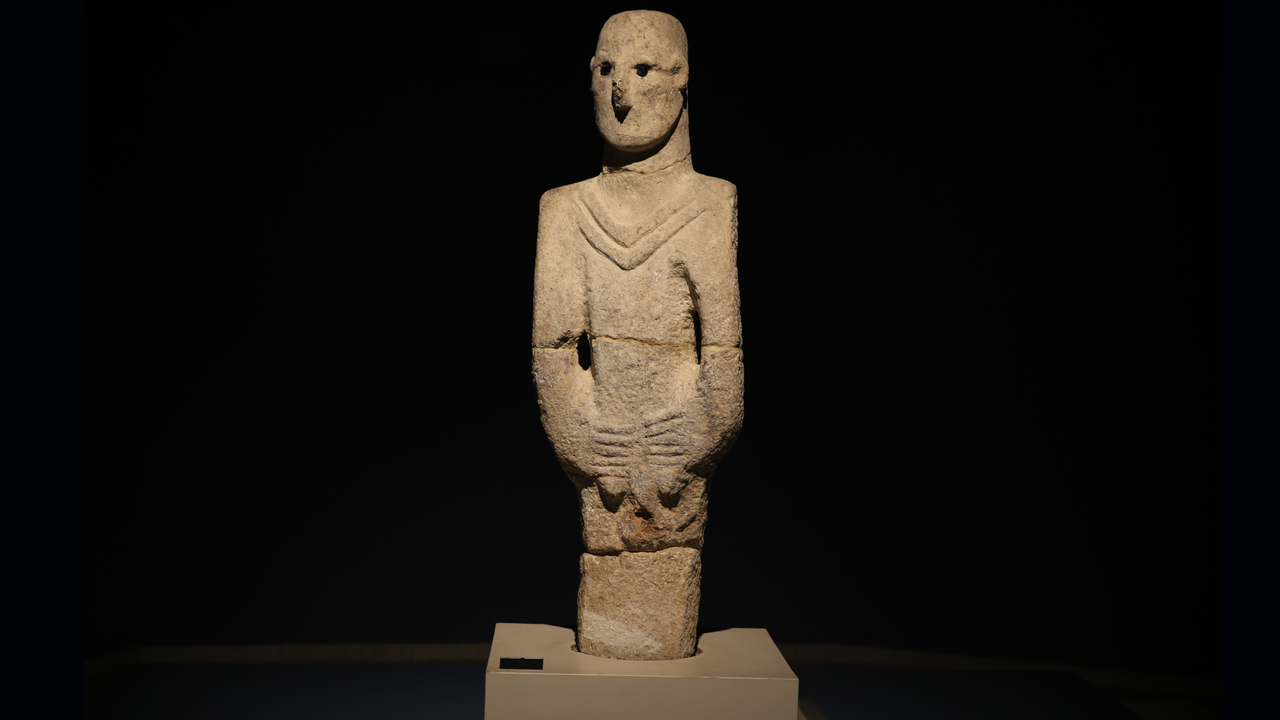
More than 11,500 years ago, long before writing existed, before cities rose, before most of what we call civilization had even taken shape, someone in what is now southern Turkey carved a life-size human figure out of limestone. That statue — known today as Urfa Man — is the oldest known life-size human sculpture ever discovered, and it has been quietly rewriting what we thought we knew about prehistoric art and belief.
What makes Urfa Man especially striking isn’t just its age. It’s the pose: arms crossed over the lower body, hands clasped around the genitals. Deliberate. Intentional. Deeply human. And after more than a century of archaeological study, we still don’t fully understand what it meant to the people who made it.
The statue now lives in the Şanlıurfa Archaeological Museum in Turkey, where it stands as one of the most remarkable — and most underappreciated — objects in the entire archaeological record.
What Urfa Man Actually Is
Urfa Man is also known as the Balıklıgöl statue, named after the area near where it was found in Şanlıurfa, a city in southeastern Turkey. It dates to approximately 9500 B.C., placing it firmly in the Neolithic period — a time when humans in this region were only just beginning to shift from nomadic hunter-gatherer lifestyles toward settled agricultural communities.
The statue is carved from limestone and stands at life-size scale, making it unlike anything else from its era. Most prehistoric art from this period consists of small figurines, cave paintings, or carved reliefs. A full-scale human figure is something else entirely — it suggests a level of artistic ambition, technical skill, and perhaps spiritual motivation that researchers are still working to understand.
According to the Şanlıurfa Archaeological Museum, which owns and displays the statue, Urfa Man was discovered accidentally — a detail that adds its own layer of intrigue. Many of the most significant archaeological finds in this region have come not from planned excavations but from chance encounters during construction or farming.
The Statue at a Glance
| Detail | Information |
|---|---|
| Name | Urfa Man (also: Balıklıgöl statue) |
| Material | Limestone |
| Approximate Age | Over 11,500 years old |
| Date of Creation | Circa 9500 B.C. |
| Origin | Şanlıurfa, Turkey |
| Discovery | Accidental |
| Current Location | Şanlıurfa Archaeological Museum, Turkey |
| Scale | Life-size |
Why This Region Was the Center of the Ancient World
Şanlıurfa sits in a part of Turkey that archaeologists have come to regard as one of the most important regions in human prehistory. This is the same landscape that gave us Göbekli Tepe, the massive ceremonial stone complex widely considered the world’s oldest known temple, also dating to around 9500 B.C.
The proximity is not coincidental. The people who carved Urfa Man and those who constructed Göbekli Tepe were likely part of the same broader cultural world — hunter-gatherers on the edge of a profound transformation, building monuments and crafting images at a scale no one had attempted before.
What drove this creative and spiritual explosion in this particular corner of the ancient world remains one of archaeology’s great open questions. Some researchers point to the region’s ecological richness. Others suggest that the transition toward agriculture created new social structures that demanded new forms of ritual and communal expression. Urfa Man fits somewhere in that story — exactly where is still being debated.
What the Pose Actually Tells Us
The most discussed feature of Urfa Man is unquestionably the pose. The figure stands with both hands meeting at the groin, fingers wrapped around the genitals. This is not an accident of carving or a matter of anatomical convenience. It is a deliberate artistic choice made by someone who understood human anatomy and chose to emphasize this specific gesture.
Scholars have proposed several interpretations:
- Fertility symbolism — The gesture may represent a celebration or ritual invocation of male reproductive power, common across many early cultures.
- Protective posture — Some researchers read crossed-hand poses in ancient statuary as gestures of self-protection or spiritual guardianship.
- Ritual or priestly identity — The figure may represent a specific type of individual — a shaman, priest, or ancestor — whose role in the community was connected to life, death, or spiritual mediation.
None of these interpretations can be confirmed with the evidence currently available. The honest answer is that we don’t know — and that uncertainty is part of what makes Urfa Man so compelling.
The Oldest of Its Kind, but Far From the Last
Urfa Man represents the beginning of a sculptural tradition that would eventually spread across the ancient world. According to researchers, people in what is now southern Turkey began crafting life-size human statues for the first time over 11,500 years ago, and Urfa Man is the oldest surviving example of that tradition.
That framing matters. This wasn’t a one-off curiosity. It was the start of something — a human impulse to render the human form at human scale, to make something that looked like a person and place it somewhere significant. That impulse would eventually produce the statues of ancient Egypt, Greece, and Rome. It continues today.
Much about Urfa Man remains a mystery, as the Şanlıurfa Archaeological Museum acknowledges. Where exactly it was found, what structure or site it was associated with, who it depicted, and what purpose it served are all questions without definitive answers. Future excavations in the region may eventually provide more context — but for now, the statue stands largely on its own, silent and strangely modern-looking, staring out from a time almost incomprehensibly distant from our own.
Frequently Asked Questions
What is Urfa Man?
Urfa Man, also known as the Balıklıgöl statue, is a life-size limestone statue from Şanlıurfa, Turkey, dating to approximately 9500 B.C. It is considered the oldest known life-size human sculpture ever discovered.
How old is Urfa Man?
The statue is over 11,500 years old, placing its creation in the Neolithic period around 9500 B.C.
Where was Urfa Man found?
It was discovered in Şanlıurfa, in southeastern Turkey, and was found accidentally according to the Şanlıurfa Archaeological Museum.
Where is Urfa Man kept today?
The statue is owned and displayed by the Şanlıurfa Archaeological Museum in Turkey.
Why does Urfa Man hold his genitals?
The exact meaning of the pose has not been confirmed. Researchers have proposed interpretations ranging from fertility symbolism to protective gestures or ritual identity, but no definitive explanation has been established.
Is Urfa Man connected to Göbekli Tepe?
Both sites are located in the Şanlıurfa region and date to approximately the same period, suggesting they were part of the same broader Neolithic cultural world, though the precise connection has not been fully confirmed by the available source material.



Leave a Reply