
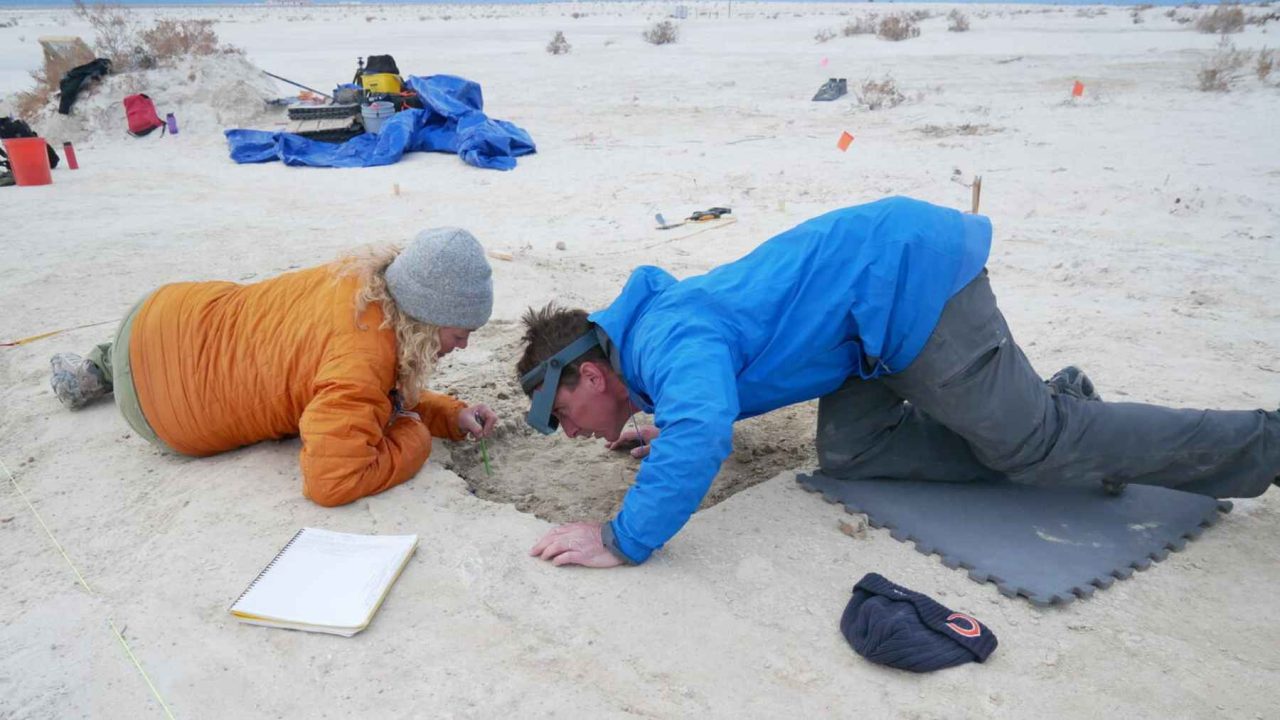
Buried beneath the surface of a dry New Mexico lakebed, a trail of ancient human footprints has forced scientists to rethink one of archaeology’s most fundamental questions: when did people first arrive in the Americas? The answer, according to a new study, is far earlier than most textbooks have ever suggested.
At White Sands National Park in southern New Mexico, researchers have confirmed that fossilized human footprints preserved in the desert sediment are between approximately 21,000 and 23,000 years old. That places people in North America during the height of the last ice age — a period when, according to the long-dominant scientific view, the continent was largely inaccessible to human migration.
The discovery is not entirely new, but the science behind it keeps getting stronger — and the debate it has ignited among archaeologists shows no sign of cooling down.
The Footprints That Rewrote the Timeline
White Sands is already one of the most striking landscapes in the American Southwest, a vast expanse of white gypsum dunes stretching across the Chihuahuan Desert. But beneath its surface lies something far older than its famous sand: a record of human presence that dates back to the deep ice age.
The fossilized tracks were first brought to wide scientific attention in 2021, when researchers published initial dating results. Those early dates, based on radiocarbon analysis of tiny seeds from an aquatic plant found embedded in the same sediment layers as the footprints, suggested the prints were made somewhere between 21,000 and 23,000 years ago.
The implications were enormous. If accurate, it meant that humans were walking across what is now New Mexico thousands of years before the widely accepted window for the peopling of the Americas — a period many researchers had placed closer to 13,000 to 16,000 years ago.
Understandably, not everyone was convinced.
Why Scientists Pushed Back — and What They Found
The core objection raised by skeptical archaeologists centered on a well-known problem in radiocarbon dating called the reservoir effect. Aquatic plants can sometimes absorb “old” carbon that has been dissolved in lake water for centuries or millennia. When that happens, radiocarbon dating of those plants can produce dates that appear far older than the actual age of the sample.
If the reservoir effect was significantly distorting the White Sands results, the footprints might belong not to ice age people, but to much later communities — which would bring the site back in line with conventional theories about when humans reached the Americas.
It was a serious scientific challenge, and the research team took it seriously. Rather than dismissing the criticism, they went back to the evidence. According to the new study, researchers applied additional dating methods — including radiocarbon dating of pollen extracted from the same sediment layers — to cross-check the original results.
The pollen analysis, which does not carry the same risk of reservoir effect contamination as aquatic plant seeds, supported the original timeline. The footprints, the evidence continues to suggest, really are between 21,000 and 23,000 years old.
What the White Sands Evidence Actually Shows
Here is what is currently confirmed about the White Sands footprints and the controversy surrounding them:
- The prints were found at White Sands National Park in southern New Mexico
- Initial radiocarbon dates, published in 2021, placed the prints at approximately 21,000 to 23,000 years old
- The original dating relied on seeds from aquatic plants, which raised concerns about the reservoir effect
- Skeptics argued the reservoir effect could make the prints appear older than they actually are
- A follow-up study applied additional dating methods, including pollen analysis, to test the original dates
- The new analysis continued to support the 21,000–23,000 year age range
- The findings challenge the long-held view that humans arrived in the Americas no earlier than roughly 13,000–16,000 years ago
| Dating Method | Material Analyzed | Key Concern | Result |
|---|---|---|---|
| Radiocarbon dating (2021) | Aquatic plant seeds | Potential reservoir effect | 21,000–23,000 years old |
| Radiocarbon dating (follow-up) | Pollen from sediment layers | Lower reservoir effect risk | Confirmed original timeline |
Why This Matters Beyond the Desert
For most people, ancient footprints in a national park might sound like an interesting but remote piece of history. The reality is that this debate touches something much bigger — the entire story of how and when human beings populated the Western Hemisphere.
The conventional model, sometimes called the Clovis-first theory, held for decades that the first Americans arrived roughly 13,000 years ago, crossing from Siberia into Alaska through an ice-free corridor as the last ice age began to end. Under that model, human presence at White Sands 21,000 to 23,000 years ago is simply impossible.
But evidence has been accumulating for years that the Clovis-first model is too simple. The White Sands footprints represent some of the most direct, physical evidence yet that people were present in North America far earlier — not tools, not animal bones, but the actual impressions of human feet pressed into ancient mud.
That is a different kind of proof. And it is why archaeologists, even those who remain skeptical, are paying close attention.
Where the Science Goes From Here
The debate over the White Sands footprints is far from settled. Skeptics continue to argue that the reservoir effect cannot be fully ruled out, and that extraordinary claims about human prehistory require extraordinary levels of evidence before the textbooks are rewritten.
Supporters of the findings, meanwhile, point to the consistency across multiple dating methods as a strong signal that the results are reliable. The pollen analysis, in particular, was designed specifically to address the reservoir effect criticism — and it held up.
Further research at White Sands and other sites across the Americas is ongoing. Each new study adds another layer to a picture that is becoming increasingly difficult to ignore: the story of when humans first reached the Americas is older, and more complicated, than anyone once believed.
Frequently Asked Questions
Where were these ancient human footprints discovered?
The footprints were found at White Sands National Park in southern New Mexico, in the United States.
How old are the White Sands human footprints?
The current scientific evidence places the footprints at between approximately 21,000 and 23,000 years old, dating them to the middle of the last ice age.
Why did some scientists doubt the original dating results?
Skeptics raised concerns about the reservoir effect — a phenomenon where aquatic plants absorb old carbon dissolved in lake water, which can make radiocarbon dates appear older than they actually are.
How did researchers respond to those doubts?
The research team conducted additional dating using pollen extracted from the same sediment layers, a method less vulnerable to the reservoir effect, and the results continued to support the original 21,000–23,000 year timeline.
Why are these footprints so controversial among archaeologists?
The dates challenge the long-dominant theory that humans first arrived in the Americas around 13,000 to 16,000 years ago, meaning the White Sands evidence, if confirmed, would fundamentally rewrite the accepted history of human migration to the Western Hemisphere.
Is the scientific debate over the White Sands footprints resolved?
Not entirely. While new dating methods have strengthened the case for the earlier timeline, some archaeologists remain skeptical and the broader scientific community continues to examine the evidence.




Leave a Reply