
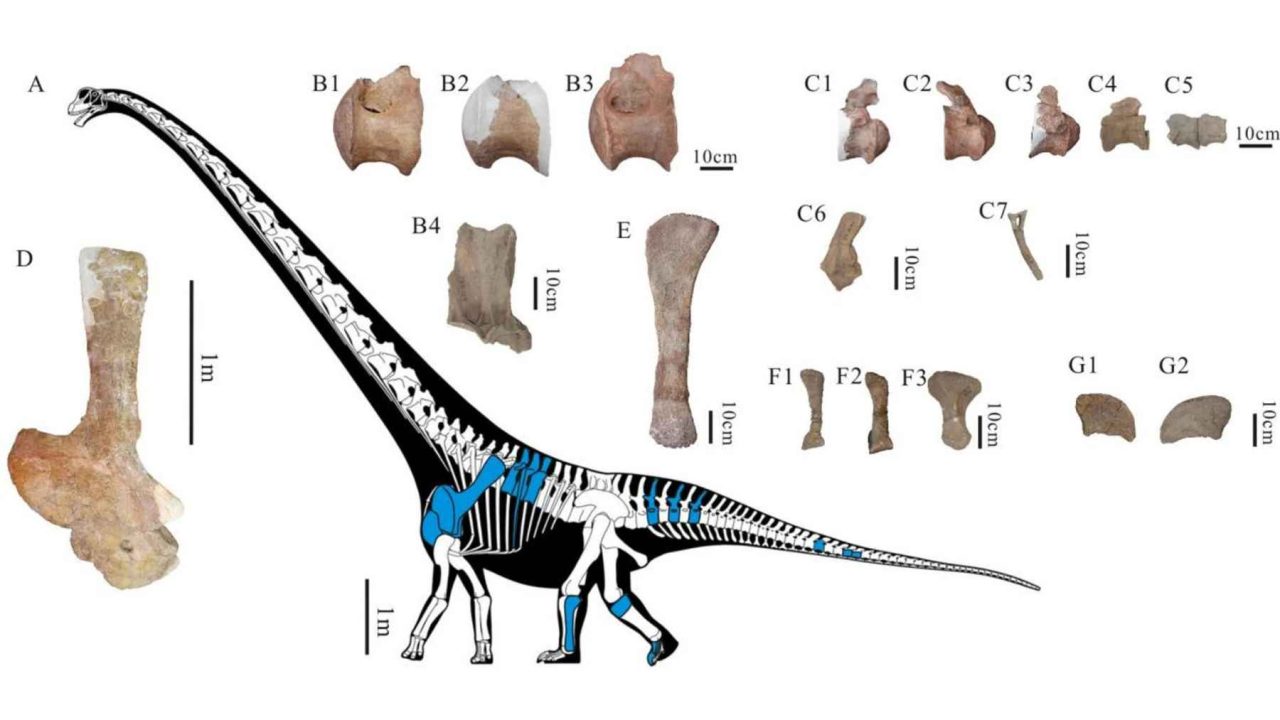
Construction workers in southwestern China weren’t expecting to make history. But in 1998, during routine building work in the Tongnan District of Chongqing, they hit something massive buried in the ground — bones so unusually large that work stopped and researchers were called in. What they had stumbled upon turned out to be one of the biggest land animals ever to walk the Earth.
Decades later, that accidental find has finally been formally described in the scientific literature. The dinosaur, named Tongnanlong zhimingi, is estimated to have stretched between roughly 23 and 28 meters in length during its lifetime, placing it among the most colossal creatures in the fossil record.
The research was led by paleontologist Xuefang Wei at the Chengdu Center of the China Geological Survey, with findings published in the journal Scientific Reports.
A Giant Sauropod Unearthed Beneath a Construction Site
The story of Tongnanlong zhimingi is as much about luck as it is about science. The bones first came to light not through a planned excavation, but through the kind of accidental discovery that paleontologists can only dream about. Workers at a building site in the Tongnan District noticed something strange in the earth beneath them — fossils far too large to be anything ordinary.
After the initial find in 1998, the remains were collected and prepared by local museums and research teams. It took years of careful study before the animal could be formally classified and named. That process, painstaking by nature, is what separates a curious find from a scientific contribution.
Tongnanlong zhimingi belongs to the mamenchisaurid family — a group of long-necked dinosaurs well known for their extraordinarily elongated necks. The animal lived during the Late Jurassic period in the Suining Formation of the Sichuan Basin, a region that has yielded a number of important dinosaur discoveries over the years.
What We Know About Tongnanlong zhimingi
The fossil material described in the study is based on a holotype skeleton that includes three back vertebrae, among other elements. While the preserved material represents only a portion of the full animal, it was enough for researchers to estimate the dinosaur’s remarkable size and confirm its place within the mamenchisaurid lineage.
| Detail | Information |
|---|---|
| Scientific name | Tongnanlong zhimingi |
| Estimated length | Approximately 23 to 28 meters |
| Dinosaur family | Mamenchisauridae |
| Time period | Late Jurassic |
| Location found | Tongnan District, Chongqing, Sichuan Basin, China |
| Geological formation | Suining Formation |
| Year discovered | 1998 |
| Lead researcher | Xuefang Wei, Chengdu Center, China Geological Survey |
| Published in | Scientific Reports |
Key characteristics of this dinosaur and its family include:
- Extremely elongated necks — the defining trait of mamenchisaurids
- Herbivorous diet, as with all sauropods
- A body size placing it among the largest known land animals in the fossil record
- Habitat in the Sichuan Basin during the Late Jurassic, a region rich in dinosaur fossils
Why This Discovery Matters Beyond the Size Record
It would be easy to reduce this story to a single headline — “enormous dinosaur found in China.” But the significance runs deeper than sheer scale.
Mamenchisaurids are among the most distinctive dinosaurs known from Asia, and each new species helps researchers build a clearer picture of how these giants evolved, spread, and diversified across the ancient continent. The Sichuan Basin in particular has been a productive region for Late Jurassic fossils, and Tongnanlong zhimingi adds another important data point to that record.
There is also something worth pausing on about how the discovery happened. The fact that a dinosaur of this size — potentially 28 meters long — was sitting undisturbed beneath a construction site until 1998 is a reminder of how much remains buried and undiscovered. Fossils of this quality and scale are not found through fieldwork alone. Sometimes the Earth simply gives them up on its own terms.
The gap between the 1998 discovery and the formal scientific description also reflects just how long the process of identifying and classifying a new species can take. Preparation, analysis, comparison with related species, and peer review all take time — often years or even decades.
What Comes Next for Tongnanlong Research
Now that Tongnanlong zhimingi has been formally described in Scientific Reports, it enters the broader scientific record and becomes available for comparison with other mamenchisaurids and large sauropods from around the world.
Researchers studying the evolution of gigantism in dinosaurs — one of the most fascinating open questions in paleontology — will likely take note. How animals of this size sustained themselves, moved, and interacted with their environment remains an active area of inquiry, and each new giant species contributes fresh evidence to those debates.
Whether additional fossil material from this individual or related animals exists in the Tongnan District or elsewhere in the Sichuan Basin is not confirmed by the current study, but the region’s track record suggests further discoveries are plausible over time.
Frequently Asked Questions
What is Tongnanlong zhimingi?
It is a newly described species of long-necked sauropod dinosaur from the Late Jurassic period, belonging to the mamenchisaurid family and estimated to have reached between 23 and 28 meters in length.
Where was Tongnanlong zhimingi discovered?
The fossil was found in the Tongnan District of Chongqing, in the eastern part of the Sichuan Basin in southwestern China.
How was the dinosaur discovered?
Construction workers uncovered the unusually large fossils during building work in 1998. The remains were later collected and studied by local museums and research teams.
Who led the research on this dinosaur?
The study was led by paleontologist Xuefang Wei at the Chengdu Center of the China Geological Survey, with findings published in the journal Scientific Reports.
What makes mamenchisaurids distinctive?
Mamenchisaurids are known for their extremely elongated necks, which set them apart from other sauropod dinosaur families.
Is Tongnanlong zhimingi one of the largest dinosaurs ever found?
Based on the estimated length of 23 to 28 meters, it ranks among the largest land animals known from the fossil record, though precise rankings depend on available fossil material and ongoing research.



Leave a Reply