
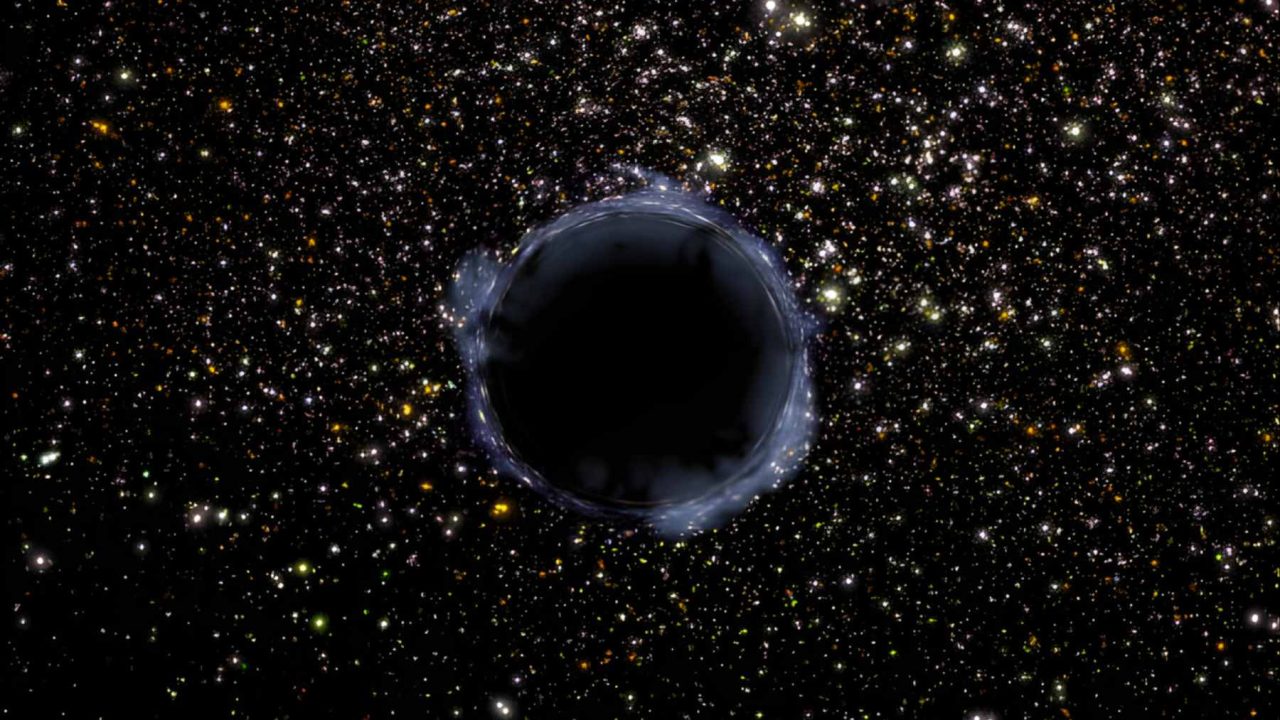
What if everything science fiction taught you about wormholes is wrong? A growing line of scientific thinking suggests that the famous Einstein-Rosen bridge — the mathematical structure that inspired decades of “cosmic shortcut” storytelling — is not a tunnel through space at all. Instead, it may be something far stranger: a bridge between the future and the past.
That single shift in interpretation, quiet as it sounds, carries enormous consequences. It changes how physicists think about black holes, the nature of time, and even what might have existed before the Big Bang. And it starts with a 1935 paper that was never actually about space travel to begin with.
The Movie Version Got It Wrong From the Start
The image is familiar to anyone who has watched science fiction: a glowing tunnel opens in space, a ship flies through, and seconds later it emerges near a distant galaxy. Wormholes, in popular culture, are shortcuts. Cosmic highways. Faster-than-light loopholes built into the fabric of reality.
The problem is that this idea was always more Hollywood than physics. When Albert Einstein and Nathan Rosen developed the concept in 1935, they were not thinking about starships. They were wrestling with a deeply technical problem: how do you describe a particle within the curved spacetime of general relativity without violating the rules of quantum physics?
Their solution was a mathematical construction — a “bridge” connecting two mirror copies of spacetime. It was a tool for understanding particles, not a proposed mechanism for interstellar travel. Later physicists noticed that the geometry of this bridge loosely resembled a tunnel, and the popular myth was born. But the resemblance, researchers now argue, was always superficial.
What the Einstein-Rosen Bridge Actually Describes
The reinterpretation gaining traction among some physicists reframes the Einstein-Rosen bridge not as a connection between two distant points in space, but as a connection between two opposite directions in time — a quantum mirror linking past and future rather than here and there.
This is a significant departure from the sci-fi version, and it matters for reasons that go well beyond semantics. General relativity itself, researchers point out, does not actually permit the kind of traversable wormhole that popular science has long described. The math simply does not support it in the way most people imagine.
The new framing treats the bridge as something more like a temporal structure — a feature of spacetime’s geometry that reflects the relationship between time’s two directions rather than offering a passageway across cosmic distances.
Why This Changes How Scientists Think About Black Holes
The implications extend directly into one of the most contested areas of modern physics: the nature of black holes. Black holes and wormholes have always been mathematically linked — both emerge from the same equations in general relativity — and the way physicists understand one tends to shape how they understand the other.
If the Einstein-Rosen bridge is genuinely a temporal structure rather than a spatial one, it reframes questions about what happens at the interior of a black hole. The singularity at a black hole’s center has long been a place where the known laws of physics break down. A temporal bridge interpretation opens different ways of approaching that breakdown — potentially offering new mathematical tools for describing what general relativity currently cannot.
Researchers working in this area suggest the reinterpretation could also shed light on what happened at the moment of the Big Bang, or even what the concept of “before” the Big Bang might meaningfully describe. If time itself has a bridge-like structure at extreme scales, the boundary conditions of the universe look very different.
Key Concepts at a Glance
| Concept | Popular Understanding | Revised Scientific Interpretation |
|---|---|---|
| Wormhole / Einstein-Rosen Bridge | Tunnel connecting two distant points in space | Bridge connecting two opposite directions of time |
| Original purpose (1935) | Mechanism for faster-than-light travel | Mathematical tool for describing particles in curved spacetime |
| Relationship to black holes | Separate but related phenomenon | Deeply linked through the same relativistic equations |
| What general relativity allows | Traversable cosmic shortcuts | Does not support traversable wormholes as popularly imagined |
| Broader implication | Potential future space travel technology | New framework for understanding time, black holes, and the Big Bang |
- Einstein and Rosen published their bridge concept in 1935, not as a travel mechanism but as a solution to a quantum-gravity compatibility problem.
- The “tunnel” interpretation came later, introduced by other physicists who noted a geometric resemblance — not a physical equivalence.
- General relativity does not permit the kind of traversable wormhole depicted in science fiction.
- The temporal bridge model reframes the structure as linking past and future, not distant locations in space.
What This Means Beyond the Physics Department
For most people, the practical stakes of wormhole theory feel abstract. But the questions this research touches on are among the most fundamental anyone can ask: What is time? Does the universe have a true beginning? Are the laws of physics the same everywhere — and in every direction of time?
The reinterpretation of the Einstein-Rosen bridge as a temporal structure rather than a spatial shortcut pushes those questions into sharper focus. It suggests that the geometry of spacetime may encode relationships between past and future in ways physicists are only beginning to map.
For anyone who has ever wondered whether time travel is possible, this line of research offers a sober but genuinely fascinating answer: the universe may already contain structures that connect different moments in time — just not in the way the movies promised.
Where the Research Goes From Here
This reinterpretation is part of a broader effort to reconcile general relativity with quantum mechanics — two frameworks that each describe reality with extraordinary precision in their own domains but that have resisted unification for nearly a century.
The Einstein-Rosen bridge sits at exactly that fault line. How physicists choose to interpret it — as a spatial shortcut, a temporal bridge, or something else entirely — will influence the theoretical tools they build and the experiments they design in the years ahead.
The conversation is far from settled. But the direction it is moving suggests that the universe’s most exotic structures may turn out to be not highways through space, but something more subtle and more profound: mirrors held up to the nature of time itself.
Frequently Asked Questions
What is an Einstein-Rosen bridge?
It is a mathematical construction developed by Albert Einstein and Nathan Rosen in 1935 to describe a particle within curved spacetime — not, as is commonly believed, a proposed mechanism for space travel.
Are wormholes actually shortcuts through the universe?
According to the reinterpretation discussed in current research, no. The Einstein-Rosen bridge appears to connect two opposite directions of time rather than two distant points in space.
Does general relativity allow traversable wormholes?
Based on the research referenced, general relativity does not support the kind of traversable wormhole depicted in science fiction — the math simply does not permit it in that form.
Why does this matter for black hole research?
Black holes and wormholes emerge from the same equations in general relativity, so reinterpreting the Einstein-Rosen bridge as a temporal structure opens new ways of thinking about what happens inside a black hole’s singularity.
Could this research change our understanding of the Big Bang?
Researchers suggest it could, by offering new frameworks for thinking about the boundary conditions of the universe and what the concept of “before” the Big Bang might mean in a spacetime with bridge-like temporal structures.
Why did the “cosmic tunnel” idea become so popular if it was always a misreading?
Later physicists noticed that the geometry of the Einstein-Rosen bridge resembled a tunnel, and that visual metaphor took hold in popular science — even though the original 1935 paper had an entirely different purpose.


Leave a Reply