
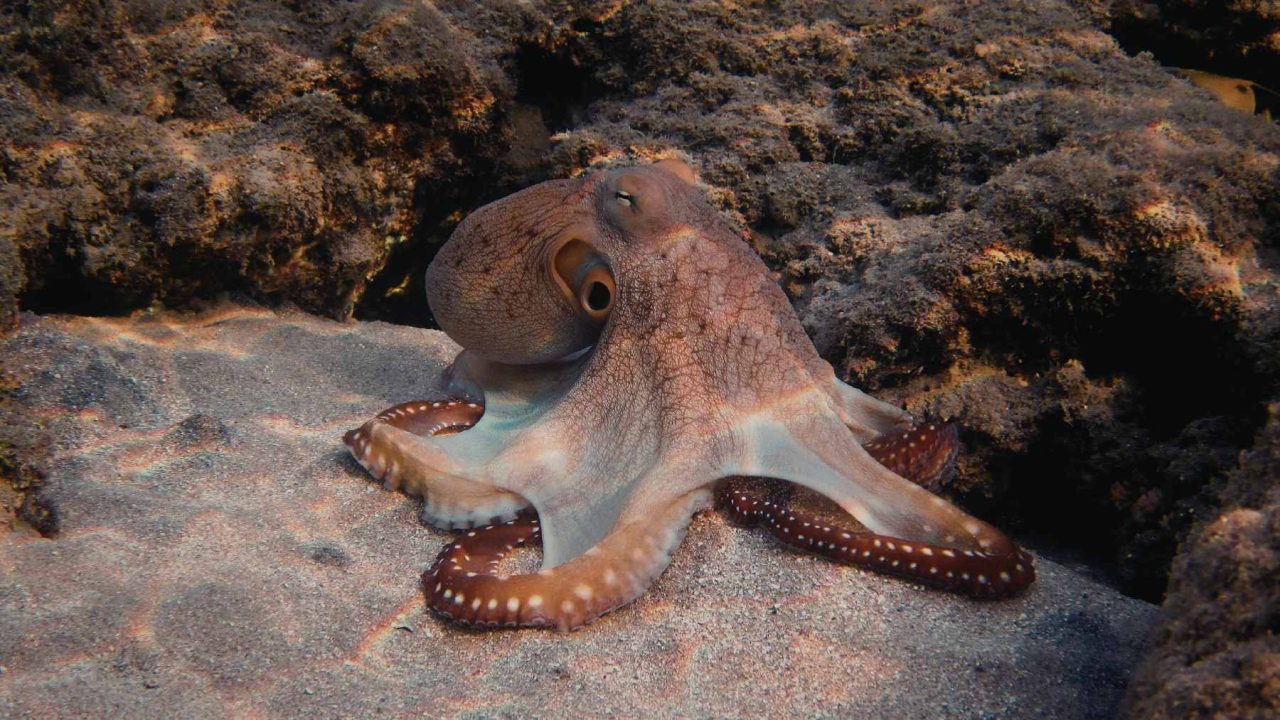
What creature on Earth could one day fill the evolutionary gap left by humanity — and why are scientists pointing to something with eight arms, no bones, and a brain that works nothing like ours? The answer coming out of academic circles might genuinely surprise you.
University of Oxford zoologist Tim Coulson recently sparked a wave of online discussion when he named octopuses as one of the most plausible candidates for post-human ecological dominance. It is not a prediction, and it is certainly not a guarantee. But the reasoning behind it reveals something genuinely fascinating about how evolution works — and how much we still underestimate the intelligence already living beneath the ocean’s surface.
The idea has been circulating widely since the interview, and for good reason. It forces a question most of us never think to ask: if we disappeared tomorrow, who — or what — would eventually take our place?
The Thought Experiment That Started the Conversation
Coulson’s argument begins with the basics of evolutionary biology. Evolution, as he explained it, is driven by genetic mutations that help certain individuals survive and reproduce more successfully. Over generations, those traits spread through a population and become more common. That is the engine behind every major shift in the history of life on this planet.
He also made a point that is easy to intellectually accept but hard to really sit with: extinction is the fate of all species, including humans. No species lasts forever. The fossil record is essentially a long list of things that no longer exist.
From there, the thought experiment takes shape. If humans and our closest great ape relatives were to vanish, which species would be positioned to step into new ecological roles? Which animals already show the cognitive flexibility, the adaptability, and the behavioral complexity that might — over millions of years — lead somewhere remarkable?
Coulson’s answer: octopuses deserve serious consideration. Not insects. Not other mammals. Something that already lives in the largest, most resource-rich habitat on the planet — the ocean.
Why Octopuses and Not Something More Familiar
It is tempting to assume that if humans vanished, some other land-based mammal would eventually rise to fill the gap. Rats are survivors. Crows are clever. Insects already outnumber everything else by an enormous margin.
But Coulson’s framing shifts the question. The ocean covers the majority of Earth’s surface and represents by far the largest available habitat. Whatever species is best positioned to exploit that space — and is already demonstrating signs of complex cognition — has a structural advantage that land-based competitors simply do not have.
Octopuses check several of those boxes in ways that researchers find genuinely compelling:
- They demonstrate problem-solving behavior that goes well beyond simple stimulus-response patterns
- They can use tools, navigate mazes, and appear to learn from observation
- Their nervous systems are extraordinarily complex — the majority of their neurons are located in their arms, not their central brain
- They adapt quickly to new environments and challenges
- They already occupy a wide range of ocean ecosystems across the globe
None of this means octopuses are on the verge of building cities. But it does mean the raw material for sophisticated cognition is already present — and that evolution has something to work with.
What the Science Actually Confirms — and What It Does Not
It is worth being clear about what Coulson’s comments represent. This is a thought experiment grounded in real evolutionary principles, not a peer-reviewed forecast. No scientist is claiming that octopus civilization is inevitable or even likely within any timeframe we can meaningfully imagine.
| Claim | Status |
|---|---|
| Extinction is the eventual fate of all species, including humans | Confirmed — established evolutionary biology |
| Evolution is driven by genetic mutations that aid survival and reproduction | Confirmed — foundational science |
| Octopuses named as a plausible post-human successor by Tim Coulson | Confirmed — from interview with Oxford zoologist |
| Octopus “civilization” is inevitable or scientifically predicted | Not confirmed — described explicitly as a thought experiment |
| Insects or other mammals are stronger candidates than octopuses | Not supported by Coulson’s reasoning |
The distinction matters. What makes this conversation worth having is not a sensational prediction — it is what the underlying logic reveals about evolution, intelligence, and the quiet complexity of ocean life that most of us walk past every day without a second thought.
The Oceans Are Already Changing Fast
There is a layer to this story that goes beyond the philosophical. Octopuses are not just theoretically interesting — they are thriving in oceans that are changing rapidly due to human activity. While many marine species are under severe pressure from warming waters, acidification, and habitat loss, cephalopods as a group have shown a remarkable ability to adapt and, in some cases, expand their populations.
That resilience is not incidental to Coulson’s argument. An organism that can survive and proliferate in a destabilized environment is exactly the kind of organism that evolutionary pressure tends to reward over long timescales. The ocean of the future may look very different from the one we know — and octopuses appear better equipped than most to navigate that uncertainty.
This does not make them our successors in any concrete sense. But it does make them worth paying attention to, both as indicators of ocean health and as a reminder that intelligence and adaptability take forms we are only beginning to understand.
What This Means for How We Think About Intelligence
Perhaps the most useful takeaway from Coulson’s thought experiment is not about octopuses at all. It is about the assumptions we carry regarding what intelligence looks like and where it can exist.
We tend to measure animal cognition against a human template — language, tool use, social hierarchy, long-term planning. Octopuses challenge that template at almost every level. Their intelligence is distributed, embodied differently, and expressed in ways that do not map neatly onto our own experience.
If evolution were to continue working on a lineage like that — across millions of years, in the world’s largest habitat, under selective pressures we cannot fully anticipate — the results would likely be something we would struggle to recognize as intelligent at all. Until, perhaps, it was impossible to ignore.
Frequently Asked Questions
Who suggested octopuses could be humanity’s successor?
University of Oxford zoologist Tim Coulson raised the idea in a recent interview, framing it as a thought experiment rooted in evolutionary biology rather than a scientific prediction.
Is this a confirmed scientific theory?
No. Coulson explicitly presented it as a thought experiment, not a peer-reviewed forecast. The underlying evolutionary principles are real, but the specific outcome is speculative.
Why octopuses rather than insects or other mammals?
Coulson’s reasoning centers on the ocean being the largest habitat on Earth and octopuses already demonstrating complex cognitive abilities within that space, giving them a structural and biological advantage over land-based competitors.
Are octopuses actually intelligent?
Research has shown octopuses exhibit problem-solving, tool use, and learning behaviors, with nervous systems far more complex than most people realize — the majority of their neurons are distributed throughout their arms.
Does this mean humans are going extinct soon?
Coulson’s point is that extinction is the eventual fate of all species over geological timescales — not that human extinction is imminent. The thought experiment is about deep evolutionary time, not the near future.
Are octopuses doing well in today’s changing oceans?
Cephalopods as a group have shown notable resilience and adaptability in changing ocean conditions, which is part of what makes them an interesting candidate in long-term evolutionary discussions.


Leave a Reply