
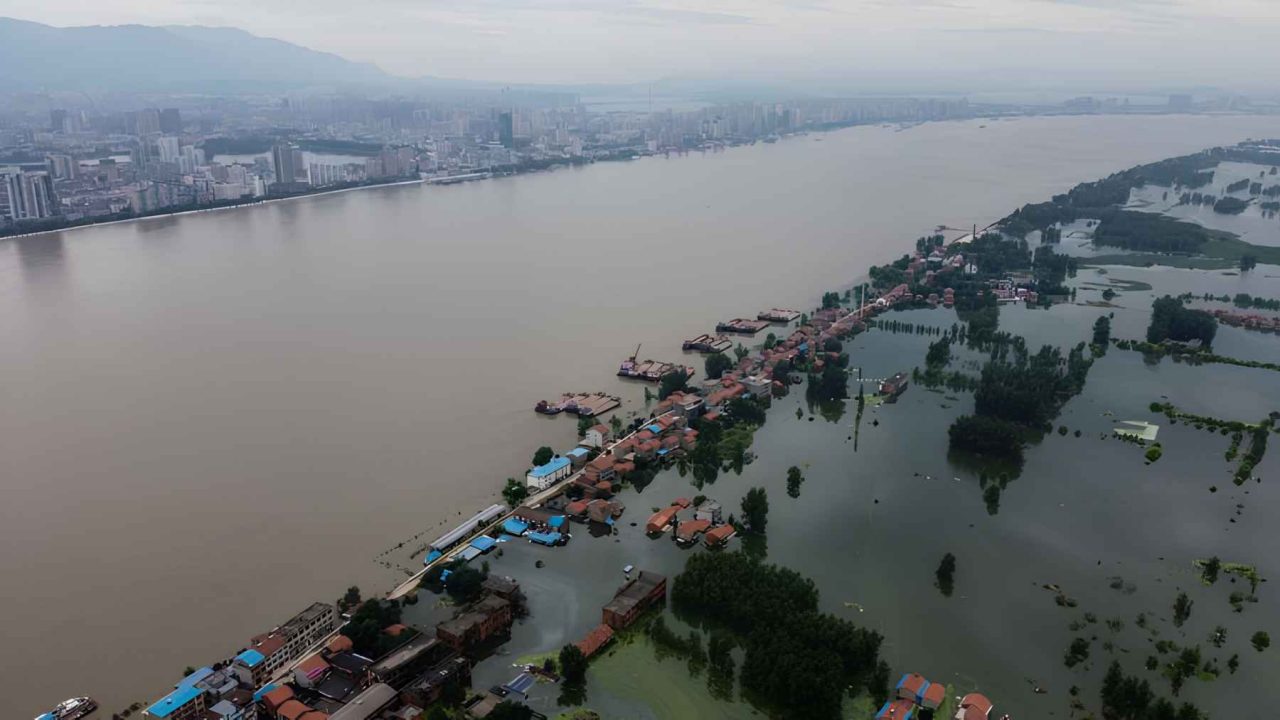
Sea levels are rising faster than at any point in the last 4,000 years — and the ground beneath some of the world’s most densely populated cities is sinking at the same time. That combination is not a distant forecast. It is already reshaping the risk profile of China’s major coastal hubs, according to researchers at Rutgers University.
The numbers behind this story are stark. Since 1900, global average sea level has climbed at roughly one and a half millimeters per year — about one-sixteenth of an inch annually. That may sound small, but scientists say it is faster than any comparable century-long period they can identify in geological records stretching back four millennia. For roughly 4,000 years before the 1800s, sea level stayed relatively stable. Then something changed.
What makes the situation in China’s coastal cities especially urgent is that rising water is only half the problem. The ground itself is sinking — and researchers say the vast majority of that sinking is something humans caused, which means it is also something humans could potentially slow down.
Why Sea Levels Are Rising at a Rate Not Seen in 4,000 Years
The Rutgers University analysis frames this as a convergence of two separate but compounding forces. On one side, you have global sea level rise driven by climate change — the warming of ocean water causing it to expand, combined with the melting of glaciers and ice sheets. That process has been accelerating since the Industrial Revolution, and the current pace is, by the geological record, historically unprecedented.
On the other side, you have what scientists call subsidence — the gradual sinking of land. In river deltas, where many of China’s largest cities sit, this process can be particularly severe. Deltas are naturally soft, compressible terrain. But the Rutgers research points to something beyond natural settling.
The study estimates that at least 94% of rapid modern urban subsidence in the region is linked to human activity, not to natural geological processes. The implication is significant: while rising seas are a global problem driven by planetary-scale forces, the sinking ground beneath coastal cities is largely a local, human-driven one — and therefore potentially more manageable.
What the Data Actually Shows
The research draws on both modern measurements and geological evidence to place current conditions in long-term context. Here is what 5 mm per year since 1900
| Factor | Detail | Source |
|---|---|---|
| Rate of sea level rise since 1900 | ~1.5 mm per year (~1/16 inch) | Rutgers University analysis |
| Historical comparison | Fastest pace in at least 4,000 years | Geological evidence reviewed in study |
| Period of prior stability | Roughly 4,000 years before the 1800s | Same analysis |
| Human-caused urban subsidence | At least 94% of rapid sinking attributed to human activity | Rutgers University analysis |
| Region of focus | China’s major coastal cities, particularly river deltas | Same analysis |
The Cities Already on the Front Lines
China’s coastline is home to some of the most economically vital urban centers on Earth. Many of them — including cities built on or near river deltas — are sitting on exactly the kind of terrain the Rutgers research identifies as most vulnerable. When you layer accelerating sea level rise on top of ground that is actively sinking, the effective rate of relative sea level change at those locations can be dramatically higher than the global average.
That is the core of what makes this finding so consequential. A global average rise of 1.5 mm per year sounds manageable in isolation. But if the land beneath a city is also subsiding — and the research suggests most of that subsidence is human-driven — the combined effect compounds the flood risk in ways that standard global projections can understate.
River deltas are particularly exposed. They are naturally low-lying, often just a few meters above current sea level. They are also the locations where groundwater extraction, urban construction, and land use changes tend to be most intensive — and those are precisely the human activities researchers link to accelerated sinking.
The Part of This Story That Offers a Sliver of Hope
The finding that 94% of rapid urban subsidence is human-caused is alarming. But researchers frame it as carrying a practical implication: if people caused most of the sinking, people may be able to slow it.
That does not mean the problem is easy to solve. Reducing groundwater extraction, changing construction practices, and managing land use in dense urban environments are politically and logistically difficult. But it does mean that coastal cities are not entirely passive victims of forces beyond their control. Some portion of the compounding risk — the sinking ground, if not the rising sea — may be addressable through local policy decisions.
The global sea level rise itself is a different story. That requires coordinated action at a planetary scale, and the geological record makes clear that the current trajectory represents a sharp break from thousands of years of relative stability. The 1800s marked a turning point, and the rate has continued to climb since then.
What Researchers Are Watching Next
The Rutgers analysis highlights that the convergence of these two forces — rising seas and sinking land — can cause risk to escalate quickly and nonlinearly in delta environments. Small changes in either factor can push a location past critical thresholds for flooding frequency and severity.
Scientists note that the current pace of sea level rise is already without modern precedent. Whether that pace continues to accelerate, levels off, or worsens will depend heavily on global emissions trajectories. But for China’s coastal cities, the immediate challenge is managing a risk that is already present and already compounding — not waiting for a future scenario to arrive.
Frequently Asked Questions
How fast are sea levels rising right now?
Researchers estimate global average sea level has been rising at approximately 1.5 millimeters per year since 1900 — a pace described as faster than any century-long period in the last 4,000 years of geological evidence.
Why are China’s coastal cities especially at risk?
Many of China’s major coastal cities sit on river deltas where the ground is also sinking, compounding the effect of rising seas and increasing flood risk beyond what global averages alone would suggest.
What is causing the ground to sink beneath these cities?
The Rutgers University analysis attributes at least 94% of rapid urban subsidence in the region to human activity rather than natural geological settling, though
Can the sinking be stopped or slowed?
Researchers point to the human-caused nature of most subsidence as a reason for cautious optimism — if human activity is driving the sinking, changes in that activity could potentially slow it, though the specifics remain complex.
How long was sea level stable before the recent rise began?
According to the analysis, sea level remained relatively stable for roughly 4,000 years before beginning to climb in the 1800s.
Who conducted this research?
The analysis was conducted by researchers at Rutgers University, according to the source reporting.




Leave a Reply