
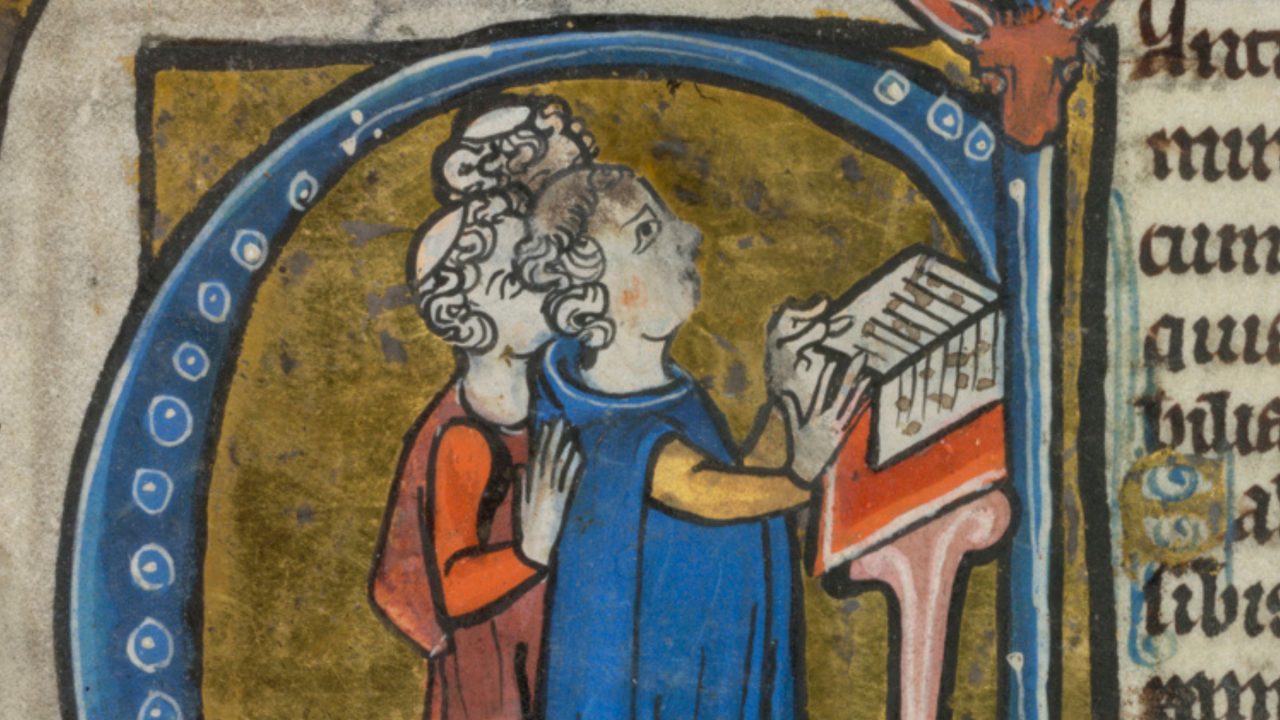
More than 4,000 musical fragments scattered across medieval manuscripts are quietly rewriting what historians thought they knew about how culture traveled through early Europe — and the answer turns out to have less to do with religion than with politics.
A new study published in the Transactions of the International Society for Music Information Retrieval has used computational network modeling to trace how liturgical music spread across Western Europe between the ninth and fourteenth centuries. What researchers found was striking: the flow of sacred music didn’t simply follow pilgrimage routes or monastic networks. It followed borders — specifically, the political borders carved out when the Carolingian Empire was divided in the ninth century.
The finding adds a new dimension to how scholars understand the relationship between political power and cultural transmission in the medieval world. Music, it turns out, was not immune to the boundaries drawn by kings and emperors.
What Tropes Actually Are — and Why They Matter
The musical pieces at the center of this study are called tropes — additions inserted into established Gregorian chants. A trope could add new words, new melodies, or both, effectively expanding an existing liturgical piece. In some cases, tropes offered additional theological commentary or rhetorical elaboration on the original chant text.
One example cited in the research illustrates the form well. The chant “Viri Galilei” deals with the Ascension of Christ and how the apostles perceived the event. A trope added to this chant introduced the following text before the main piece began: “The apostles marveled, and the angels spoke to them.” The trope doesn’t replace the original — it frames it, enriches it, and gives congregations a new way into the familiar liturgy.
Tropes were not official church doctrine. They were local additions, often created by individual monasteries or cathedral schools, which is precisely what makes them such useful historical evidence. Because they were locally generated and then shared across regions, tracing where they appeared — and where they didn’t — reveals the invisible networks that connected medieval communities.
How the Carolingian Divide Shaped Medieval Chant
The Carolingian Empire, built by Charlemagne and his successors, once stretched across much of Western Europe. But in the ninth century, it fractured. The territorial divisions that followed — splitting the empire into regions that would eventually become the foundations of modern France, Germany, and other states — appear to have had a lasting effect on how music moved across the continent.
The researchers analyzed more than 4,000 trope elements preserved in manuscripts dating from the ninth to the fourteenth centuries. Using computational network models, they mapped how these musical additions traveled from one region to another. The results showed that trope distribution closely reflected those post-Carolingian territorial boundaries.
In other words, monasteries and churches on one side of a political border tended to share tropes with each other — and much less frequently with institutions on the other side, even when the geographic distance was similar.
Key Findings at a Glance
| Detail | Finding |
|---|---|
| Manuscripts analyzed | Dating from the 9th to the 14th centuries |
| Trope elements examined | More than 4,000 |
| Method used | Computational network modeling |
| Published in | Transactions of the International Society for Music Information Retrieval |
| Key political event referenced | Division of the Carolingian Empire in the 9th century |
| Type of chant studied | Tropes — additions to Gregorian chant |
- Tropes could consist of new words, new melodies, or a combination of both
- They were inserted into established Gregorian chants, expanding the original liturgical pieces
- Some tropes provided additional theological or rhetorical commentary on the base chant
- The distribution of tropes across Europe closely mirrored post-Carolingian territorial boundaries
- The study used digital analysis methods to trace transmission patterns across centuries of manuscripts
Why This Changes How We Think About Medieval Culture
For a long time, the dominant assumption about medieval cultural transmission was that the Church provided a kind of unified highway for ideas, art, and music to travel across Europe. Monasteries were connected to each other through shared religious orders. Bishops traveled to Rome. Pilgrims crossed borders constantly. The logic followed that culture moved relatively freely within Christendom, regardless of which king claimed a given territory.
This study complicates that picture considerably. The evidence suggests that political fragmentation created real, measurable barriers to cultural exchange — even in something as seemingly universal as sacred music. The borders drawn by rulers in the ninth century were still influencing which monastery shared music with which, centuries later.
How have politics shaped music making in the past? Using sophisticated generative network models, @timeipert's work in @TismirJ shows a close link between political boundaries in central Europe towards the end of the first millennium and the repertoire of chants in use. pic.twitter.com/T2lfaDTm8D
— Fabian C. Moss (@fabianmoss) March 2, 2026
That’s a significant finding. It means that when historians try to understand how medieval culture developed, they can’t treat the Church as operating independently of political geography. Power structures shaped what people heard when they went to mass.
What Comes Next for This Research
The use of computational and digital methods to study medieval manuscripts is a relatively young field, and this study represents a meaningful step forward in what those methods can reveal. By applying network modeling to thousands of musical fragments — a task that would be essentially impossible to do manually at this scale — researchers were able to identify patterns that span centuries and hundreds of manuscripts.
The broader implication is that similar methods could be applied to other forms of medieval cultural transmission: manuscript illustrations, theological texts, architectural styles, or legal documents. If political borders shaped the spread of liturgical music, they may well have shaped the movement of other cultural forms in ways that haven’t yet been fully mapped.
For now, the study stands as a reminder that even the most spiritual dimensions of medieval life — the music sung in churches and monasteries across a continent — were never entirely free from the politics of the world outside the cathedral walls.
Frequently Asked Questions
What are tropes in medieval music?
Tropes were additions inserted into established Gregorian chants, and could include new words, new melodies, or both — sometimes adding theological or rhetorical commentary to the original liturgical piece.
How many trope elements did the researchers analyze?
The study examined more than 4,000 trope elements preserved in medieval manuscripts dating from the ninth to the fourteenth centuries.
What method did researchers use to study the manuscripts?
The team used computational network models to trace how tropes were transmitted across Western Europe and how their spread was shaped by geography and politics.
Which historical event did the study link to patterns in medieval chant?
Researchers found that the distribution of tropes closely reflected the territorial boundaries established after the Carolingian Empire was divided in the ninth century.
Where was the study published?
The findings were published in the Transactions of the International Society for Music Information Retrieval.
Does this mean the Church had less influence on music than previously thought?
The study suggests that political borders created measurable barriers to musical exchange even within the Christian world, complicating the idea that the Church provided a unified network for cultural transmission across medieval Europe.


Leave a Reply