
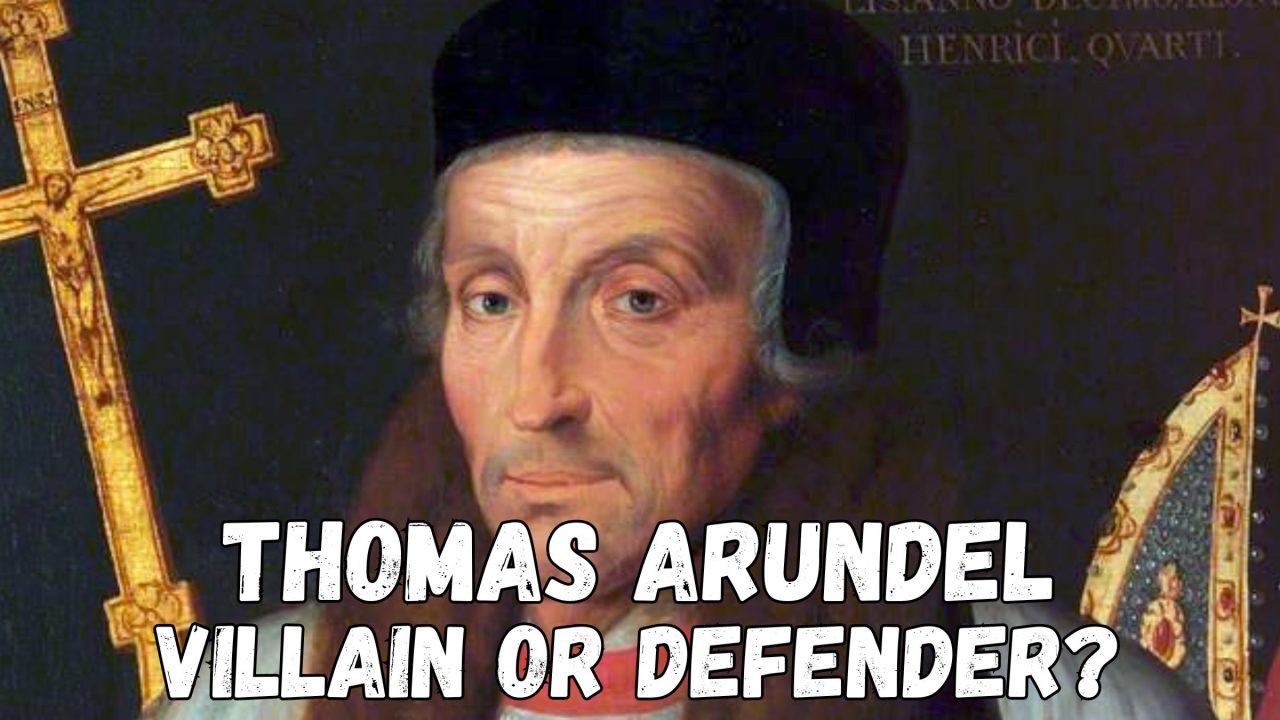
A BBC poll in December 2005 asked the British public to nominate the most infamous villain of each century over the past millennium. For the fifteenth century, the winner was not Richard III — one of history’s most recognizable royal villains — but an archbishop. Thomas Arundel, once the most powerful churchman in England, was judged more deserving of infamy than a king accused of murdering his own nephews.
That result alone tells you something remarkable about how history has treated Arundel. Now, a new book by historian Chris Given-Wilson is challenging that verdict — or at least complicating it significantly. The question at the heart of it is one that medieval history rarely makes simple: was Thomas Arundel a ruthless persecutor, or a man genuinely trying to defend the institution he believed held England together?
The answer, as Given-Wilson makes clear, is neither straightforward nor comfortable.
Why Thomas Arundel Became One of History’s Most Condemned Archbishops
The BBC poll’s description of Arundel was blunt. He “used his authority to persecute the Lollards, a group promoting lay priesthood and translations of the Bible.” To modern ears, that framing immediately puts Arundel on the wrong side of history. The Lollards were advocating for ideas — accessible scripture, a less hierarchical church — that would eventually become central to the Protestant Reformation. Opposing them looks, in retrospect, like opposing progress itself.
But historical figures rarely have the benefit of hindsight, and Given-Wilson’s work asks readers to consider Arundel within his own world rather than ours. In late medieval England, the established Church was not simply a religious institution — it was a pillar of social order, legal authority, and political stability. A challenge to its doctrines was, in the eyes of those who held power, a challenge to everything.
Arundel served as Archbishop of Canterbury during one of the most turbulent periods in English history. His actions against the Lollards were not those of a fringe fanatic but of the most senior churchman in the country, operating with the full weight of ecclesiastical and royal authority behind him.
The Man Behind the Reputation — What the Historical Record Actually Shows
One of the most striking details in Given-Wilson’s account involves what happened to Arundel’s tomb more than a century after his death. In 1540, as the sweeping Protestant reforms of the 1530s reached their peak, Thomas Cranmer — England’s first Protestant Archbishop of Canterbury — oversaw the demolition and removal of the chantry chapel that Arundel had endowed to enclose his tomb-chest in the nave of Canterbury Cathedral.
The chapel had stood for approximately 130 years. After Cranmer was done, nothing remained but, in the words recorded at the time, “a bare gravestone levelled with the floor.”
That act of deliberate erasure speaks volumes. England’s early Protestants did not simply disagree with Arundel — they wanted him unmemorialized, his physical legacy reduced to nothing. It was the Reformation’s way of writing a verdict on his life.
Cranmer, who oversaw the demolition, would not have argued with the BBC poll’s conclusion. His actions suggest he considered Arundel’s memory an obstacle to the new religious order rather than a neutral piece of history.
Thomas Arundel in Context — The Figures History Judges Alongside Him
The BBC poll placed Arundel in notable company. Understanding who else made the list helps frame just how seriously his reputation has been damaged by the historical record.
| Century | Named Villain | Reason Given |
|---|---|---|
| 12th Century | St Thomas Becket | Divided England in a way many felt was unnecessary and self-indulgent |
| 13th Century | King John | Not specified in detail by the poll |
| 15th Century | Thomas Arundel | Used authority to persecute the Lollards, who promoted lay priesthood and Bible translation |
| 19th Century | Jack the Ripper | Serial killer |
| 20th Century | Oswald Mosley | British fascist leader |
Arundel beating Richard III to the fifteenth-century slot is particularly telling. Richard III has been the subject of centuries of debate, rehabilitation efforts, and even a celebrated reburial. Arundel, by contrast, has remained largely fixed in the role of persecutor — a man who used power against those who wanted ordinary people to read the Bible in their own language.
What Given-Wilson’s Book Argues That Other Accounts Have Missed
Given-Wilson’s central argument is that the complexity of Arundel’s life has been flattened by the lens of the Reformation. Once Protestant writers — and later, Protestant historians — framed the story, Arundel became a symbol of everything the new faith was fighting against. His motivations, his political context, his genuine beliefs about the Church he served: all of it was reduced to the single fact of his persecution of the Lollards.
The demolition of his tomb chapel in 1540 was not just physical destruction. It was the beginning of a historical narrative that Given-Wilson believes has obscured the real man for nearly five centuries.
Whether Arundel deserves rehabilitation, or simply a more honest accounting, is the question his book sets out to explore. The answer matters not just for medieval history, but for how we think about powerful figures who act according to the logic of their own time — and are then judged by the values of a very different one.
Frequently Asked Questions
Who was Thomas Arundel?
Thomas Arundel was Archbishop of Canterbury in late medieval England and one of the most powerful figures in the English Church. He is best known historically for his persecution of the Lollards.
Who were the Lollards?
According to the BBC poll cited in the source, the Lollards were a group promoting lay priesthood and translations of the Bible into English — ideas that anticipated the Protestant Reformation.
Why did Thomas Cranmer demolish Arundel’s tomb chapel?
Cranmer oversaw the demolition in 1540 as part of the sweeping Protestant reforms of the 1530s, leaving only a bare gravestone where Arundel’s elaborate chantry chapel had stood for around 130 years.
Did Thomas Arundel rank above Richard III as a historical villain?
Yes — according to the 2005 BBC poll, Arundel was chosen as the most infamous British villain of the fifteenth century, ahead of Richard III.
What is Chris Given-Wilson’s new book about?
Given-Wilson’s book revisits Arundel’s life and argues that the historical record presents a far more complex figure than the simple villain narrative that has dominated since the Reformation.
Was Thomas Becket also named in the BBC poll?
Yes — Becket was named as the most infamous villain of the twelfth century, described as having divided England in a way that even many sympathetic churchmen considered unnecessary and self-indulgent.



Leave a Reply