
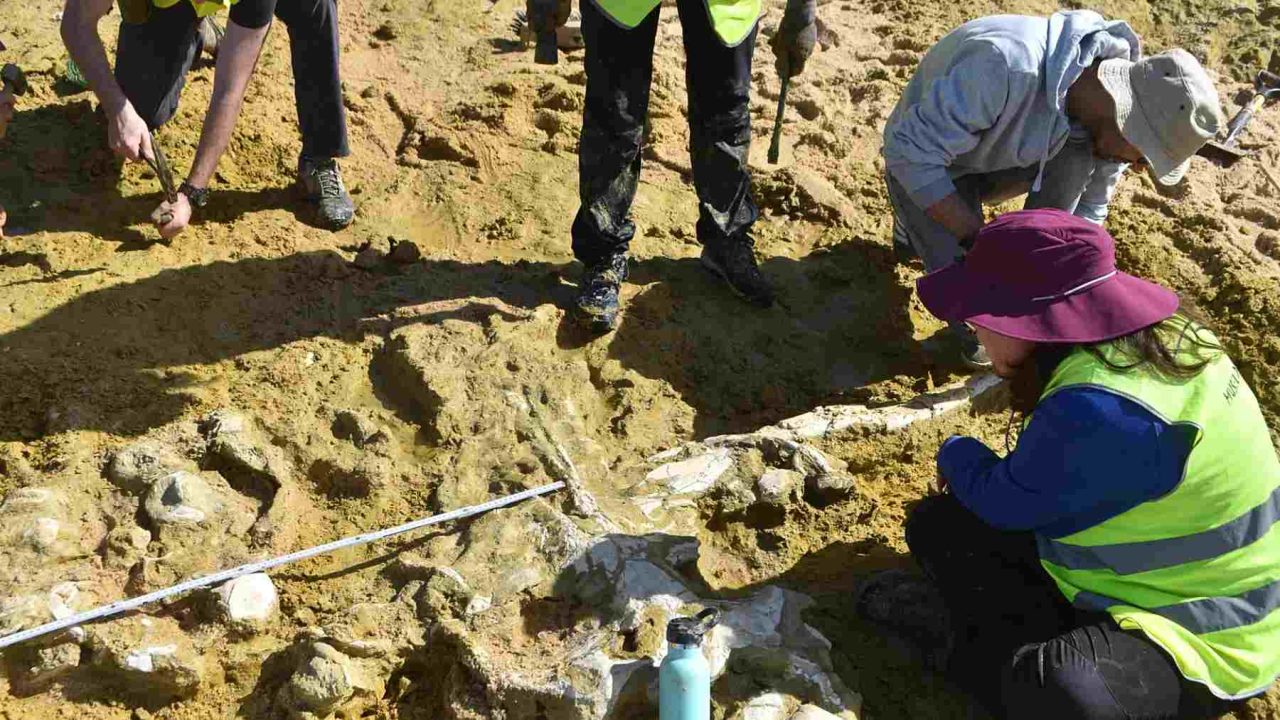
Two whale skeletons, each roughly 10 million years old, have emerged from a beach in southern Portugal — not through a planned excavation, but because a series of winter storms stripped away the sand covering them. The find is already drawing attention across Europe, and for good reason: both skeletons arrived with skulls, jaws, and major bones still intact, which is far rarer than it sounds in fossil discovery.
For paleontologists who study the early evolution of baleen whales, completeness like this is the difference between a footnote and a breakthrough. Most ancient whale remains turn up as fragments — a rib here, a vertebra there. Finding two near-complete animals at the same site changes what researchers can actually test.
The circumstances of the discovery were almost as dramatic as the fossils themselves. Scientists had only narrow windows between tides to work the site, racing against surf that could fracture bones or bury them again within hours.
What the Storms Revealed at Galé-Fontainhas Beach
The fossils surfaced at Galé-Fontainhas beach in southern Portugal, after winter storms peeled back the sand to expose a long rock slab running along the shoreline. Once the sand pulled back, more than 110 yards of rock lay open between the surf and the dry beach — a narrow, tide-cut zone that doesn’t stay accessible for long.
The rock layers belong to the Alcácer do Sal Formation, a geologic unit that formed during the Miocene epoch — a period spanning roughly 23 to 5 million years ago. Studies of this formation place the specific layers here at around 11.5 million years old, though the fossils themselves are described as approximately 10 million years old.
The Miocene was a pivotal time for marine mammals. Ocean temperatures, sea levels, and nutrient patterns were all shifting, and baleen whales — the filter-feeding giants that include today’s blue and humpback whales — were diversifying rapidly. Fossils from this window help scientists understand how that diversification actually unfolded.
A Race Against the Tide
Carla Tomás, a paleontologist at the Lourinhã Museum, was part of the team that worked the site. She helped lift one skull before waves returned — a detail that captures just how tight the operational window was.
Every bone had to be stabilized, packed, and moved quickly. A delay of even a few hours, That kind of urgency is unusual even by field paleontology standards, where conditions are rarely ideal.
The fact that the team managed to recover skulls, jaws, and major bones from both animals under those constraints makes the preservation record all the more significant.
Why Skull and Jaw Bones Matter So Much
In whale paleontology, skull and jaw anatomy carries an outsized amount of scientific information. The shape of the skull reveals how a whale fed, how it heard, and how it relates to other species on the evolutionary tree. Jaw structure, in particular, is central to understanding the development of baleen — the filtering plates that replaced teeth in this lineage.
Most fossil whales are known only from partial remains, which limits what researchers can say with confidence. When two individuals from the same site and the same time period both preserve these critical structures, it opens the door to comparisons that simply aren’t possible with fragments.
The discovery is being described as surprising for Europe — a continent that has produced important Miocene marine fossil sites before, but rarely ones with this level of skeletal completeness from this period.
Key Facts From the Discovery at a Glance
| Detail | Information |
|---|---|
| Location | Galé-Fontainhas beach, southern Portugal |
| Estimated age of fossils | Approximately 10 million years old |
| Geologic formation | Alcácer do Sal Formation |
| Geologic epoch | Miocene (approx. 23–5 million years ago) |
| Formation age estimate | Around 11.5 million years old |
| Rock exposed by storms | More than 110 yards along the shoreline |
| Bones preserved | Skulls, jaws, and major skeletal bones (both individuals) |
| Lead field paleontologist | Carla Tomás, Lourinhã Museum |
| Type of whale | Early baleen whales |
- Both skeletons were found within the same exposed rock slab
- Recovery required working between tidal cycles with no room for delay
- The Lourinhã Museum team led the on-site extraction effort
- The discovery is considered significant enough to revise scientific understanding of early baleen whale biology
What This Means for the Science Going Forward
The immediate impact is on what researchers can now test. With complete or near-complete skulls and jaws from two individuals of similar age and location, scientists can examine variation within the species, compare feeding anatomy across individuals, and draw more reliable conclusions about how these animals relate to other Miocene whales found elsewhere in Europe and beyond.
Portugal’s coastline has a history of producing significant marine vertebrate fossils — the Lourinhã Museum itself is well known for its dinosaur material from the Jurassic. But Miocene whale finds of this quality are less common, and the combination of storm exposure, rapid response, and skeletal completeness makes this particular discovery stand out even in that broader context.
Researchers will now need time to clean, analyze, and formally describe the specimens — a process that typically takes months to years before full scientific findings are published. But the bones are out of the water, and that, given the circumstances, was the hardest part.
Frequently Asked Questions
Where exactly were the fossil whales found?
The fossils were uncovered at Galé-Fontainhas beach in southern Portugal, after winter storms exposed more than 110 yards of rock along the shoreline.
How old are the whale fossils?
The fossils are estimated to be approximately 10 million years old, from rock layers of the Alcácer do Sal Formation dated to around 11.5 million years ago during the Miocene epoch.
What type of whales are these?
The fossils are identified as early baleen whales, the filter-feeding lineage that includes modern species such as blue and humpback whales.
Who led the recovery effort?
Carla Tomás, a paleontologist at the Lourinhã Museum in Portugal, was part of the team that worked the site and helped recover one of the skulls before tidal conditions made further work impossible.
Why is it significant that the skulls and jaws were preserved?
Skull and jaw anatomy carries critical information about feeding behavior, hearing, and evolutionary relationships in whales — structures that are rarely preserved intact in fossils this old.
When will full scientific results be available?
This has not yet been confirmed in the available reporting; formal analysis and publication of findings typically takes months to years after initial recovery.


Leave a Reply