
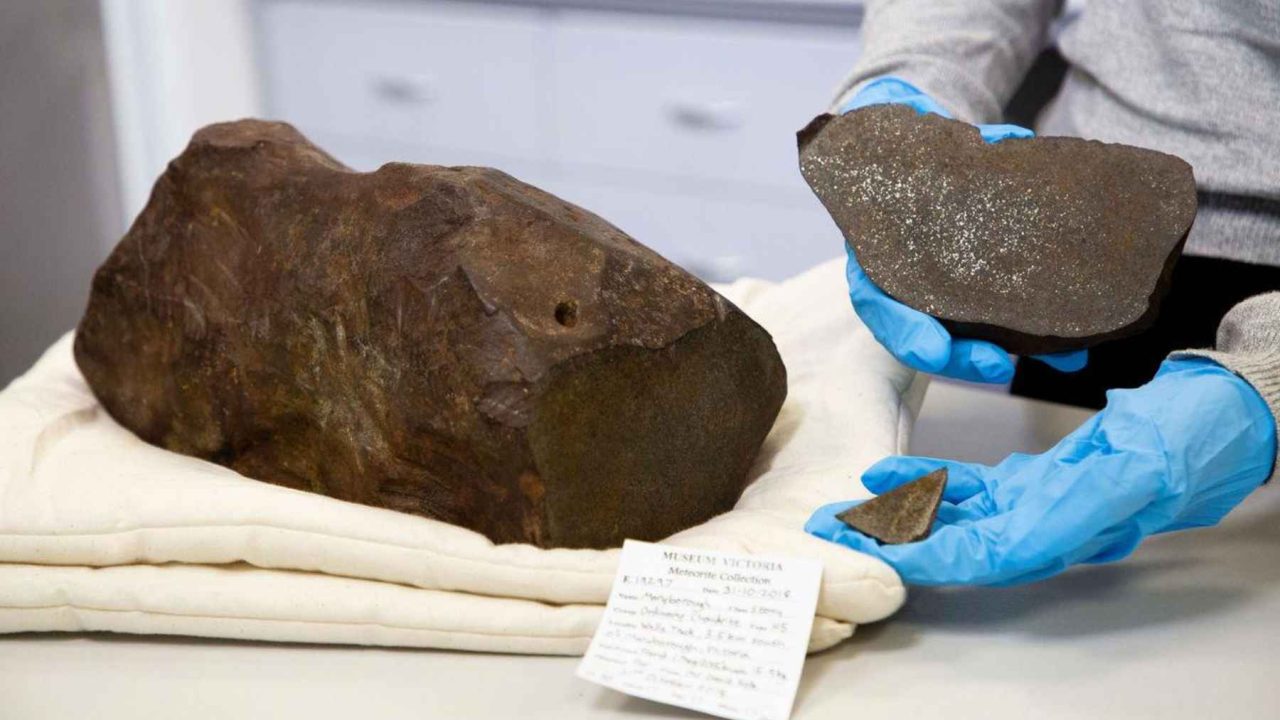
A rock that weighs roughly 37.5 pounds, stretches about 15 inches long, and feels like lifting a small sack of concrete — that is what David Hole pulled out of the ground in Maryborough Regional Park in Victoria, Australia, back in May 2015. He was convinced he had found something valuable. He was right, just not in the way he expected.
For years, the heavy reddish stone sat in his possession while he tried to crack it open — drilling into it, grinding at it, even exposing its outer surface to acid. Nothing worked. The rock refused to give up its secrets easily. That resistance, as it turned out, was a clue in itself.
When scientists finally got a look at it, what they confirmed was extraordinary: Hole had been carrying around a genuine meteorite — a fragment of the early solar system that predates Earth itself. It had traveled across the void of space and landed quietly in regional Victoria, waiting in the dirt until a man with a metal detector came along.
What the Maryborough Meteorite Actually Is
Scientists confirmed that the rock is an ordinary chondrite — a classification that sounds underwhelming until you understand what it means. Chondrites are some of the oldest solid material in the solar system. They formed before planets existed, during the earliest stages of the solar system’s assembly, and they carry chemical and structural clues about conditions that existed billions of years ago.
The word “ordinary” in the classification refers to its mineral composition relative to other chondrite types, not to its rarity or significance. Ordinary chondrites are the most common type of meteorite found on Earth, but that does not make any individual specimen routine. Each one is a time capsule.
Research indicates the Maryborough meteorite most likely originated in the asteroid belt between Mars and Jupiter — the vast ring of rocky debris left over from the solar system’s formation. At some point, gravitational forces or a collision nudged it out of that belt and onto a trajectory that eventually brought it to Earth. Scientists believe it may have landed within the last 1,000 years, though pinpointing exactly when is difficult.
The Find That Almost Wasn’t Recognized
The story of how this meteorite was nearly dismissed is just as remarkable as the rock itself. When Hole dug it up in May 2015, the reddish, unusually heavy stone immediately drew his attention because of its weight. In the Maryborough area, gold nuggets are not unheard of — the region has a history tied to the Australian gold rush era — and a metal detector hit on something this dense would naturally raise hopes.
Back home, he tried everything to figure out what was inside. Drill bits. A grinder. Acid on the outer surface. None of it made a significant dent. The rock’s toughness was, in retrospect, a telling sign — meteorites are often extraordinarily hard and dense compared to Earth rocks of similar size, partly because of their iron and nickel content.
It was only after scientists examined the specimen that the truth emerged. The lab analysis confirmed its extraterrestrial origin and classified it as a chondrite, completing a journey that began billions of miles away and billions of years ago.
Key Facts About the Maryborough Meteorite
| Detail | Confirmed Information |
|---|---|
| Discovery date | May 2015 |
| Discoverer | David Hole |
| Location found | Maryborough Regional Park, Victoria, Australia (approx. 1.2 miles south of the town) |
| Weight | Approximately 37.5 pounds |
| Length | Approximately 15 inches |
| Classification | Ordinary chondrite |
| Likely origin | Asteroid belt between Mars and Jupiter |
| Estimated time on Earth | Within the last 1,000 years |
Why This Kind of Discovery Matters Beyond the Headline
It is easy to read a story like this and focus on the twist — gold hunter finds space rock instead. But the scientific significance runs much deeper than a good anecdote.
Chondrites are considered among the most scientifically valuable objects on Earth precisely because they have not been altered by the geological processes that constantly reshape our planet. Earth’s rocks are recycled through volcanism, erosion, tectonic movement, and time. Meteorites like this one arrive essentially unchanged from the earliest days of the solar system.
Researchers studying chondrites can examine the raw ingredients from which planets — including Earth — were eventually built. The minerals, isotopes, and tiny structures preserved inside these rocks offer a window into conditions that existed before any planet had fully formed. That is not something you can replicate in a lab or find anywhere on Earth’s surface.
The fact that this particular specimen sat in a shed for years, subjected to drilling and acid, before being properly identified also raises a practical point: there may be other significant meteorites sitting unrecognized in garages, attics, and collections around the world. The Maryborough meteorite is a reminder that extraordinary things sometimes hide in plain sight.
What Comes Next for the Maryborough Meteorite
Once a meteorite is formally classified and documented, it typically enters the scientific record and becomes available for study. Researchers can use small samples to analyze isotopic ratios, mineral composition, and other properties that reveal details about the early solar system.
The Maryborough meteorite’s documented history — including Hole’s attempts to open it — will also be part of the scientific record. Even the damage from drilling and acid exposure is noted, as it affects how future researchers interpret any analysis of the outer surfaces.
For the broader public, discoveries like this one serve as a reminder that space is not just something that exists far away in observatories and rocket programs. Pieces of it land here. They sit in parks, fields, and sheds. Sometimes a person with a metal detector finds one and thinks they have struck gold — and in a way far more profound than they imagined, they have.
Frequently Asked Questions
What is the Maryborough meteorite?
It is a space rock found in Victoria, Australia, in May 2015, later confirmed by scientists to be an ordinary chondrite — a type of meteorite that carries clues about the early solar system.
Who found the Maryborough meteorite?
David Hole discovered it while using a metal detector in Maryborough Regional Park, approximately 1.2 miles south of the town of Maryborough.
Where did the meteorite come from?
Research indicates it most likely originated in the asteroid belt between Mars and Jupiter, the debris field left over from the solar system’s formation.
How long has the meteorite been on Earth?
Scientists believe it may have landed within the last 1,000 years, though an exact date has not been confirmed.
Why couldn’t David Hole break it open?
He tried drilling, grinding, and exposing the surface to acid, but the rock resisted all attempts — a characteristic consistent with the extreme density and hardness common in iron-rich meteorites.
What makes chondrites scientifically valuable?
Ordinary chondrites like this one formed before planets existed and have not been altered by geological processes, making them rare preserved records of the earliest conditions in our solar system.

Leave a Reply