
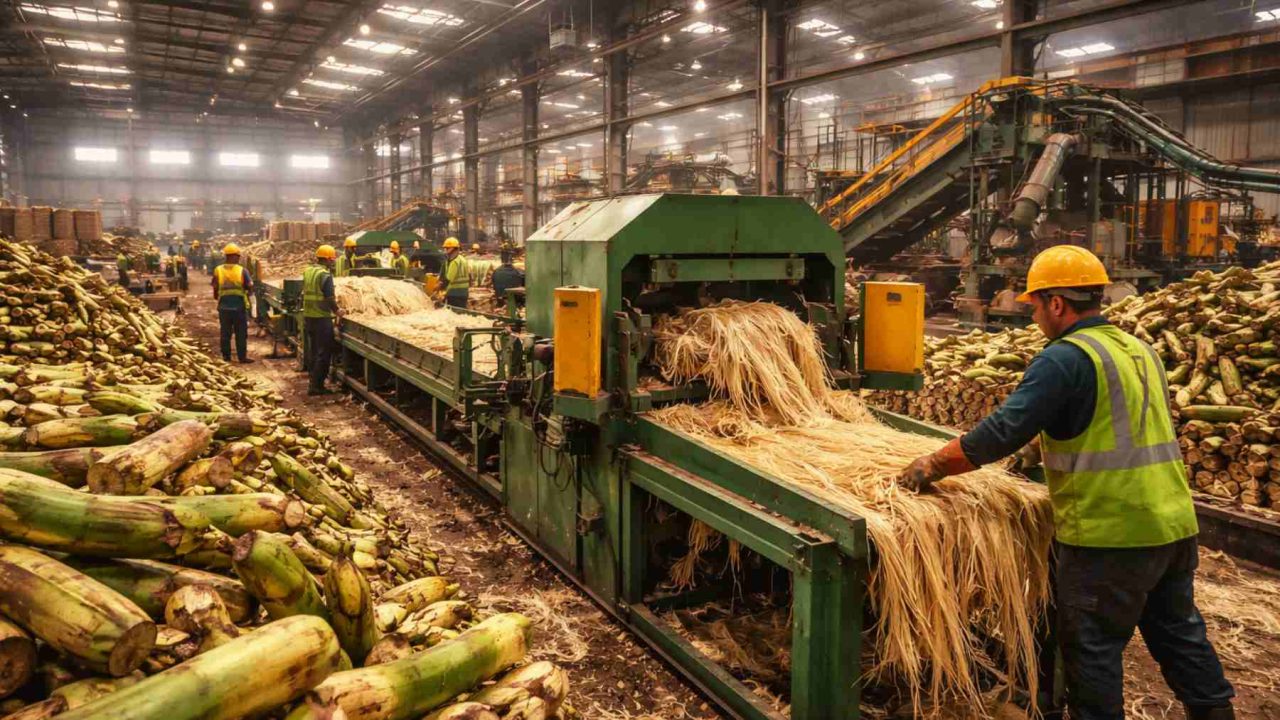
Every time a banana harvest ends, farmers are left with something they never asked for: thousands of tons of thick, water-logged plant material that has nowhere useful to go. These leftover pseudostems — the tall, trunk-like structures that supported the banana plant — are typically dumped in fields or burned, creating odors, releasing carbon dioxide, and adding to the growing problem of agricultural waste.
Now, a study published in April 2026 suggests that waste stream could be redirected into something far more valuable: tissue paper and packaging materials. Researchers found that a relatively straightforward chemical process can convert banana pseudostems into usable pulp, with yields reaching as high as 44 percent in lab trials.
That number matters. A 44 percent pulp yield from what is currently treated as garbage represents a meaningful opportunity — both for the paper industry, which is under pressure to find sustainable raw materials, and for banana-growing regions dealing with mounting post-harvest waste.
What a Banana Pseudostem Actually Is — and Why It Gets Wasted
The banana plant is a single-harvest crop. Once it produces fruit, the plant is cut down. What remains is the pseudostem — something that looks like a wooden trunk but is actually made of tightly packed, overlapping leaf sheaths that hold a significant amount of water.
Because of its high moisture content and bulk, the pseudostem is awkward to deal with. Farmers often leave it to rot in the field or burn it to clear the land. Both options carry environmental costs. Decomposing pseudostems can generate unpleasant odors and attract pests, while burning releases carbon dioxide directly into the atmosphere.
Researchers describe this as a “valorization” problem — the challenge of turning a low-value or zero-value waste stream into something the market will actually pay for. The April 2026 study, led by Shaukat Ibrahim Abro and colleagues, takes a direct run at that problem by testing whether the fibrous material inside pseudostems can be chemically processed into paper pulp.
The Process: Sodium Hydroxide, Heat, and a 44 Percent Yield
The processing method tested in the study is not exotic. Researchers used sodium hydroxide — a common industrial chemical also known as lye — applied to banana pseudostem material at a temperature of 230°F. The heat and alkaline environment break down the plant’s structure, separating the cellulose fibers needed for papermaking from the surrounding material.
The result, based on the April 2026 trials, was a pulp yield of up to 44 percent. That pulp was then pressed into paper sheets and evaluated for properties relevant to tissue paper and packaging applications.
| Process Element | Detail |
|---|---|
| Raw material | Banana pseudostems (post-harvest waste) |
| Chemical used | Sodium hydroxide (lye) |
| Processing temperature | 230°F |
| Maximum pulp yield achieved | 44 percent |
| Target products | Tissue paper, packaging materials |
| Trial date | April 2026 |
The use of sodium hydroxide in pulping is a well-established approach in industrial papermaking. The fact that researchers were able to apply it to banana pseudostems and achieve competitive yields suggests the material is genuinely compatible with existing processing infrastructure — which matters enormously if anyone ever wants to scale this up.
Why This Matters Beyond the Lab
Banana is one of the most widely grown crops in the world. That means the volume of pseudostem waste generated each year is enormous. Most of it currently has no commercial use. If even a fraction of that material could be reliably converted into paper pulp, the implications for both waste reduction and raw material supply chains would be significant.
The paper and packaging industry is already under pressure to move away from virgin wood pulp, which comes with its own deforestation and land-use concerns. Agricultural residues — materials left over after food crops are harvested — represent an alternative fiber source that doesn’t require additional land to produce. Banana pseudostems fit squarely into that category.
- Banana pseudostems are generated automatically as part of every harvest cycle, requiring no additional farming
- The material is currently discarded, meaning it has near-zero acquisition cost at the source
- Processing uses sodium hydroxide, a widely available industrial chemical
- The target products — tissue paper and packaging — represent large, stable consumer markets
- Diverting pseudostems from burning or decomposition reduces direct carbon emissions at the farm level
For banana-growing communities, particularly in tropical regions where the crop is a primary agricultural industry, a working valorization process could create new economic activity around what is currently a disposal problem.
The Real Question: Can This Move Beyond a Laboratory Setting?
Lab results and commercial viability are two very different things. A 44 percent pulp yield is promising, but the study was conducted in a controlled research environment. Scaling up to industrial volumes introduces variables that lab trials don’t capture — equipment costs, water usage, chemical handling at scale, and the logistics of collecting pseudostems from dispersed farms.
The researchers framed their work as demonstrating that the process is technically feasible, producing pulp with properties suitable for tissue paper and packaging. Whether that technical feasibility translates into a commercially attractive operation is a question the study does not fully resolve — and honestly, that’s not unusual for early-stage materials research. The point is to establish that the chemistry works. The engineering and economics come next.
What the April 2026 findings do establish clearly is that banana pseudostems are not just waste. They contain fiber. That fiber can be extracted. And the resulting pulp can be made into products people already buy every day.
Frequently Asked Questions
What is a banana pseudostem?
It is the tall, trunk-like structure of the banana plant — made of tightly packed leaf sheaths — that is cut down after the plant produces fruit and typically discarded as waste.
What pulp yield did the April 2026 trials achieve?
The study reported pulp yields of up to 44 percent using a sodium hydroxide process at 230°F.
What products can be made from banana pseudostem pulp?
According to the study, the pulp produced is suitable for making tissue paper and packaging materials.
Who led the research?
The study was conducted by Shaukat Ibrahim Abro and colleagues, though the full institutional affiliation was not included in the available source material.
Is this process ready for commercial use?
The research demonstrates technical feasibility in a lab setting. Whether it can be scaled to commercial production has not yet been confirmed by the study.
Why are banana pseudostems currently burned or left to rot?
Because banana plants fruit only once before being cut down, the leftover pseudostems have no immediate agricultural use and are typically burned or left to decompose, releasing carbon dioxide and causing other environmental issues.




Leave a Reply