
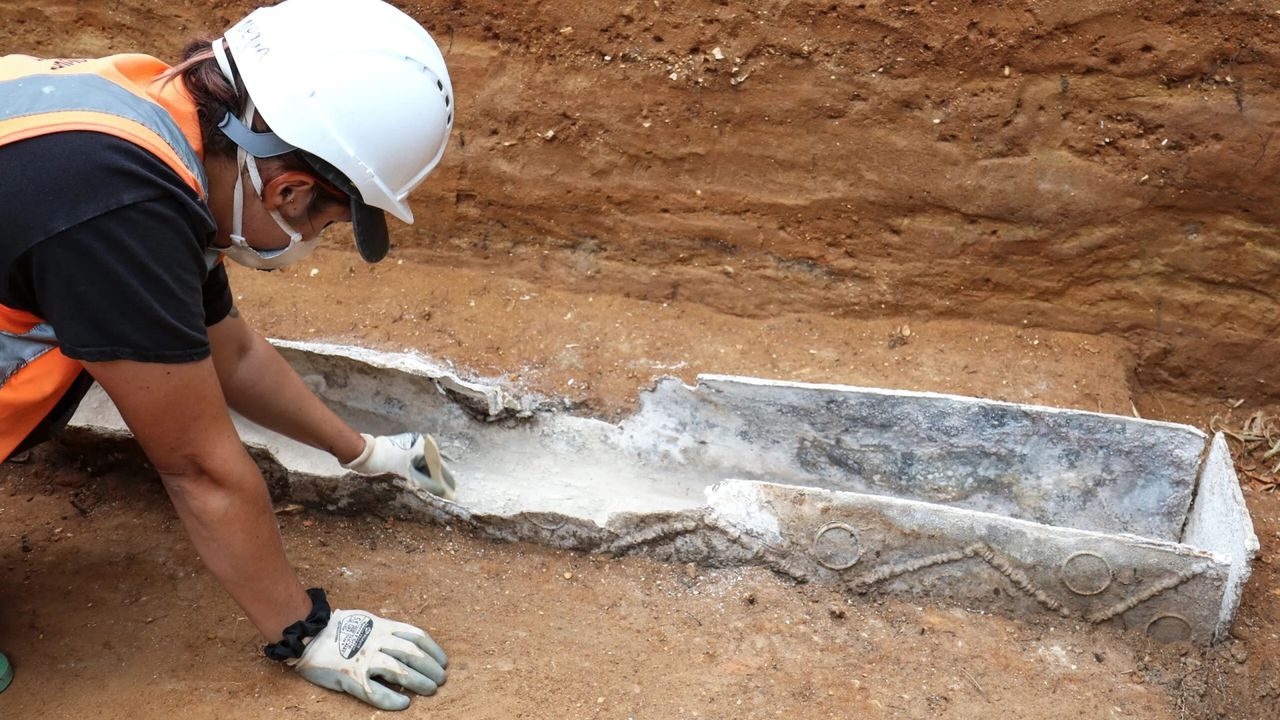
Archaeologists working in Colchester, England, have uncovered one of the most remarkable Roman-era burials found in the region in years — the remains of a high-status woman sealed inside a decorated lead coffin, accompanied by jet hairpins, rare glass flasks, and what appears to be exotic resins and gypsum.
The discovery is turning heads in the archaeological community not just because of the coffin itself, but because of the sheer combination of evidence pointing to a carefully staged, richly furnished burial. This wasn’t a simple interment. Someone went to considerable effort and expense to send this woman into the afterlife with objects that would have been hard to come by in Roman Britain.
The find was made in Colchester — historically significant as one of the earliest Roman settlements in Britain — and is being studied by the Colchester Archaeological Trust, whose researchers have described it as among the most compelling Roman burials they have examined in recent memory.
Who Was She? What the Burial Tells Us
Based on analysis of her remains, the woman was in her late 20s or early 30s when she died. She lived during a period when the Roman Empire held firm control over England, and while the exact date of her burial has not been pinned down, archaeologists believe she was laid to rest during the late Roman period — roughly spanning the late third century to the early fifth century A.D.
Her identity remains unknown. No inscription or name marker has been reported among the grave goods. But what she was buried with speaks volumes about her position in Roman society.
The lead coffin itself is decorated, which already signals wealth. Lead coffins were not common in Roman Britain — they were expensive to produce and typically reserved for individuals of elevated social standing. That she was placed in one suggests her family or community had both the means and the motivation to honor her in an exceptional way.
What Was Found Inside the Roman Lead Coffin
The grave goods recovered from the burial paint a picture of a woman of considerable status and, possibly, cosmopolitan tastes. The items found alongside her include materials that would not have been locally sourced, pointing to trade networks that stretched well beyond Roman Britain.
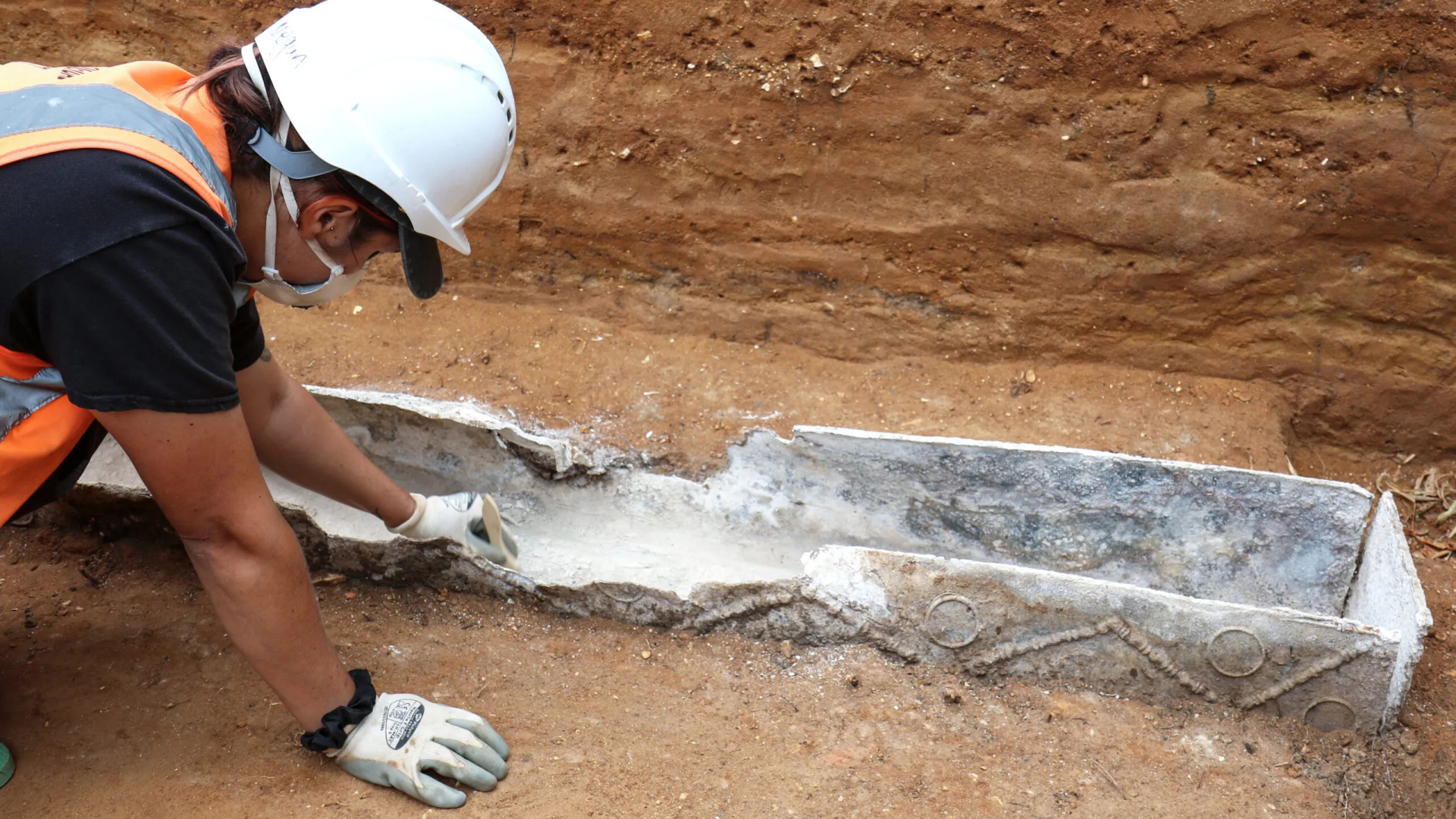
- Jet hairpins — jet was a prized material in Roman Britain, often associated with mourning and high status
- Rare glass flasks — a group of them, described as uncommon finds in this context
- Exotic resins — materials that would have required long-distance trade to obtain
- Gypsum — sometimes used in Roman burial practices, potentially as a preservative or ritual material
The presence of exotic resins in particular is striking. Such materials were not native to Britain and would have had to travel significant distances — likely through Mediterranean trade routes — before ending up in a burial in Colchester. Their inclusion suggests this woman, or those who mourned her, had access to goods that most people in Roman Britain simply could not acquire.
| Burial Feature | Significance |
|---|---|
| Decorated lead coffin | Rare and expensive; associated with elite Roman burials |
| Jet hairpins | Prized material in Roman Britain; linked to high status |
| Rare glass flasks | Uncommon grave goods suggesting wealth and access to trade goods |
| Exotic resins | Imported materials requiring long-distance trade networks |
| Gypsum | Possibly used as a ritual or preservative material in burial |
| Estimated age at death | Late 20s to early 30s |
| Burial period | Late Roman period, roughly late 3rd to early 5th century A.D. |
Why This Discovery Matters for Understanding Roman Britain
Colchester — known in Roman times as Camulodunum — was the first Roman city established in Britain and served as a major administrative and cultural hub. Burials found there offer a direct window into what life, death, and social hierarchy looked like under Roman rule on the island’s eastern coast.
What makes this particular burial stand out is the convergence of multiple lines of evidence. The coffin material, the grave goods, and the scientific analysis of substances like resins and gypsum all align to tell the same story: this was a woman of real social prominence, buried with intention and care.
Adam Wightman, director of archaeology at Colchester Archaeological Trust, described it plainly:
“This is one of the most fascinating Roman burials we have worked on in Colchester in recent years. The combination of the coffin, grave goods and scientific evidence make it a compelling burial.”
That combination — physical remains, material objects, and scientific data — is exactly what makes modern archaeological analysis so powerful. Each element on its own would be interesting. Together, they build a portrait of an individual life in a way that isolated finds rarely can.
What Researchers Are Still Working to Understand
Despite the richness of the find, significant questions remain open. Archaeologists have not confirmed the precise date of the burial within the late Roman period, meaning the window of possibility spans more than a century. Her name, her family, her specific role in Colchester society — none of that has been established from the evidence recovered so far.
The presence of gypsum and exotic resins also raises questions about burial practices and religious beliefs. Were these materials used for preservation? For ritual purposes? Did they reflect personal beliefs, family traditions, or the influence of Mediterranean customs that traveled to Britain along with Roman administration and trade? Those are the kinds of questions that ongoing scientific analysis may help answer.
The Colchester Archaeological Trust has not yet detailed a full timeline for the publication of their findings, but the discovery has already generated significant interest in the broader archaeological community.
Frequently Asked Questions
Where was the Roman lead coffin discovered?
The coffin was found in Colchester, England — one of the earliest and most historically significant Roman settlements in Britain.
Who was the woman buried in the coffin?
Her identity is unknown. Based on her remains, she was in her late 20s or early 30s at the time of death and appears to have been a person of high social status based on the richness of her burial.
When was she buried?
Archaeologists believe the burial took place during the late Roman period, which ran roughly from the late third century to the early fifth century A.D., though the precise date has not been confirmed.
Why is a lead coffin considered significant?
Lead coffins were expensive to produce and rare in Roman Britain, making them a strong indicator of elite social standing. Their use was typically reserved for individuals of considerable wealth or prominence.
What were the exotic resins found in the burial?
Their presence suggests access to long-distance trade networks, likely through Mediterranean routes.
Who is investigating the discovery?
The Colchester Archaeological Trust is leading the investigation, with Adam Wightman, the organization’s director of archaeology, having publicly commented on the significance of the find.




Leave a Reply