
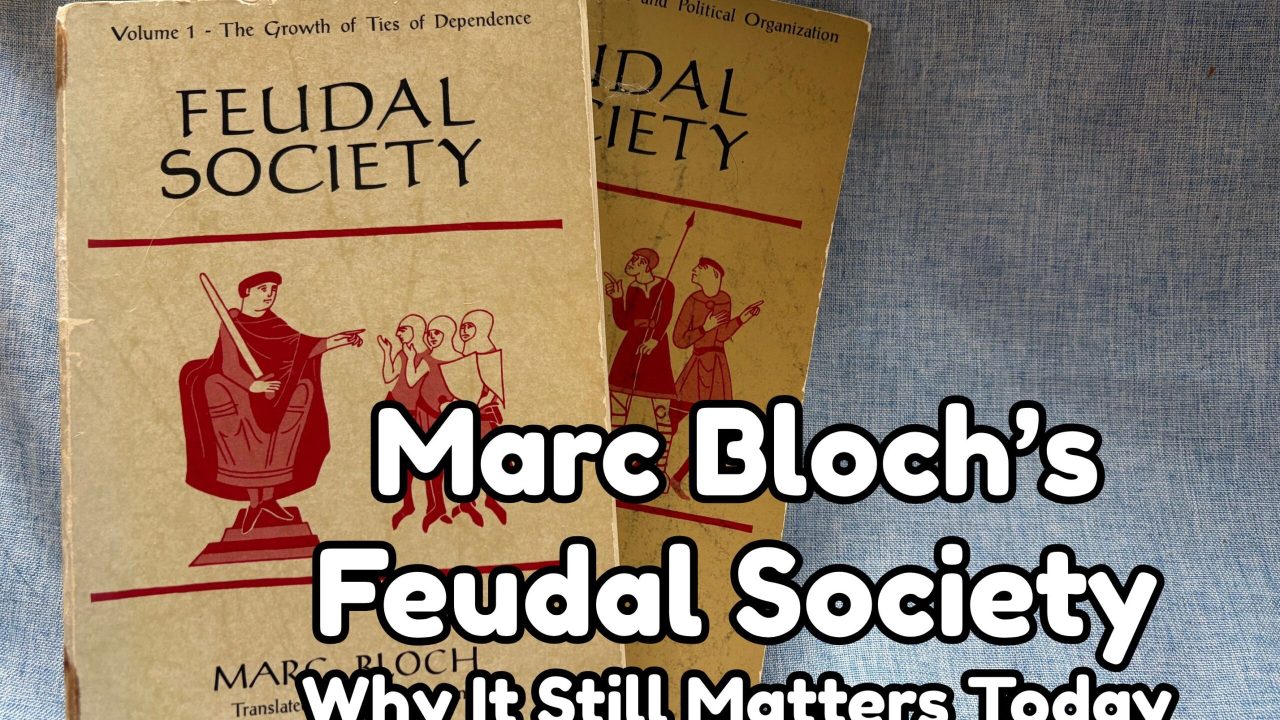
On June 23, 2026, a medieval historian who died holding the hand of a terrified teenager before a Nazi firing squad will be inducted into France’s Panthéon — one of the highest honors the French Republic can bestow. His name is Marc Bloch, and his masterwork, Feudal Society, is still being read, debated, and taught more than eighty years after it was written.
That combination — the scholar and the martyr — makes Bloch one of the most extraordinary figures in the history of Western intellectual life. But the story of why his work still matters is more complicated, and more interesting, than simple reverence for a brave man.
The real question is this: what do you do with a landmark book that shaped how generations understood the medieval world, but whose specific conclusions historians have since challenged? The answer, according to those who study Bloch most closely, is that you read it anyway — and for reasons that go far deeper than its arguments.
Who Marc Bloch Was — and Why France Is Honoring Him Now
The Panthéon, originally built as a church in the eighteenth century, became a national mausoleum after the French Revolution. It is the resting place of figures who shaped France’s intellectual and political life. Bloch will join an extraordinary roster that includes Marie Curie, Simone Veil, Émile Zola, Voltaire, Jean-Jacques Rousseau, Victor Hugo, Josephine Baker, and Jean Moulin.
Bloch was a French medieval historian whose scholarship helped define how the modern world understands feudalism, rural life, and the structures of power in the Middle Ages. He was also a Resistance fighter during World War II. He was captured by the Gestapo and executed in 1944.
According to a Smithsonian Magazine account drawn from survivors of the execution, Bloch — then fifty-eight years old — held the hands of a terrified sixteen-year-old boy in the moments before they were both shot. He reassured the boy, then shouted “Vive la France!” as the firing began.
That detail is not incidental to understanding his work. It is, in a very real sense, the key to it.
What Feudal Society Actually Argued — and Why Historians Still Argue Back
Feudal Society remains Bloch’s most influential book. It attempted something ambitious: a sweeping, synthetic account of how feudal structures organized European life during the Middle Ages — the bonds of loyalty, the hierarchies of land and obligation, the textures of daily existence for people across the social spectrum.
Historians have since challenged many of its specific conclusions. That is how scholarship works. New evidence emerges, methods evolve, interpretations shift. A book written in the mid-twentieth century cannot be expected to survive untouched into the twenty-first.
But Geoffrey Koziol, writing in the foreword to the Routledge Classics edition of Feudal Society, offers what may be the clearest explanation of why the book still deserves to be read.
“We read it because of what he would have regarded as his acts of citizenship.”
That phrase — “acts of citizenship” — is the heart of the matter. For Bloch, scholarship was not separate from civic life. It was an expression of it. Understanding the past was a moral obligation, not just an intellectual exercise. His writing and his resistance were, in his own mind, the same kind of work.
The Case for Reading Bloch Today
Joëlle Rollo-Koster, the scholar whose essay on Bloch accompanies his Panthéon induction, makes a pointed argument: respect for Bloch is not enough. The most meaningful way to honor him is to actually read him.
That distinction matters. It is easy to venerate a martyr. It is harder — and more useful — to engage seriously with what he thought, how he argued, and what his methods reveal about the craft of historical writing.
Bloch’s scholarship cannot be separated from his civic conscience. That is precisely what makes him relevant to readers today, not just to specialists in medieval European history. His approach to evidence, his insistence on asking how ordinary people actually lived, and his belief that the past has something urgent to say to the present — these are not dated methodological quirks. They are a model for how to think.
Key Facts About Marc Bloch and His Legacy
| Detail | Information |
|---|---|
| Panthéon induction date | June 23, 2026 |
| Age at execution | 58 years old |
| Key work | Feudal Society |
| Notable Panthéon companions | Marie Curie, Voltaire, Victor Hugo, Simone Veil, Josephine Baker, Jean Moulin |
| Foreword to Routledge Classics edition | Written by Geoffrey Koziol |
| Essay on Bloch’s legacy | Written by Joëlle Rollo-Koster |
| Panthéon’s original purpose | Built as a church in the eighteenth century; became a national mausoleum after the French Revolution |
Why This Moment Asks Something of Readers, Not Just Historians
The Panthéon induction will generate headlines. There will be ceremonies, speeches, and tributes. Bloch will be rightly celebrated as a hero of the French Resistance and a giant of twentieth-century historical thought.
But the scholars who know his work best are making a quieter, more demanding point. They are not asking the public to admire Bloch from a distance. They are asking people to sit down with a difficult, ambitious, imperfect book and engage with it seriously — to understand what Bloch was trying to do and why the attempt still has something to teach.
That is a harder ask than lighting a candle. It is also a more fitting tribute to a man who believed, until the last moments of his life, that ideas and citizenship were inseparable.
Frequently Asked Questions
When is Marc Bloch being inducted into the Panthéon?
Marc Bloch’s Panthéon induction is scheduled for June 23, 2026.
What is the Panthéon and why does induction matter?
The Panthéon was originally built as a church in the eighteenth century and became a national mausoleum after the French Revolution. It honors figures who shaped France’s intellectual and political life, including Marie Curie, Victor Hugo, and Voltaire.
What is Feudal Society about?
Feudal Society is Marc Bloch’s major work examining how feudal structures organized European life during the Middle Ages. Historians have since challenged many of its specific conclusions, but it remains widely studied for its methods and ambition.
How did Marc Bloch die?
Bloch was a French Resistance fighter captured by the Gestapo during World War II. He was executed in 1944 at the age of fifty-eight. Survivors reported that he held the hand of a terrified sixteen-year-old boy before they were shot, and shouted “Vive la France!” as the firing began.
Why do scholars say Feudal Society is still worth reading if its conclusions have been challenged?
Geoffrey Koziol, writing in the Routledge Classics foreword, argues that readers return to Bloch because of what he called his “acts of citizenship” — the idea that scholarship and civic conscience were inseparable in his work.
Who wrote the essay arguing for Bloch’s continued relevance?
The essay exploring why Feudal Society still matters was written by Joëlle Rollo-Koster, a scholar whose work engages directly with Bloch’s legacy and methods.


Leave a Reply