
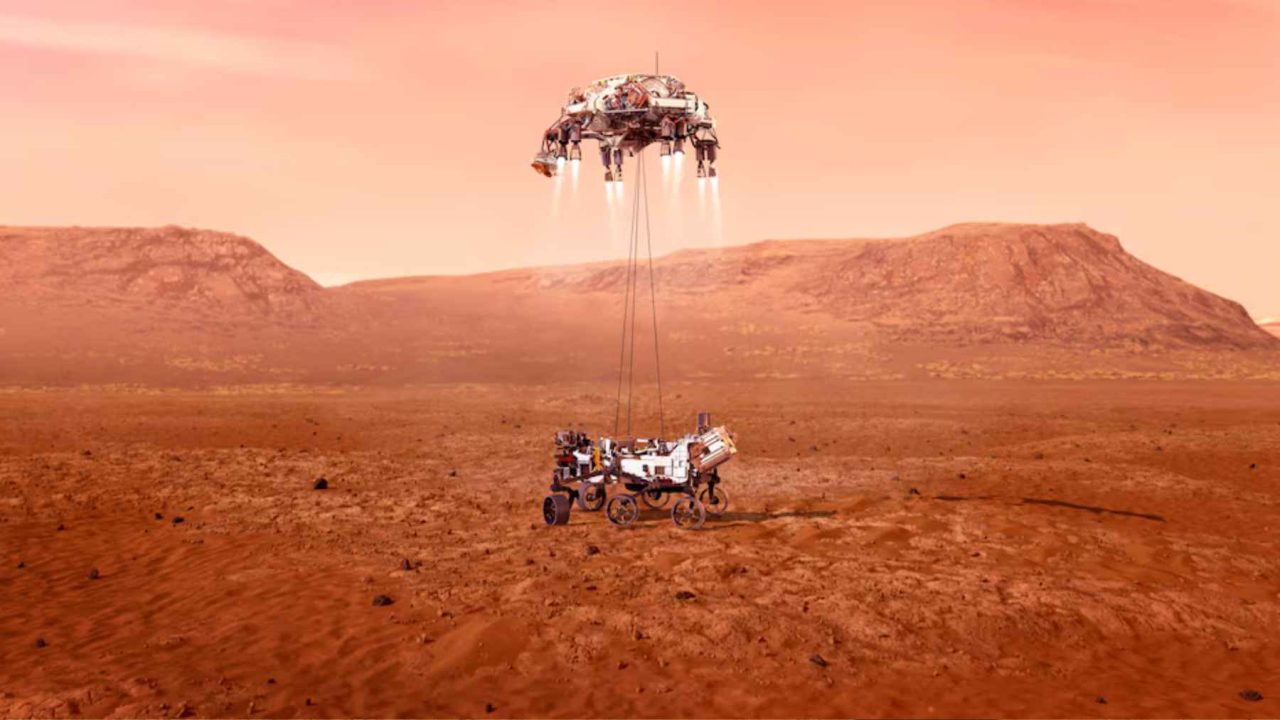
Fifty-five times over the course of roughly four Earth years, a microphone on NASA’s Perseverance rover picked up something scientists had long debated but never directly confirmed: electrical discharges crackling through the thin Martian atmosphere. For decades, the question of whether Mars could produce anything resembling lightning was purely theoretical. Now, for the first time, there is real, in-place evidence collected at the planet’s surface.
The discovery doesn’t look like the dramatic lightning bolts we see splitting open a summer sky here on Earth. Mars is too dry, too thin-aired, and too alien for that. But what has been detected is still remarkable — and it carries real consequences for how scientists understand Martian chemistry, climate, and the risks facing future exploration missions.
This is a story about dust, static electricity, and a rover that has quietly been rewriting what we thought we knew about our neighboring planet.
What Perseverance Actually Detected on Mars
The signals were captured by a microphone aboard the Perseverance rover — a piece of equipment that has already proven far more scientifically valuable than many expected. During whirlwinds and storm fronts, the microphone recorded 55 distinct events that researchers have identified as electrical discharges. The data spans two Martian years, which works out to approximately four Earth years.
The mechanism behind these discharges is one most people will recognize from everyday life: static electricity. When dust particles blow across the Martian surface, they collide and build up an electrical charge. When that charge becomes large enough, it jumps — a discharge. On Earth, we call the large-scale version of this lightning. On Mars, the scale is smaller, but the physics is the same.
The peer-reviewed study behind this finding was led by Baptiste Chide of the University of Toulouse, with contributions from Ralph D. Lorenz of the Johns Hopkins Applied Physics Laboratory and a team of international collaborators. Their work represents the first confirmed in-place detections of electrical discharges on the Martian surface.
Why Mars Was Always a Strange Case for Lightning
For decades, scientists argued about whether Mars could produce electrical discharges at all. The skepticism wasn’t unreasonable. Mars presents a very different environment from Earth in almost every way that matters for this kind of phenomenon.
The Martian atmosphere is far thinner than Earth’s — about 1% of Earth’s atmospheric pressure at the surface. It is also composed primarily of carbon dioxide rather than the nitrogen-oxygen mix we breathe. Both of those factors change how electricity behaves, and neither makes it easy for large electrical buildups to occur.
That’s part of what makes the Perseverance findings so significant. The detections confirm that even under those constraints, dust-driven static electricity can accumulate enough charge to discharge. It’s a smaller-scale phenomenon than Earth lightning, but it is real, it is measurable, and it is happening repeatedly across Martian weather events.
The Key Numbers Behind the Discovery
| Detail | Confirmed Data |
|---|---|
| Total discharge events recorded | 55 |
| Observation period (Martian years) | 2 Martian years |
| Observation period (Earth years) | Approximately 4 Earth years |
| Detection instrument | Microphone aboard Perseverance rover |
| Conditions during events | Whirlwinds and storm fronts |
| Lead researcher | Baptiste Chide, University of Toulouse |
| Contributing institution | Johns Hopkins Applied Physics Laboratory |
- The discharges are driven by dust particles colliding and building static charge during wind events
- Mars’s thin, carbon dioxide-rich atmosphere changes how electricity behaves compared to Earth
- The findings are published in a peer-reviewed study with international collaboration
- A related News & Views article accompanied the research publication
Why This Matters Beyond the Science Headlines
It would be easy to file this away as a fascinating but distant curiosity. It is anything but. Electrical discharges in the Martian atmosphere have potential ripple effects across several serious areas of research and planning.
On the chemistry side, electrical discharges can trigger reactions between atmospheric molecules that wouldn’t otherwise occur. On Earth, lightning plays a role in the nitrogen cycle and in the formation of certain compounds. If similar processes are happening on Mars, even at a smaller scale, it could affect how scientists model the planet’s atmospheric chemistry — and potentially its history.
For climate researchers, understanding how dust storms and whirlwinds generate electricity adds another variable to Martian weather models. Mars is famous for its planet-wide dust storms, and any electrical component to those events is scientifically significant.
Perhaps most practically, this finding matters for future human exploration. Electrical discharges in a dust-heavy environment pose real risks to equipment and, eventually, to astronauts. Knowing that this phenomenon exists and can be measured is the first step toward designing missions that account for it.
What Comes Next for Mars Electrical Research
The Perseverance rover continues to operate on Mars, and its onboard microphone remains a tool that has clearly delivered beyond initial expectations. The 55 events recorded so far represent a baseline — researchers now have confirmed proof of concept that these discharges occur, which opens the door to more targeted observation and analysis.
The study’s international team, including contributors from the Johns Hopkins Applied Physics Laboratory, will likely use these findings to refine models of Martian atmospheric electricity. Understanding the frequency, scale, and triggering conditions of these discharges will be essential for anyone planning long-duration surface missions.
Mars has surprised scientists repeatedly over the past decade — with evidence of ancient water, organic molecules, and now confirmed electrical discharges. Each discovery chips away at the idea that Mars is simply a cold, inert rock. It is a dynamic world, and Perseverance is still listening.
Frequently Asked Questions
Has lightning on Mars been detected before?
No. According to the peer-reviewed study, these are the first confirmed in-place detections of electrical discharges on the Martian surface.
How was the lightning detected?
A microphone aboard NASA’s Perseverance rover picked up the signals during whirlwinds and storm fronts over approximately four Earth years.
How many discharge events were recorded?
Researchers identified 55 distinct electrical discharge events across two Martian years, which equals roughly four Earth years.
Who led the research?
The study was led by Baptiste Chide of the University of Toulouse, with contributions from Ralph D. Lorenz of the Johns Hopkins Applied Physics Laboratory and international collaborators.
Is this the same as lightning on Earth?
The mechanism — static electricity from colliding particles discharging — is similar, but Mars’s thin carbon dioxide atmosphere means the scale and behavior differ significantly from Earth lightning.
Does this affect plans for human missions to Mars?




Leave a Reply