
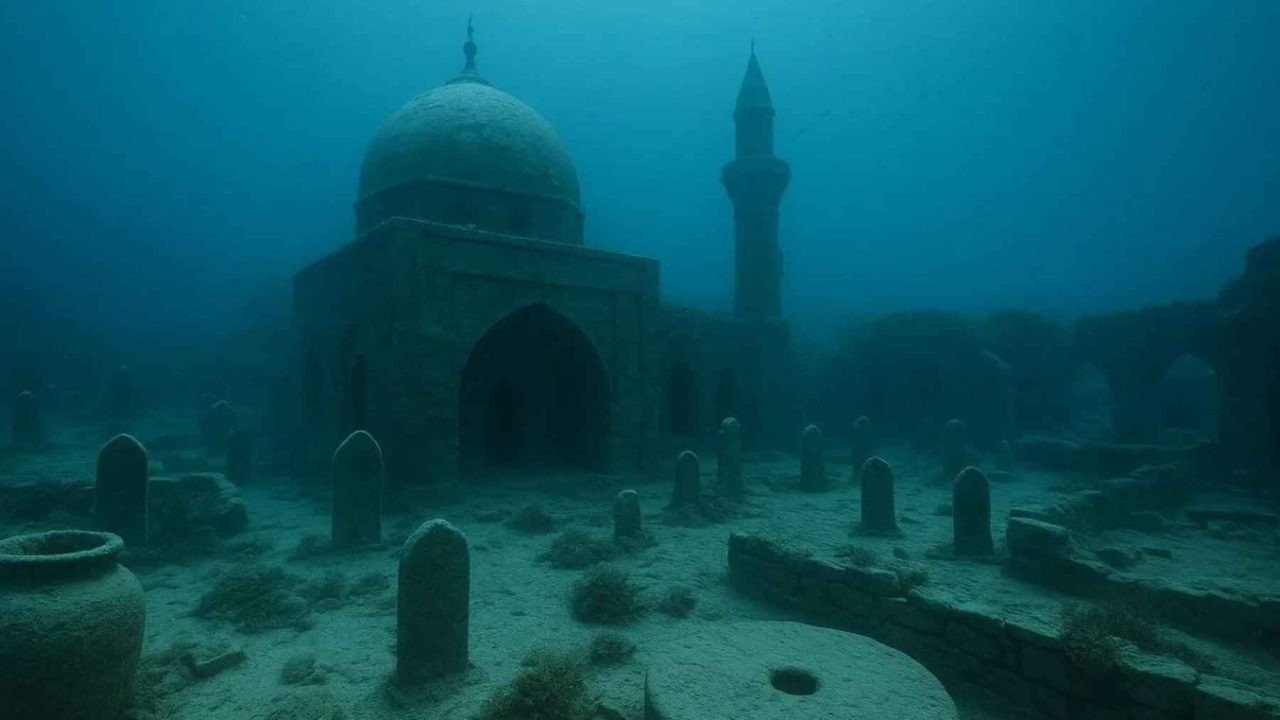
Beneath the surface of a mountain lake in Central Asia, streets and buildings lie submerged — not lost to myth, but confirmed by divers who mapped walls, kilns, and pottery just 3 to 13 feet underwater. What they found near the shores of Lake Issyk-Kul in Kyrgyzstan is being called a medieval city, and it is reshaping what historians understand about life and trade along one of the ancient world’s most important travel corridors.
This is not a legend handed down through generations, nor a blurry sonar image open to interpretation. Archaeologists physically surveyed the flooded zone, recovered artifacts, and identified four distinct areas where structural remains are still largely intact. The discovery has drawn comparisons to Atlantis — not because of any mythological connection, but because of the sheer strangeness of finding a functioning urban settlement sitting quietly on a lakebed.
For the researchers involved, the bigger question now is not whether a city exists down there. It does. The question is how much of it remains to be found.
What Archaeologists Actually Found at Lake Issyk-Kul
The site sits near a village called Toru-Aygyr, along the southern edge of Lake Issyk-Kul in Kyrgyzstan, a landlocked country in Central Asia south of Kazakhstan. Divers from an underwater expedition surveyed the flooded area and returned with enough evidence for archaeologist Valery Kolchenko of the National Academy of Sciences of the Kyrgyz Republic to formally identify it as a city.
The depth range is surprisingly shallow. Most of the ruins sit between 3 and 13 feet below the lake’s surface — close enough that the remains have stayed protected under sediment rather than being scattered by deep currents. Kolchenko’s team identified four separate areas where walls, beams, and pottery had remained intact enough to map.
A full street plan has not yet been recovered, but the structural evidence is significant on its own. Brick buildings and kiln complexes were found beneath the water during the 2023–2024 expedition. Kilns suggest industrial or craft activity — the kind of infrastructure you build when a community is producing goods, not just passing through.
Alongside the masonry, divers collected broken ceramics, animal bones, and slag. That last material — the leftover waste from metal heating and refining — points to metalworking operations at the site. Under loose sand, the team also uncovered a preserved cultural layer, a band of soil densely packed with evidence of human occupation.
Why This Discovery Changes the Historical Map
Lake Issyk-Kul sits in a region that served as a crossroads for ancient and medieval trade. Central Asia’s overland routes connected China, the Middle East, and Europe for centuries, and communities along those paths were essential to how goods, ideas, and religions moved across the continent.
Finding a submerged city in this location does more than add a dot to a map. It raises the possibility that significant settlements — trading posts, religious centers, or administrative hubs — were established in places that no longer appear on any historical record, because they eventually sank beneath the water. Historians looking for evidence of commerce, daily life, and faith along these corridors may now need to look down as well as across the land.
The intact state of the ruins makes this especially valuable. When walls, beams, and pottery survive together in context, archaeologists can begin to reconstruct how people actually lived — what they made, what they ate, what they built, and how they organized their communities.
What the Evidence Tells Us So Far
| Type of Evidence | What Was Found | What It Suggests |
|---|---|---|
| Structural remains | Walls, beams, brick buildings | Permanent settlement, not a temporary camp |
| Kiln complexes | Multiple kilns beneath the water | Craft production or industrial activity |
| Ceramics | Broken pottery recovered by divers | Domestic use, trade goods, or manufacturing |
| Animal bones | Found alongside other debris | Evidence of food consumption and daily life |
| Slag | Waste from metal heating and refining | Metalworking operations at the site |
| Cultural layer | Preserved band of soil under sand | Dense record of sustained human occupation |
- Four separate underwater areas were mapped by Kolchenko’s team
- Ruins are located between 3 and 13 feet below the lake surface
- The site sits near the village of Toru-Aygyr on Lake Issyk-Kul
- The expedition and formal reporting took place during 2023–2024
- The research is led through the National Academy of Sciences of the Kyrgyz Republic
The Part of This Story Most Reports Are Missing
The Atlantis comparison is attention-grabbing, but it can obscure what makes this discovery genuinely significant. This is not a mythological city. It is a real medieval settlement, confirmed through physical evidence, sitting in shallow water that divers can actually reach and study.
That accessibility matters. Deep-sea wrecks and ruins require expensive, specialized equipment to investigate. A site sitting 3 to 13 feet below the surface is, by archaeological standards, remarkably workable. Researchers can return repeatedly, recover artifacts carefully, and build a detailed picture of the community over time.
What is still unknown is how the city came to be submerged. Lake levels in Central Asian mountain lakes can shift over centuries due to glacial melt, seismic activity, or gradual geological changes.
What Comes Next for the Issyk-Kul Excavation
The 2023–2024 expedition produced a formal report describing what was found, but the researchers themselves acknowledge that the full street plan of the city has not yet been revealed. What exists now is a confirmed footprint — enough to establish that a significant urban settlement once stood here, but not yet enough to understand its full extent or history.
Future dives will likely focus on recovering more of that preserved cultural layer beneath the sand, mapping the connections between the four identified areas, and piecing together a timeline for when the city was active and when it went under. Each artifact recovered adds to a picture that, right now, is still only partially visible.
For the broader field of Central Asian archaeology, the Issyk-Kul discovery is a reminder that the historical record is far from complete — and that some of what is missing may be hiding in plain sight, just beneath the water’s surface.
Frequently Asked Questions
Where exactly is the submerged city located?
The ruins are situated near the village of Toru-Aygyr along Lake Issyk-Kul in Kyrgyzstan, a country in Central Asia south of Kazakhstan.
How deep underwater are the ruins?
The structural remains were found at depths ranging from 3 to 13 feet below the lake’s surface, making them accessible to divers without specialized deep-sea equipment.
Who led the archaeological investigation?
Archaeologist Valery Kolchenko of the National Academy of Sciences of the Kyrgyz Republic led the identification of the site as a city based on the expedition findings.
What kinds of artifacts were recovered?
Divers collected broken ceramics, animal bones, and slag, and also identified brick buildings, kiln complexes, and a preserved cultural layer beneath loose sand.
Why did the city end up underwater?
Lake levels in mountain regions can shift over centuries due to various geological factors, but this has not yet been determined for this site.
Has the full layout of the city been mapped?
Not yet. Researchers identified four separate areas with intact remains, but the complete street plan of the settlement remains unknown and will require further investigation.



Leave a Reply