
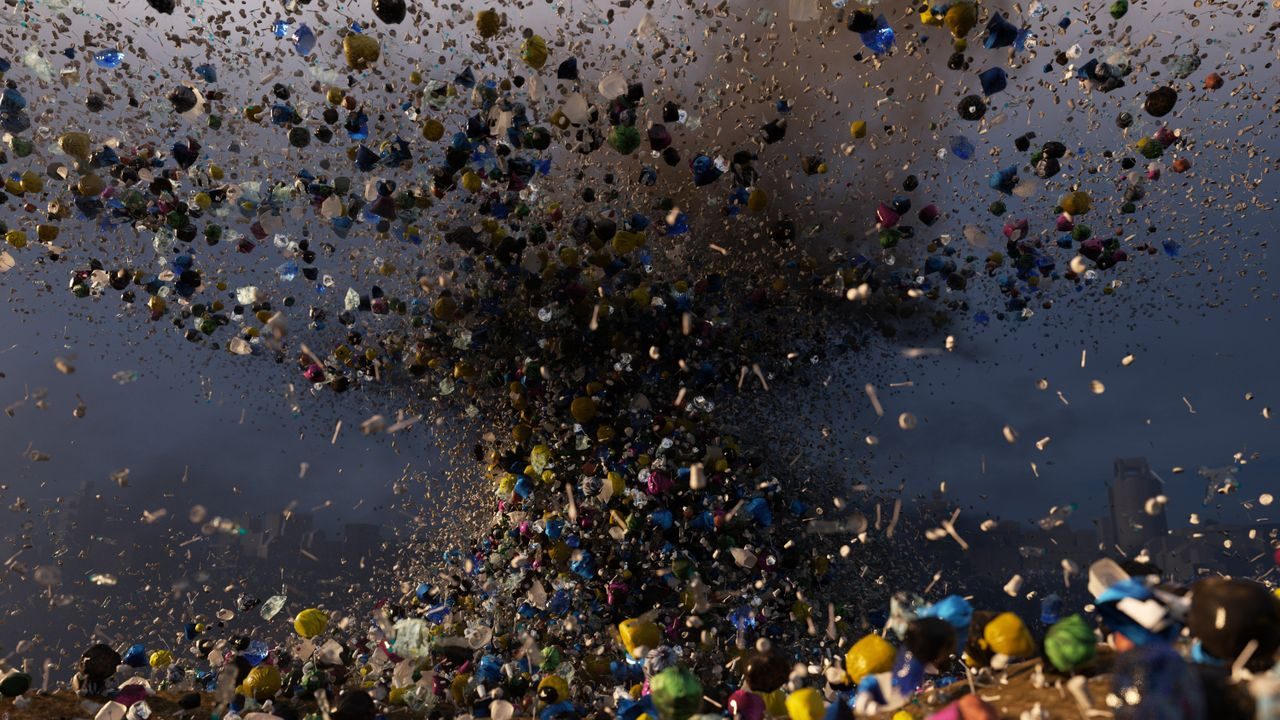
Microplastics were already one of the most unsettling environmental stories of our time — turning up in human blood, breast milk, and the deepest ocean trenches. Now, a new study has found something even more alarming: those same particles floating in the atmosphere are absorbing heat and actively contributing to global warming.
The research, published Monday, May 4, in the journal Nature Climate Change, is the first to seriously quantify what plastic particles are doing to the climate once they’re airborne. The short answer is that they’re making things worse — and scientists are only beginning to understand the full picture.

It’s one more chapter in a story that keeps getting harder to ignore.
How Microplastics Are Warming the Atmosphere
Scientists have known for some time that plastic particles get swept high into the atmosphere. Wind currents carry them enormous distances, and they’ve been detected in remote locations far from any human population. What wasn’t clear until now was what effect, if any, they were having on the climate while they were up there.
The new study found that the answer depends heavily on the color of the plastic. Lighter-colored plastics actually scatter sunlight back into space, which creates a slight cooling effect. But darker-colored plastics do the opposite — they absorb sunlight and radiation, trapping heat in the atmosphere.
When you account for both effects together, the overall result is a net warming. The darker plastics win out, and the atmosphere ends up retaining more heat because of it.
Study co-author Drew Shindell, a distinguished professor of Earth science at Duke University, told Live Science that the climate impact of plastic particles is “fairly small — comparable to the emissions of a small country.” In numerical terms, the contribution is roughly equivalent to a couple of percent of the warming caused by carbon dioxide, or a couple of hundredths of a percent when measured against CO2’s total role as the main driver of climate change.
That might sound minor. But given how rapidly plastic production and pollution are growing globally, researchers say it’s a number worth taking seriously.
What the Numbers Actually Tell Us
Context matters when you’re talking about fractions of a percent. Here’s what the study’s findings break down to in practical terms:
| Factor | Detail |
|---|---|
| Study published | May 4, in Nature Climate Change |
| Named co-author | Drew Shindell, Duke University |
| Shindell’s title | Distinguished Professor of Earth Science |
| Overall climate effect | Net warming (darker plastics absorb more than lighter ones reflect) |
| Warming compared to CO2 | Approximately a couple of percent of CO2’s contribution |
| Comparable scale | Emissions of a small country |
| Light-colored plastics | Scatter sunlight — slight cooling effect |
| Dark-colored plastics | Absorb sunlight and radiation — warming effect |
The comparison to a small country is a useful anchor. It means the effect is real and measurable — not a rounding error — but it also means plastic particles aren’t currently competing with fossil fuels as the dominant climate threat. The concern is trajectory: plastic pollution is accelerating, not slowing down.
Why This Finding Matters Beyond the Numbers
The significance of this study isn’t just the size of the warming effect — it’s the fact that atmospheric microplastics hadn’t been factored into climate models at all until now. That means current projections of future warming may be slightly underestimating the problem.
Microplastics and nanoplastics are now considered pervasive in the atmosphere. They’ve been found at high altitudes, in polar regions, and in air samples taken far from industrial areas. Scientists describe them as a hidden variable — present everywhere, but largely unmeasured in terms of their climate effects.
This study changes that. By establishing that plastic particles have a quantifiable radiative effect — meaning they interact with incoming solar radiation and outgoing heat — researchers have opened a new line of inquiry into how pollution and climate change are intertwined in ways we’re still mapping out.
The fact that the effect is currently small doesn’t mean it will stay that way. Global plastic production has increased dramatically over the past several decades, and without significant policy intervention, the volume of plastics entering the environment — and the atmosphere — is expected to keep rising.
The Bigger Microplastics Problem This Sits Inside
This climate finding lands on top of an already alarming body of research about what microplastics are doing to human health and ecosystems. These particles have been detected in human blood, lungs, and even breast milk. They’ve been found in the placentas of unborn babies. Marine ecosystems are heavily contaminated, and the particles move up food chains in ways scientists are still studying.
The atmospheric dimension adds a layer that’s harder to see but potentially just as significant over the long term. Unlike pollution that stays in water or soil, airborne microplastics are mobile on a global scale — carried by wind systems across continents and oceans, depositing in places that have never produced a single piece of plastic.
What this study adds is the understanding that those particles aren’t just passing through the atmosphere harmlessly. They’re interacting with it, absorbing energy, and nudging the climate in a warmer direction.
What Researchers Are Watching Next
The publication of this study in Nature Climate Change is likely to prompt further research into how atmospheric plastic concentrations are changing over time, and whether the warming effect grows proportionally as plastic pollution increases. Scientists will also be looking more closely at the role of nanoplastics — particles even smaller than microplastics — which may behave differently in the atmosphere and could have effects that are harder to measure.
For now, the study represents a significant step: plastics can no longer be treated as a climate non-factor. They belong in the conversation alongside other atmospheric pollutants, even if their current contribution is smaller than those of greenhouse gases.
The researchers have identified a mechanism. The next question is how much worse it gets.
Frequently Asked Questions
What did the new microplastics study find?
A study published May 4 in Nature Climate Change found that plastic particles in the atmosphere create a net warming effect, because darker plastics absorb more sunlight and radiation than lighter plastics scatter back into space.
How significant is the warming effect of atmospheric microplastics?
According to study co-author Drew Shindell of Duke University, the effect is comparable to the emissions of a small country — roughly a couple of percent of the warming contribution from carbon dioxide.
Do all microplastics in the atmosphere cause warming?
No. Light-colored plastics actually scatter sunlight back into space, creating a slight cooling effect. However, darker-colored plastics absorb heat, and the overall balance tips toward warming.
Were atmospheric microplastics included in climate models before this study?
Who conducted the research?
The study was published in Nature Climate Change and co-authored by Drew Shindell, a distinguished professor of Earth science at Duke University. Additional co-authors are not named in the available source material.
Should I be worried about microplastics in the atmosphere affecting the climate?
Scientists describe the current effect as relatively small but real and measurable — and the concern is that as plastic pollution grows globally, the atmospheric warming contribution could increase over time.



Leave a Reply