
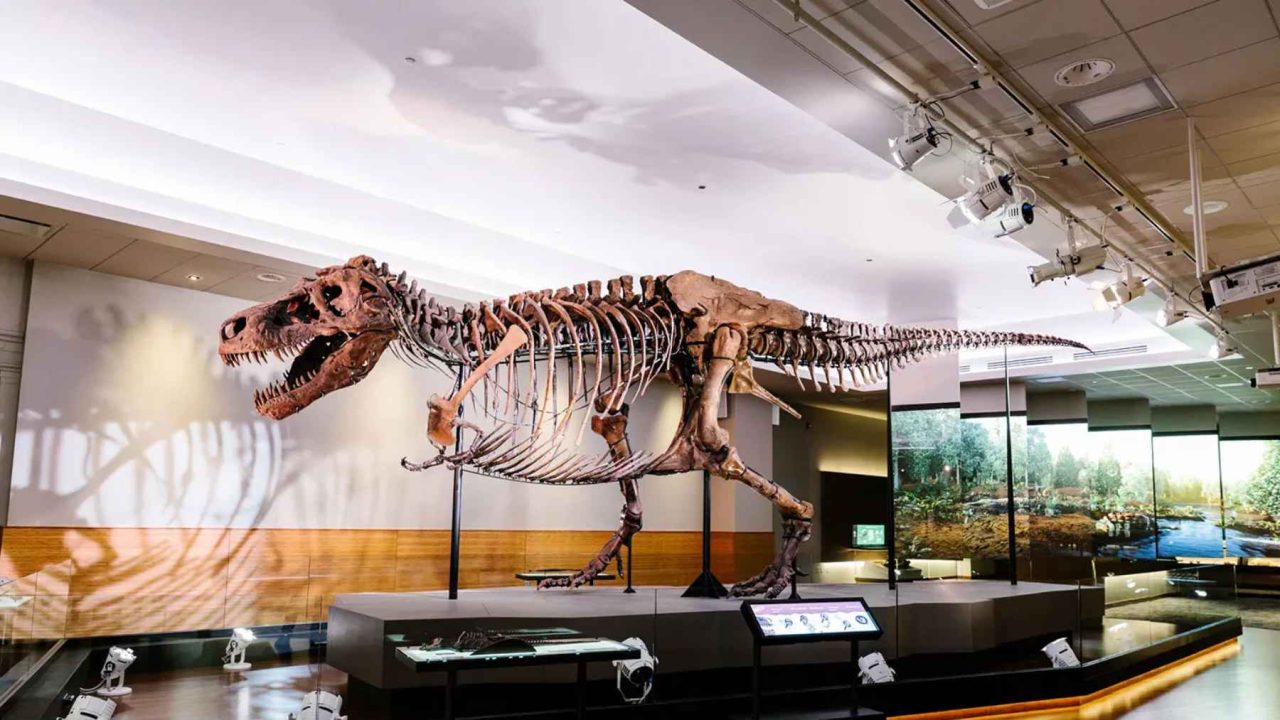
Everyone thinks they know Tyrannosaurus rex. Massive. Terrifying. The undisputed apex predator of prehistoric North America. But a new scientific study suggests that one of the most fundamental assumptions about how this animal moved — how its foot hit the ground with every step — may have been wrong all along.
Researchers now argue that T. rex likely struck the ground toes-first while walking and running, much like modern birds do today. If that finding holds up, it could reshape how scientists calculate the animal’s speed, its hunting style, and the broader picture of how it lived.
The study draws on one of paleontology’s most prized specimens: the famous skeleton known as Sue, housed at the Field Museum in Chicago and widely regarded as the largest and most complete T. rex ever found. Reexamining Sue — combined with measurements from multiple other skeletons — is what led researchers to this surprising conclusion.
What Scientists Actually Found When They Looked Again at Sue
The research comes from scientists at the College of the Atlantic in Maine. Their approach was methodical: they built a biomechanical model of how a T. rex foot would interact with the ground during movement, feeding in measurements gathered from several skeletons, with Sue serving as a central reference point.
The question they were trying to answer sounds almost too simple: What part of the foot hit the ground first? In biomechanics, this is called the “foot strike,” and it turns out to be one of the most revealing things you can know about how an animal moves.
Think of it like studying the wear pattern on the sole of a shoe. Where the rubber wears down first tells you a lot about how that person walks, how fast they move, and how much stress their joints absorb with every step. The same logic applies to a 40-foot predator that went extinct 66 million years ago.
The researchers concluded that T. rex most likely made contact with the ground toes-first — a pattern seen in modern birds, which are, of course, the living descendants of theropod dinosaurs. This is a significant departure from the flat-footed or heel-first walking style that has often been assumed or depicted in popular culture and even in some scientific models.
Why the Foot Strike of a T. Rex Actually Matters
This isn’t just a technical footnote. The way an animal’s foot strikes the ground has direct consequences for how fast it can move, how much energy it uses, and what kinds of prey it can realistically chase down.
If T. rex was a toe-first striker, that changes the physics of how its body weight was distributed during movement. It affects estimates of its top speed. It influences how scientists interpret the stress on its leg bones. And it raises new questions about whether the animal was more agile than previously thought — or less.
The connection to modern birds is also worth pausing on. Birds are living theropods. When researchers find that a Cretaceous predator may have moved in a way that closely mirrors how a cassowary or an ostrich walks today, it reinforces the evolutionary link between dinosaurs and their feathered descendants in a very concrete, physical way.
Key Facts About Sue and the New Research
| Detail | Information |
|---|---|
| Specimen studied | Sue — the world’s largest and most complete T. rex skeleton |
| Sue’s location | Field Museum, Chicago |
| Research institution | College of the Atlantic, Maine |
| Method used | Biomechanical foot-strike model built from multiple skeleton measurements |
| Key finding | T. rex likely struck the ground toes-first, similar to modern birds |
| Implications | May require rethinking speed estimates and hunting behavior |
| T. rex habitat | Ancient North American landmass known as Laramidia |
- The study used measurements from multiple T. rex skeletons, not just one specimen
- Sue remains the most complete T. rex ever recovered, making it an essential reference point
- The foot-strike pattern observed mirrors what scientists see in living birds today
- The research was conducted at the College of the Atlantic in Maine
- T. rex roamed what is now North America on a landmass scientists call Laramidia
What This Means for How We Picture the World’s Most Famous Predator
Popular culture has given T. rex a very specific image. The thunderous stomp. The ground shaking underfoot. The flat, heavy tread of an animal so massive it could barely support its own weight. Films, documentaries, and museum exhibits have all leaned into this version of events.
But the new research suggests that image may be off. A toes-first gait implies something more dynamic — an animal whose movement had more in common with a large flightless bird than with the plodding monster of the movies.
Researchers argue this kind of revision matters beyond the academic world. How we understand T. rex’s movement affects everything from how we model its predatory behavior to how we interpret fossil trackways left in ancient mud. A toe-first striker would leave a different kind of impression in soft sediment than a flat-footed one — which means some existing fossil footprint interpretations may need a second look.
The broader point is that even the most studied, most famous creatures in the fossil record still have secrets. Sue has been examined by scientists for decades, and yet a new modeling approach, applied to familiar bones, produced a finding that challenges long-held assumptions.
Where This Research Goes From Here
The study opens several avenues for follow-up work. Scientists will likely want to test the model’s predictions against known T. rex trackways — fossilized footprints that can reveal pressure distribution and gait patterns in a way that bones alone cannot.
Researchers may also apply similar biomechanical modeling to other large theropods to see whether the toe-first pattern was specific to T. rex or common across the group. And as new specimens are discovered and existing ones are scanned with increasingly precise technology, the data feeding into these models will only improve.
For now, the finding stands as a reminder that paleontology is not a finished science. Every skeleton still in a museum drawer, every fossil not yet fully analyzed, is a potential source of revision — and occasionally, a reason to rethink everything.
Frequently Asked Questions
What is the “foot strike” finding about T. rex?
Researchers at the College of the Atlantic in Maine built a biomechanical model suggesting T. rex struck the ground toes-first when walking and running, similar to how modern birds move.
Why is the skeleton called Sue significant?
Sue is housed at the Field Museum in Chicago and is widely considered the largest and most complete T. rex skeleton ever found, making it a critical reference point for this kind of research.
How does a toes-first gait change what we know about T. rex?
It could affect scientific estimates of the animal’s speed, its energy use during movement, and how researchers interpret fossil footprints left behind in ancient sediment.
Where did T. rex live?
T. rex roamed an ancient North American landmass known as Laramidia during the Cretaceous period.
Is this finding confirmed as fact?
The research presents a biomechanical model based on multiple skeleton measurements, but further testing against fossil trackways and additional specimens will be needed to fully validate the conclusion.
Who conducted this research?
The study was conducted by scientists at the College of the Atlantic in Maine, who developed a model of T. rex foot mechanics using data from multiple skeletons, including Sue.



Leave a Reply