
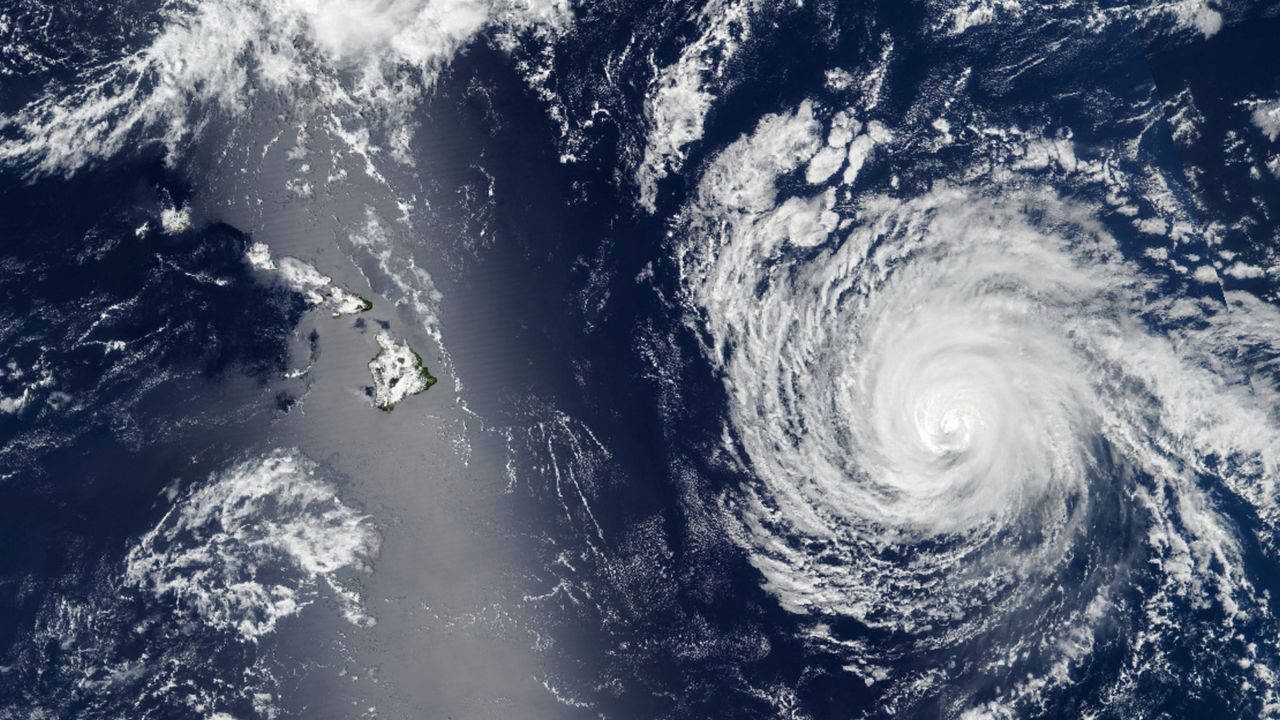
A shimmering band of silver light stretches across the Pacific Ocean in a stunning NASA satellite image — and hidden beneath that glittering veil are the Hawaiian Islands, with a Category 4 hurricane bearing down on them.
The photograph, captured on September 7, 2025, by the Suomi NPP satellite, shows one of nature’s most dramatic optical phenomena — known as sunglint — coinciding with one of its most powerful forces. The result is an image that is as beautiful as it is unsettling.
Hurricane Kiko was no ordinary storm. At its peak, it was churning with wind speeds of around 145 mph (233 km/h), and researchers had determined it was on a direct collision course with Hawaii. For a brief, alarming window, the islands faced a potentially catastrophic hit.
What Is Sunglint — and Why Does It Hide Hawaii in This Image?
The silver shimmer dominating the satellite photo is a phenomenon called sunglint. It occurs when sunlight reflects directly off the surface of the ocean at just the right angle to bounce back into a satellite’s camera lens. The effect is similar to the blinding glare you see when sunlight hits a car windshield or a mirror — except in this case, it’s happening across hundreds of miles of open ocean.
Because the reflection is so intense, it effectively washes out whatever lies beneath it. In this image, that means the Hawaiian Islands — sitting directly in the path of both the sunglint band and Hurricane Kiko — are partially obscured from view, creating an almost ghostly visual effect.
The Suomi NPP satellite, operated by NASA, routinely captures imagery like this as part of ongoing Earth observation programs. The satellite’s instruments are sensitive enough to detect subtle changes in ocean surface texture, atmospheric conditions, and storm structure — making it one of the key tools scientists use to track powerful weather systems.
Hurricane Kiko: How the Storm Formed and Where It Was Headed
Hurricane Kiko formed in the eastern Pacific Ocean on August 31, 2025. Within days, it had rapidly intensified into a formidable storm. By September 3, just three days after forming, it had reached its peak strength — a Category 4 hurricane with those near-150 mph winds that made it one of the more powerful storms to threaten Hawaii in recent memory.
The storm’s projected track alarmed researchers and residents alike. Hawaii sits in the central Pacific, and direct hurricane hits are relatively rare but historically devastating when they do occur. The prospect of a Category 4 storm making landfall on the islands prompted serious concern.
Then something shifted.
The Cold Water That Changed Everything
Hurricanes are, in a very real sense, heat engines. They draw their power from warm ocean water, using the heat and moisture to fuel their rotating winds. When a hurricane runs into a patch of significantly colder water, that energy source is cut off — and the storm weakens, sometimes dramatically.
That is exactly what happened with Hurricane Kiko. The storm encountered cold water as it moved across the Pacific, and the effect was swift. Kiko weakened from a Category 4 down to a Category 2 storm before it reached Hawaii. Equally important, its track shifted — the hurricane diverted to pass mostly north of the islands rather than directly over them.
The combination of weakening intensity and a northward track shift meant that Hawaii was spared the worst of what Kiko might have delivered at full strength.
Key Facts About Hurricane Kiko at a Glance
| Detail | Information |
|---|---|
| Storm name | Hurricane Kiko |
| Formation date | August 31, 2025 |
| Peak strength date | September 3, 2025 |
| Peak category | Category 4 |
| Peak wind speed | ~145 mph (233 km/h) |
| Satellite image date | September 7, 2025 |
| Satellite used | Suomi NPP (NASA) |
| Storm dissipation date | September 10, 2025 |
| Final location before fading | Just off the coast of Honolulu |
- Kiko formed in the eastern Pacific Ocean before tracking westward toward Hawaii
- The storm weakened after hitting a patch of cold water in the Pacific
- Its final track passed mostly north of the Hawaiian Islands
- The storm officially dissipated on September 10, just off Honolulu
- The satellite photo was taken when Kiko was still approaching, on September 7
What This Image Tells Us Beyond the Storm
There is something worth pausing on in this photograph beyond the drama of the hurricane itself. The sunglint band — that brilliant silver streak — is a reminder that satellite imagery, for all its power, is still subject to the basic physics of light. Even the most sophisticated Earth-observing technology can be partially blinded by a simple reflection off the ocean’s surface.
That limitation matters. When storms approach populated areas, scientists and emergency managers rely heavily on satellite data to track intensity, direction, and timing. Cloud cover, sunglint, and other optical interference can complicate that picture. The Suomi NPP satellite was still able to capture Kiko’s swirling structure in the image, but the sunglint obscuring the Hawaiian Islands is a visual reminder that nature rarely makes observation simple.
The image also captures a moment of genuine suspense — a Category 4 hurricane approaching one of the most isolated island chains on Earth, partially hidden beneath a curtain of reflected light. It is the kind of photograph that will likely be studied and referenced long after the storm itself has been forgotten.
Frequently Asked Questions
When was the satellite image of Hurricane Kiko and Hawaii taken?
The image was captured on September 7, 2025, by the Suomi NPP satellite operated by NASA.
What is sunglint, and why does it appear in the photo?
Sunglint is the bright silver reflection that occurs when sunlight bounces off the ocean’s surface at an angle that reflects directly into a satellite’s camera lens, washing out the view of what lies beneath.
How strong was Hurricane Kiko at its peak?
Kiko reached Category 4 strength with peak wind speeds of around 145 mph (233 km/h) on September 3, 2025.
Did Hurricane Kiko make a direct hit on Hawaii?
No. Kiko weakened to a Category 2 storm and diverted to pass mostly north of the islands before dissipating on September 10, just off the coast of Honolulu.
What caused Hurricane Kiko to weaken before reaching Hawaii?
According to available reports, the hurricane hit a patch of cold water in the Pacific, which cut off the warm-water energy source that fuels storm intensity.
Which satellite captured the image of the storm?
The photograph was taken by NASA’s Suomi NPP satellite, one of the key Earth-observing tools used to monitor weather systems and ocean conditions.


Leave a Reply