
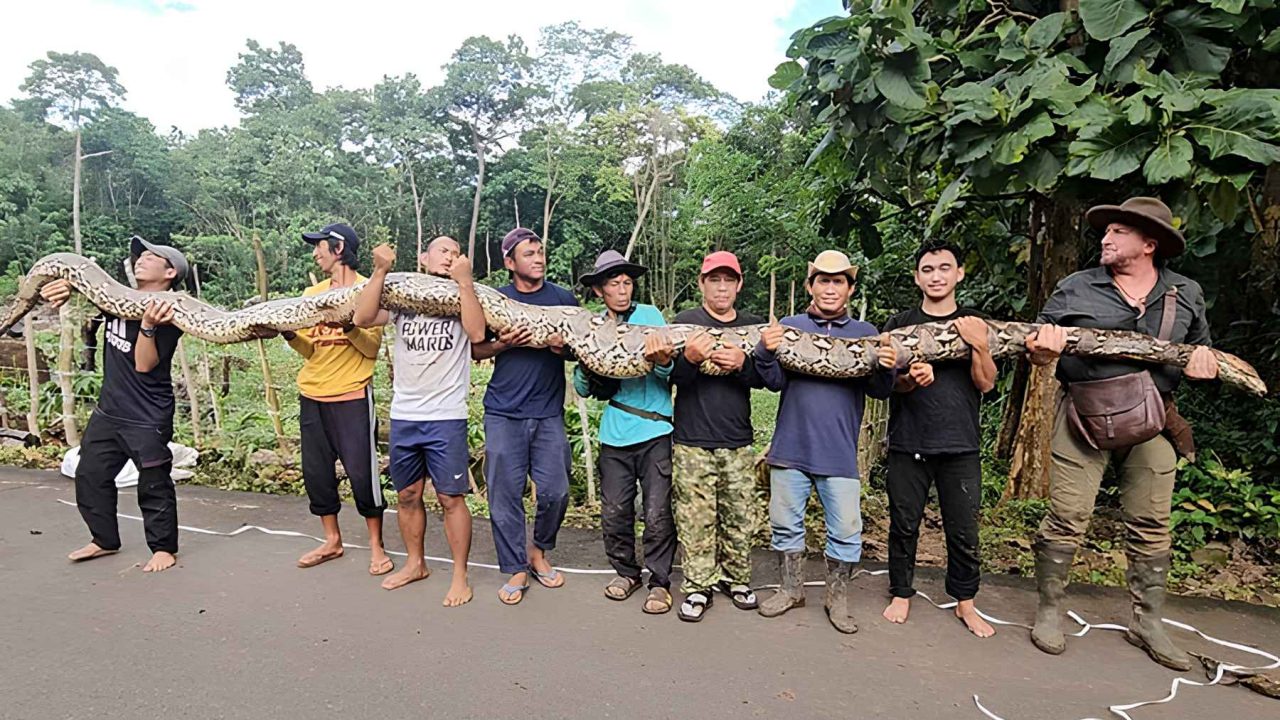
A wild female reticulated python measuring 23 feet 8 inches — or 7.22 meters — from head to tail tip has been officially recognized as the longest wild snake ever measured. Found in Indonesia and nicknamed “Ibu Baron,” meaning “The Baroness,” the snake was measured on January 18, 2026, and weighed in at 213 pounds. The numbers alone are staggering. But the story behind the measurement, and what it signals about the environment this animal came from, matters just as much as the record itself.
For years, claims about enormous pythons circulated the way most extreme wildlife stories do — half-believed, rarely verified, easy to dismiss. This one is different. The measurement was carried out using a surveyor’s tape in the field, by two named professionals, following a methodology designed to reflect the snake’s actual size rather than produce the most dramatic number possible.
That kind of rigor is rare. And the fact that a snake this large was found in the wild at all raises questions that go well beyond the record books.
How You Measure a Snake That Won’t Lie Straight
The measurement was conducted by licensed snake handler Diaz Nugraha and explorer and photographer Radu Frentiu, who traveled to Sulawesi after hearing persistent rumors of an unusually large python in the region.
Rather than forcing the snake into an unnatural straight line — which would have been both inaccurate and potentially harmful — the team used a surveyor’s tape that followed the animal’s natural curves along the ground. This approach is considered more honest than the kind of stretched-out measurements that have historically inflated python size claims.
For the weigh-in, Ibu Baron was placed inside a large sack and lifted onto a scale ordinarily used for weighing bags of rice. The result: 213 pounds for a living, wild-caught animal.
“I had never seen anything that big,” Frentiu said, describing the encounter in terms that needed no embellishment.
That quote captures something important. This was not a captive-bred animal raised in controlled conditions. This was a wild snake, living in its natural habitat, that had grown to a size most people associate with myth rather than field biology.
The Record in Context: What We Know About Reticulated Pythons
Reticulated pythons (Malayopython reticulatus) are native to South and Southeast Asia and are widely recognized as the world’s longest snake species. They are ambush predators capable of taking large prey, and they are known to inhabit forests, riverbanks, and areas near human settlements across Indonesia, Malaysia, and the Philippines.
Previous record claims have been disputed over the years due to poor documentation, measurement inconsistencies, or the fact that the animals in question were captive rather than wild. What makes the Ibu Baron measurement significant is both the size itself and the documented methodology used to arrive at it.
| Detail | Confirmed Information |
|---|---|
| Snake’s name | Ibu Baron (“The Baroness”) |
| Species | Reticulated python |
| Length | 7.22 meters / 23 feet 8 inches |
| Weight | 213 pounds |
| Date measured | January 18, 2026 |
| Location | Sulawesi, Indonesia |
| Measurement team | Diaz Nugraha and Radu Frentiu |
| Measurement method | Surveyor’s tape following natural body curves |
Why a Record-Breaking Snake Is Also a Warning Sign
A python reaching 7.22 meters in the wild does not happen by accident. It requires decades of uninterrupted growth, abundant prey, and — critically — intact habitat. A snake this size is, in a sense, a living indicator of a healthy ecosystem. It also represents exactly the kind of animal most at risk when that ecosystem begins to disappear.
Indonesia is home to some of the most biodiverse forests on the planet. It is also one of the countries experiencing the most rapid rates of deforestation, driven by agricultural expansion, palm oil production, logging, and infrastructure development. As forest cover shrinks, the large predators that depend on it — including apex reptiles like Ibu Baron — lose both prey and territory.
The fact that this snake was described as “rescued” rather than simply “found” suggests it was encountered in circumstances where human-wildlife conflict or habitat pressure played a role. That detail, while not fully elaborated in the available reporting, is consistent with a broader pattern: as wild spaces contract, large animals are increasingly pushed into contact with human communities.
Conservationists have long argued that flagship species — animals remarkable enough to capture public attention — can serve as powerful symbols for broader habitat protection. A python that breaks world records is, almost by definition, that kind of animal. The question is whether the attention her story generates translates into meaningful protection for the forests she came from.
What Happens to Ibu Baron Now
Those details have not yet been publicly confirmed.
What is clear is that the record has been formally recognized, and the documentation — including the methodology used by Nugraha and Frentiu — has been accepted as credible. That matters in a field where extraordinary claims require extraordinary evidence.
Whether Ibu Baron’s story becomes a turning point for how Indonesia approaches the protection of its remaining wild habitat remains to be seen. Records get attention. Attention, handled carefully, can become advocacy. But the forests that produced a snake this large are under real and ongoing pressure, and a single measurement — however remarkable — does not change that on its own.
The Baroness set a record. What happens next depends on whether the people paying attention decide the habitat that made her possible is worth protecting.
Frequently Asked Questions
How long is the world’s longest wild snake ever measured?
The reticulated python known as Ibu Baron measured 7.22 meters, or 23 feet 8 inches, and was officially measured on January 18, 2026, in Sulawesi, Indonesia.
How much did the snake weigh?
Ibu Baron weighed 213 pounds at the time of measurement, confirmed by placing her in a sack and weighing her on a rice scale.
Who measured the snake?
The measurement was carried out by licensed snake handler Diaz Nugraha and explorer and photographer Radu Frentiu, who traveled to Sulawesi after hearing rumors of an unusually large python.
How was the measurement taken?
The team used a surveyor’s tape that followed the snake’s natural body curves rather than forcing the animal into a straight line, which is considered a more accurate and humane approach.
What species is Ibu Baron?
She is a reticulated python, a species native to South and Southeast Asia and widely recognized as the longest snake species in the world.
What happened to the snake after the measurement?



Leave a Reply