
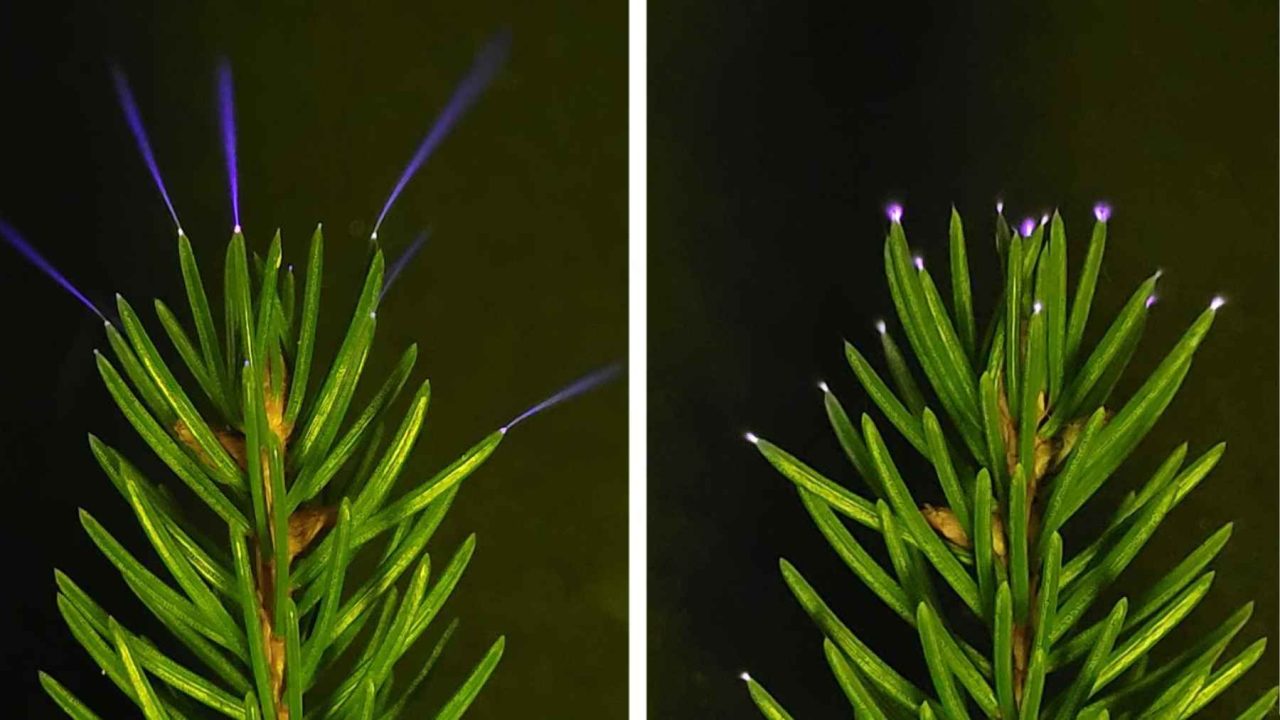
During a single thunderstorm in Pembroke, North Carolina, researchers captured 859 ultraviolet flashes on one sweetgum tree alone — electrical events completely invisible to the naked eye, flickering across the leaves and branches as lightning crackled overhead. Most people standing beneath that tree would have seen nothing unusual at all.
That finding, led by Penn State meteorologist Patrick McFarland, marks the first time scientists have documented these tiny electrical discharges — called “coronae” — occurring on real trees outdoors during an actual storm. It sounds like something from a science-fiction film. But it happened, it was recorded, and researchers are still working out what it means.
The short answer is this: forests may be quietly “lighting up” during thunderstorms far more often than anyone previously realized, and the implications for tree health and atmospheric chemistry remain largely unknown.
What Are Corona Discharges, and Why Does This Discovery Matter?
A corona discharge is a small, localized electrical event that occurs when the electric field around a pointed or curved surface — like the tip of a leaf — becomes strong enough to ionize the surrounding air. The result is a faint glow of light, mostly in the ultraviolet range, that the human eye simply cannot detect without specialized equipment.
These discharges are not lightning strikes. They are far smaller, far more frequent, and until now had never been systematically observed on trees in a natural outdoor setting during a live storm. McFarland’s team changed that by pointing an ultraviolet-sensitive camera at branches of a sweetgum tree and a nearby loblolly pine during a storm and simply watching what happened.
What they saw was striking. The flashes were real, they were numerous, and they behaved in ways that suggested the tree itself was playing an active role in the electrical environment of the storm — not just standing passively beneath it.
What the Cameras Actually Captured During the Storm
The research team monitored three branches of a sweetgum tree in Pembroke, North Carolina, over the course of approximately 90 minutes during a thunderstorm. Using ultraviolet-sensitive cameras, they identified 41 distinct corona events on those branches alone during that window.
Each individual flash lasted up to 3 seconds. Notably, the signals often appeared to hop from leaf to leaf as the branches swayed in the wind — suggesting that movement and the changing geometry of the tree in relation to the storm’s electric field both played a role in where and when the discharges appeared.
When researchers expanded their analysis to include every detectable event across the full tree, the numbers grew considerably larger.
| Tree / Location | Corona Events Recorded | Observation Period |
|---|---|---|
| Sweetgum tree (monitored branches) | 41 distinct events | ~90 minutes |
| Sweetgum tree (full count) | 859 corona events | Same storm |
| Nearby loblolly pine | 93 corona events | Same storm |
The difference between 41 and 859 on the same tree reflects how much activity was occurring across the entire canopy simultaneously — not just on the three branches the team was closely tracking. The loblolly pine’s 93 events suggest this phenomenon is not limited to one species or one location within the storm’s range.
The Part of This Story Most Reports Are Missing
Here is where the science gets genuinely uncertain — and genuinely interesting.
Researchers have documented that these ultraviolet flashes are real and widespread. What they have not yet determined is what these corona discharges actually do. Two major questions remain unanswered.
- Tree health: Do repeated corona discharges during storms cause any damage to leaves, bark, or the broader biology of the tree? Or are trees essentially unaffected by them?
- Atmospheric chemistry: Corona discharges ionize air. When this happens at the scale suggested by hundreds of events per tree per storm — multiplied across entire forests — could it be altering the chemical composition of the air in measurable ways?
Scientists note that forests cover enormous portions of the Earth’s surface and experience thunderstorms regularly. If every storm is triggering hundreds or thousands of these tiny electrical events across a forest canopy, the cumulative effect on local air chemistry could be significant. Or it could be negligible. Right now, no one knows.
Why Forests and Storms Are a More Complex System Than We Thought
This discovery adds a new layer to how scientists think about the relationship between vegetation and electrical storms. Trees are not simply tall objects that occasionally get struck by lightning. They are living electrical conductors embedded in a dynamic atmospheric environment, and their canopies — with thousands of pointed leaf tips — may be acting as natural sites for continuous low-level electrical activity during storms.
The fact that the flashes hopped between leaves as branches moved is particularly telling. It suggests the geometry of the tree — the way its shape changes moment to moment in the wind — directly influences where these discharges occur. A swaying branch is not just moving; it may be redirecting tiny bolts of ultraviolet electricity across the canopy in real time.
For atmospheric scientists, this opens up questions about how forests interact with the electrical fields generated by storms at a much finer scale than previously studied. For ecologists, it raises the possibility that trees are experiencing a form of electrical stress during storms that has simply gone undetected because it is invisible to human observers.
What Researchers Are Looking at Next
The Penn State team’s work represents a first step — outdoor, real-world confirmation that corona discharges on trees during storms are observable and documentable. The logical next phases of research would involve studying more tree species across different environments, measuring whether the discharges produce any detectable chemical byproducts in the surrounding air, and determining whether the intensity or frequency of these events varies with storm severity.
Similar activity was reported on other trees beyond the sweetgum and loblolly pine observed in this initial study, suggesting the phenomenon is not isolated to one region or one type of tree. Whether it is universal across forested areas during thunderstorms is a question that will likely drive the next round of research.
For now, the next time a storm rolls through a forest, something invisible is almost certainly happening in the canopy above — and science is only just beginning to see it.
Frequently Asked Questions
What is a corona discharge on a tree?
A corona discharge is a small electrical event that occurs when the electric field around a pointed surface — like a leaf tip — becomes strong enough to ionize the surrounding air, producing a faint ultraviolet glow invisible to the human eye.
Where did this research take place?
The outdoor observations were made during a thunderstorm in Pembroke, North Carolina, led by Penn State meteorologist Patrick McFarland and his team.
How many ultraviolet flashes were recorded during the storm?
Researchers identified 41 distinct corona events on monitored branches of a sweetgum tree over about 90 minutes, with a full count of 859 on the same tree and 93 on a nearby loblolly pine during the same storm.
Are these flashes dangerous to the trees?
This has not yet been confirmed. Whether repeated corona discharges cause any harm to tree health is one of the key unanswered questions the research raises.
Could this affect air quality or atmospheric chemistry?
Researchers have identified this as an open question. Corona discharges ionize air, and if they occur at scale across forests during storms, the cumulative chemical effect is unknown and requires further study.
Has this been observed on trees other than the sweetgum?
Yes — researchers also recorded 93 corona events on a nearby loblolly pine during the same storm, and similar activity was reported on additional trees, suggesting the phenomenon is not limited to one species.


Leave a Reply