
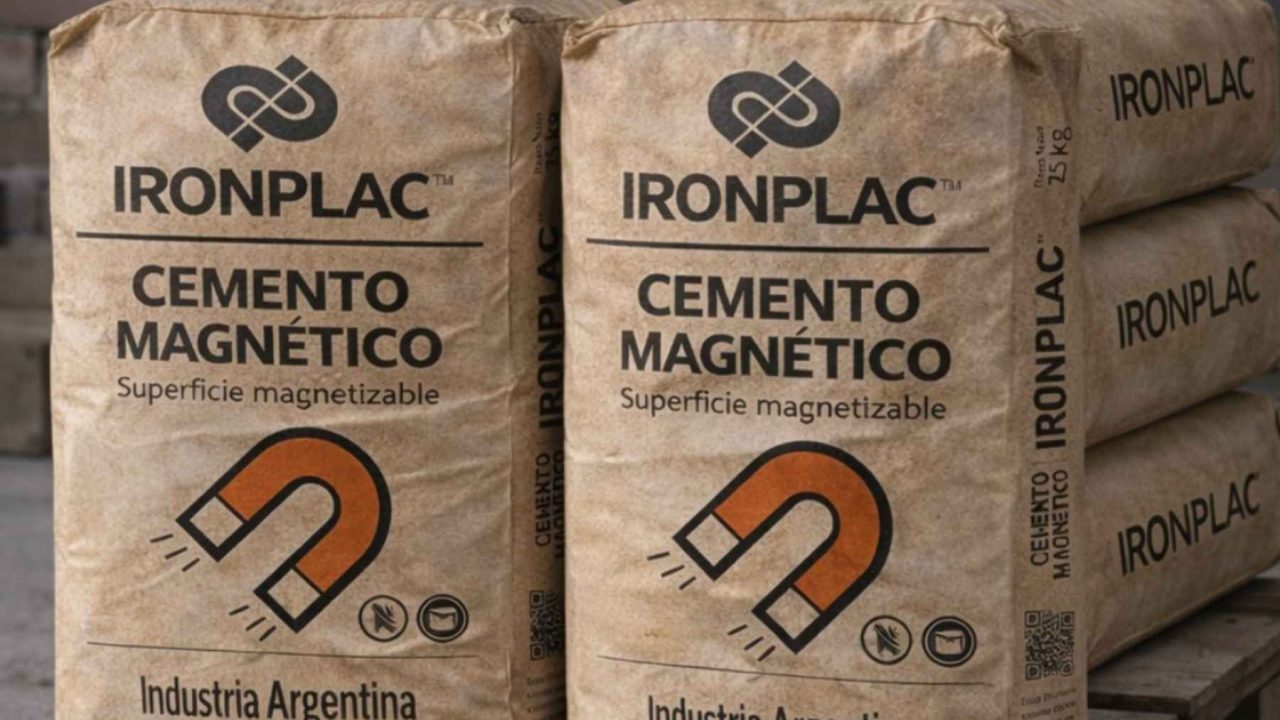
What if the walls in your home could hold a picture frame, a whiteboard, or a set of tools — no drill required, no dust on the floor, no patch job to deal with later? That is exactly the question Argentine inventor Marco Agustín Secchi is trying to answer with a material he calls Ironplac.
Secchi is 29 years old, and he has developed what he describes as a magnetizable building material — a construction system designed to turn ordinary walls into surfaces that can hold magnet-backed objects without a single nail or screw. Early pilot tests suggest the concept has real potential, though the product is still in development.
https://www.instagram.com/p/DTRLkcRjeWG/
The construction industry is not known for dramatic reinvention. Many of the materials and methods used to finish interior walls today would be recognizable to builders from several decades ago. Ironplac is an attempt to change that — not by replacing the entire system, but by adding a new capability to surfaces that have always been passive.
What Ironplac Actually Is
The core idea behind Ironplac is straightforward. Rather than treating a wall as a fixed, inert surface, the material is engineered to interact with magnets. Objects fitted with magnetic backing can be attached, removed, and repositioned without leaving any marks or damage behind.
According to its official channels, Ironplac is designed as a magnetizable construction system compatible with both wet and dry construction methods. That means it is intended to work alongside traditional plaster-style finishes — the kind applied in layers on masonry — as well as panel-based interior systems like drywall.
The material is described as compatible with cement, boards, and coatings. Crucially, it is presented as a solution for both new construction and existing walls, meaning homeowners would not necessarily need to be building from scratch to benefit from it.
The practical applications span a wide range of settings. Supporters of the concept point to homes, offices, workshops, and classrooms as environments where the ability to rearrange a wall’s contents quickly — without tools or permanent damage — could genuinely change how spaces are organized and used.
Why This Matters More Than a Novelty
It is easy to hear “magnetic wall” and think of a refrigerator surface scaled up to room size. But the ambition here goes further than decoration.
Consider what drilling into a wall actually involves: selecting the right bit, locating studs or using anchors, dealing with dust, and accepting that the hole will be there permanently even if your needs change. For renters, that process is often forbidden entirely. For homeowners, it is a commitment. For businesses reconfiguring office layouts or classrooms rearranging displays, it adds time and cost every single time something needs to move.
A magnetizable wall surface removes all of that friction. Objects go up when you want them, come down when you do not, and the wall itself stays intact throughout. That is not a minor convenience — it is a structural shift in how people could relate to their interior spaces.
The construction sector has seen significant innovation in areas like energy efficiency, structural engineering, and smart home technology. But the basic finishing layer of an interior wall — the surface people actually live and work against every day — has remained largely unchanged. Ironplac is targeting precisely that gap.
What the Material Is Designed to Do
| Feature | Detail |
|---|---|
| Inventor | Marco Agustín Secchi, age 29, Argentina |
| Product name | Ironplac |
| Core function | Magnetizable wall surface that holds magnet-backed objects |
| Compatible systems | Wet construction (plaster-style) and dry construction (panel-based) |
| Compatible materials | Cement, boards, and coatings |
| Application scope | New builds and existing walls |
| Development status | Early pilot tests completed; still in development |
- No drilling, wall anchors, or screws required for mounting objects
- Objects can be placed, removed, and repositioned freely
- Designed for homes, offices, workshops, and classrooms
- Aimed at transforming walls from passive surfaces into active, functional ones
Who Stands to Benefit From Magnetic Cement
The most immediate beneficiaries would be anyone who regularly mounts, moves, or removes things from walls. That is a broader group than it might initially seem.
Renters are an obvious category — people who cannot legally drill into their walls but still want to hang art, organize tools, or display things without relying on adhesive strips that fail or damage paint. A magnetizable wall finish would give them options they currently do not have.
For commercial spaces, the appeal is efficiency. Offices that reconfigure frequently, retail environments that change displays seasonally, schools that update classroom materials regularly — all of these settings involve repeated mounting and unmounting of wall-based content. Ironplac, if it performs as described, could reduce both the labor and the repair costs involved in those processes.
Workshops and maker spaces represent another natural fit. Organizing tools on a wall is a common practice, but it typically requires pegboards, hooks, and careful planning around fixed mounting points. A magnetic wall surface would allow that organization to evolve freely as needs change.
Where Ironplac Goes From Here
Secchi’s invention is still moving through its development phase. Early pilot tests have been described as encouraging, but Ironplac has not yet reached wide commercial availability. The product is being positioned for both new construction projects and retrofit applications in existing buildings, which would significantly expand its potential market if it reaches full deployment.
The construction industry tends to adopt new materials slowly — regulatory approval, contractor familiarity, and cost considerations all play a role in how quickly an innovation moves from promising prototype to standard practice. Whether Ironplac can clear those hurdles remains to be seen.
What is clear is that the concept addresses a real, everyday friction point that most people have simply accepted as unavoidable. Sometimes the most compelling innovations are not the ones that build something entirely new, but the ones that quietly fix something that has quietly annoyed people for years.
Frequently Asked Questions
Who invented Ironplac?
Ironplac was developed by Marco Agustín Secchi, a 29-year-old Argentine inventor.
What is Ironplac made of or designed to work with?
According to its official channels, Ironplac is designed to work with cement, boards, and coatings, and is compatible with both wet construction (plaster-style finishes) and dry construction (panel-based interior systems).
Can Ironplac be applied to existing walls, or only new construction?
The material is presented as suitable for both new builds and existing walls, though full details on retrofit application have not yet been confirmed publicly.
Is Ironplac available to buy right now?
The product is still in development. Early pilot tests have been conducted, but wide commercial availability has not been confirmed.
What kinds of spaces is Ironplac designed for?
The system is intended for homes, offices, workshops, and classrooms — any environment where the ability to mount and rearrange objects without drilling would be useful.
Does Ironplac replace standard wall materials entirely?
Based on available information, Ironplac is designed to work alongside existing construction systems as a finish or coating layer, not as a complete replacement for standard building materials.




Leave a Reply