
There is exactly one sea on Earth that has no coastline whatsoever — no beaches, no cliffs, no land of any kind forming its boundary. Instead, the Sargasso Sea is held in place entirely by ocean currents, making it one of the most unusual and scientifically fascinating bodies of water on the planet.
Located roughly 590 miles east of Florida in the North Atlantic, the Sargasso Sea defies the basic definition most people hold of what a “sea” actually is. And the stranger you look at it, the more remarkable it becomes.
It is not just a geographic curiosity. Scientists and conservation groups have identified this current-bound body of water as a critical nursery for young ocean life — while also flagging it as a place where human-made pollution tends to concentrate in troubling ways.
The Sea That Ocean Currents Built
Most seas are defined by the land surrounding them. The Mediterranean has southern Europe and North Africa. The Caribbean has its island chains. But the Sargasso Sea has none of that. Its borders are entirely made of moving water.
The sea is enclosed by the North Atlantic subtropical gyre, a large clockwise loop of major ocean currents that naturally concentrates whatever is floating on the surface. Think of it as a slow, enormous whirlpool — not violent, but persistent, and always pulling material inward.
Because of that circular motion, the water inside the gyre sits noticeably calmer than the surrounding Atlantic. Sailors who have crossed into the Sargasso have described the shift as almost eerie — the surface turning glassy, the chop fading, the whole ocean seeming to hold its breath.
That stillness has a name, and it floats.
What Makes the Sargasso Sea Look Like Nothing Else on Earth
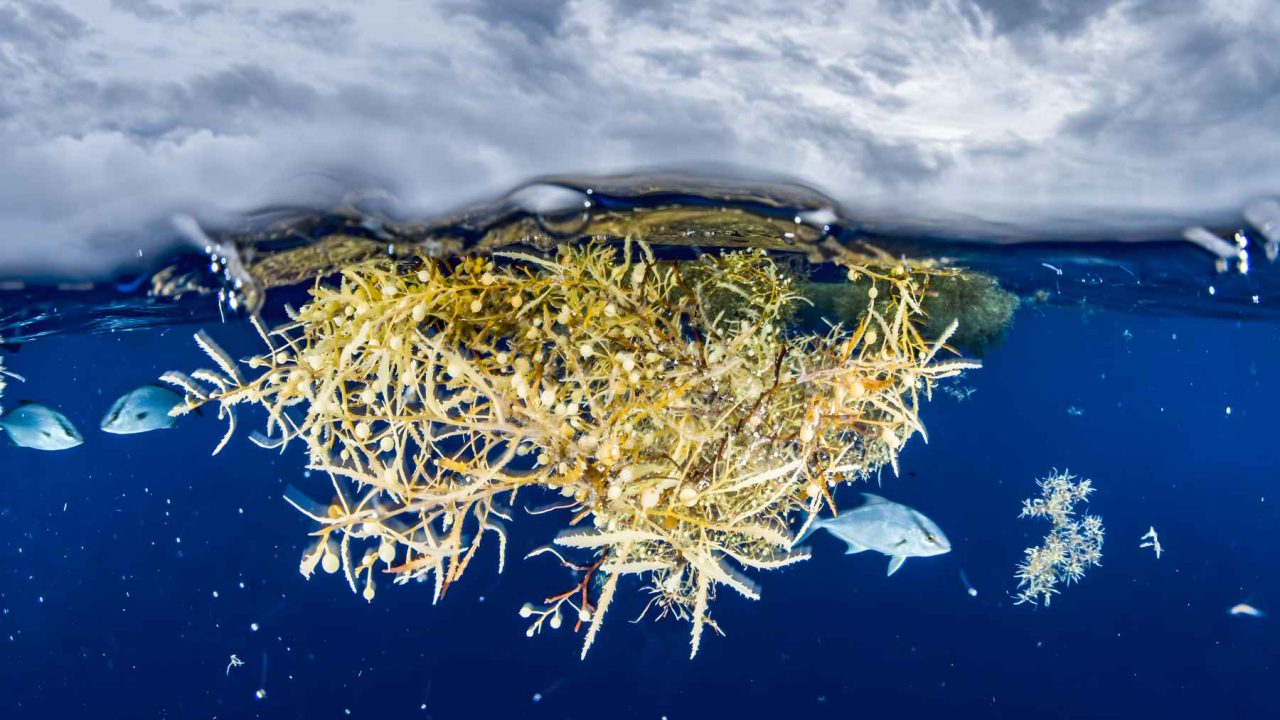
The sea takes its name from Sargassum, a golden-brown seaweed that drifts across its surface in sprawling mats. Unlike most seaweed, which anchors itself to rocks or the seafloor, Sargassum is entirely free-floating. It stays buoyant thanks to tiny gas-filled bladders that act like miniature life preservers, keeping the plant at the surface indefinitely.
These drifting mats can grow dense enough to look like floating forests from above — a patchwork of amber and brown stretching across an otherwise blue expanse. They are not just visually striking. They are ecologically essential.
Conservation researchers have identified the Sargassum mats as a nursery habitat for juvenile ocean life. Young fish, sea turtles, and other marine creatures use the floating seaweed as shelter, feeding ground, and protection from predators during vulnerable early stages of life.
Without the gyre holding the Sargassum in place, that nursery would not exist in any stable form.
Key Facts About the Sargasso Sea at a Glance
| Feature | Detail |
|---|---|
| Location | North Atlantic Ocean, approximately 590 miles east of Florida |
| Border type | Ocean currents, not land |
| Boundary mechanism | North Atlantic subtropical gyre (clockwise current loop) |
| Named after | Sargassum, a free-floating golden-brown seaweed |
| Seaweed buoyancy method | Tiny gas-filled bladders within the plant |
| Ecological role | Nursery habitat for juvenile marine life |
| Known environmental threat | Plastic and other pollutants concentrated by the same gyre |
- The Sargasso Sea is the only sea on Earth defined entirely by ocean currents rather than land boundaries
- Its surface is calmer than surrounding Atlantic waters due to the gyre’s stabilizing effect
- Sargassum seaweed floats indefinitely, never needing to anchor to the seafloor
- The same currents that create and protect the Sargasso also funnel pollution into it
The Double-Edged Nature of This Current-Bound Sea
Here is where the story turns complicated. The same gyre that makes the Sargasso Sea possible — that concentrates the seaweed, calms the surface, and creates a stable nursery — also concentrates everything else floating in the North Atlantic.
That includes plastic.
Scientists and conservation groups have noted that the circular current system funnels debris inward along with the Sargassum, turning the sea into a trap for marine pollution as much as a haven for marine life. The result is a region under pressure from two directions at once: valued for its ecological role, threatened by the very mechanism that defines it.
This dual reality makes the Sargasso Sea something more than a geography oddity. It sits at the center of broader conversations about how ocean circulation shapes both ecosystems and pollution patterns — and what the long-term health of the North Atlantic actually depends on.
Why This Place Deserves More Attention Than It Gets
The Sargasso Sea rarely makes headlines. It has no country claiming it, no port city built on its edge, no beaches drawing tourists. Its borders shift with the currents. It exists, in a sense, outside the normal frameworks humans use to divide and manage the ocean.
That borderless quality has made governance difficult. Conservation advocates have long argued that the sea’s unique status — belonging to no single nation — requires international cooperation to protect it effectively. The floating nurseries within it support species that migrate across vast stretches of ocean, meaning the sea’s health ripples outward far beyond its invisible boundaries.
What happens inside those current-drawn walls does not stay there. It travels — in the bellies of fish, on the backs of sea turtles, and unfortunately, in the slow drift of plastic that the gyre keeps circling back in.
Frequently Asked Questions
What makes the Sargasso Sea different from every other sea on Earth?
It is the only sea on the planet with no land borders — its boundaries are formed entirely by the North Atlantic subtropical gyre, a clockwise system of ocean currents.
Where exactly is the Sargasso Sea located?
It sits in the North Atlantic Ocean, roughly 590 miles east of Florida.
Why is Sargassum seaweed able to float without attaching to anything?
Sargassum contains tiny gas-filled bladders that keep it permanently buoyant at the ocean’s surface, with no need to anchor to rocks or the seafloor.
Why is the Sargasso Sea considered ecologically important?
The drifting mats of Sargassum seaweed serve as a nursery habitat for juvenile marine life, providing shelter and feeding grounds during vulnerable early life stages.
Is the Sargasso Sea threatened by pollution?
Yes — the same gyre that defines and stabilizes the sea also concentrates floating debris, including plastic, funneling pollution into the region alongside the seaweed.
Which country is responsible for protecting the Sargasso Sea?
Because the sea has no land borders and belongs to no single nation, this has not been definitively resolved — conservation advocates argue it requires coordinated international protection.




Leave a Reply