
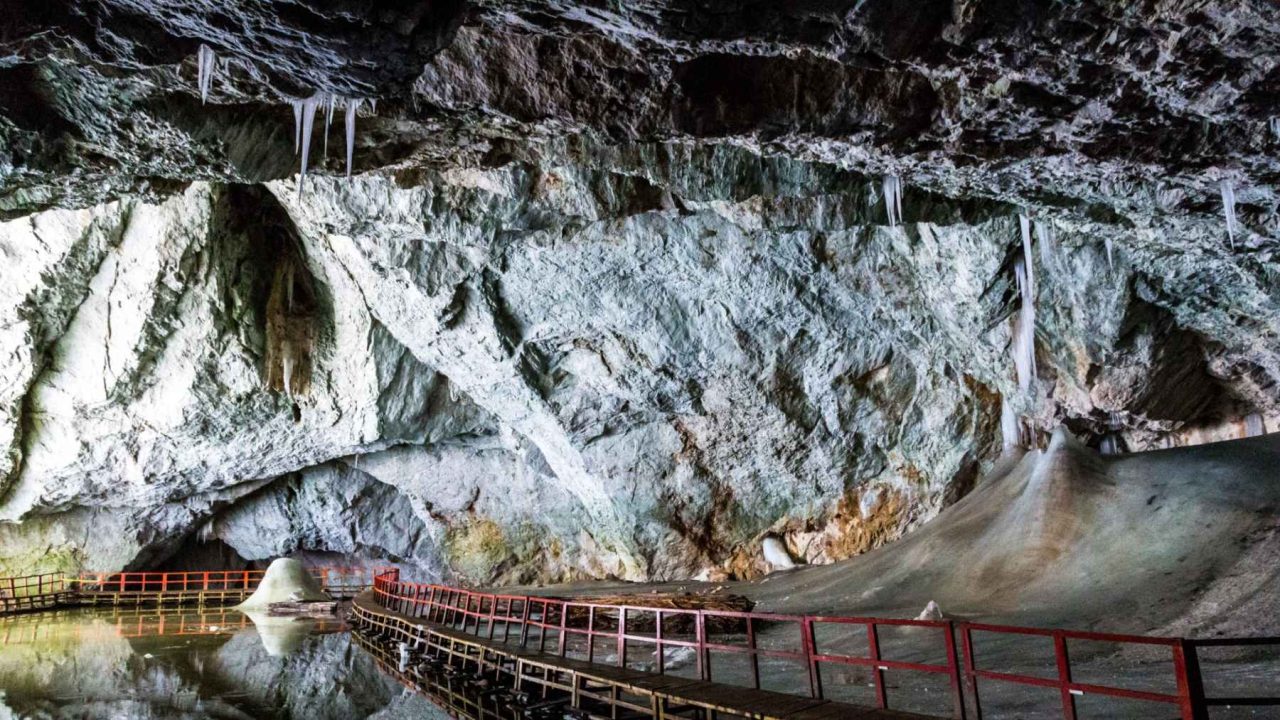
A bacterium frozen in a Romanian ice cave for roughly 5,000 years was recently revived in a laboratory — and it already knew how to resist ten modern antibiotics, none of which existed when it was alive. That finding, published in February 2026, is forcing scientists to rethink one of the most dangerous assumptions in medicine: that antibiotic resistance is something humans created.
We didn’t. Nature had a head start of several millennia.
The discovery centers on a strain called Psychrobacter SC65A.3, pulled from an ice layer estimated to date back to around 3000 BC. In lab tests, it resisted ten modern antibiotics — drugs developed by humans in the twentieth century — without any prior exposure to them. The implications reach far beyond one ancient microbe.
A Frozen Archive Older Than the Pyramids
The bacterium didn’t come from a glacier or a permafrost dig in Siberia. It came from Scarisoara Ice Cave in Romania, a place where ice has been accumulating in near-total darkness for thousands of years. Researchers drilled an ice core roughly 82 feet long — about 25 meters — from a section of the cave known as the Great Hall.
That core acts like a layered timeline. The deeper you go, the older the ice. The full core covers approximately 13,000 years of frozen history, making it one of the more remarkable natural archives scientists have access to for studying ancient microbial life.
Getting useful samples out of something like that is harder than it sounds. Any contact with modern air, surfaces, or equipment can introduce contemporary bacteria and completely corrupt the results. The team handled the ice under sterile conditions, kept it sealed during transport, and maintained it frozen until it reached the laboratory. Only then did they begin isolating living strains from the 5,000-year-old layer.
What the Ancient Bacterium Was Already Carrying
Once isolated, Psychrobacter SC65A.3 was tested against a panel of modern antibiotics. The results were striking. The bacterium resisted ten of them — not because it had evolved in response to human medicine, but because the biological tools for resistance were already built into its makeup thousands of years before the first antibiotic was synthesized.
This matters enormously. The standard narrative around antibiotic resistance tends to frame it as a consequence of overuse — too many prescriptions, too much agricultural application, bacteria evolving to survive what we throw at them. That story is true, but it’s incomplete. This discovery shows that resistance mechanisms are not purely a reaction to human behavior. They are ancient features of microbial biology.
| Detail | Confirmed Finding |
|---|---|
| Bacterium name | Psychrobacter SC65A.3 |
| Estimated age of ice layer | Approximately 5,000 years (circa 3000 BC) |
| Number of antibiotics resisted | 10 modern antibiotics |
| Source location | Scarisoara Ice Cave, Romania |
| Ice core length | ~82 feet (25 meters) |
| Total ice archive span | Approximately 13,000 years |
| Study publication date | February 17, 2026 |
Why This Changes the Way Scientists Think About Resistance
For decades, the working assumption has been that antibiotic resistance genes spread primarily because of selective pressure — meaning bacteria that survive drug exposure pass on their resistance. Reduce the drugs, reduce the resistance. That logic still holds in many contexts.
But Psychrobacter SC65A.3 complicates it. If resistance mechanisms existed 5,000 years ago, before any human-made antibiotic existed, then at least some of what we are fighting today has roots in natural microbial chemistry that long predates us. The genes may have originally served entirely different biological functions — competing with other microbes in soil or ice environments, for instance — and only later turned out to be useful against the drugs humans invented.
Researchers note that this finding also hints at a potential upside. Understanding ancient, naturally occurring resistance mechanisms could offer new insight into how bacteria defend themselves at a molecular level — and that knowledge could eventually inform the development of treatments designed to work around those defenses rather than simply overpower them.
The Part of This Story Most Reports Are Missing
There is something easy to overlook in the headlines about this discovery: the bacterium was not just old — it was alive. Scientists isolated living strains from ice that had been frozen for five millennia. That alone says something remarkable about the resilience of microbial life.
It also raises questions about what else might be preserved in ancient ice. As glaciers and permafrost continue to thaw globally, microbes that have been sealed away for thousands — or even millions — of years are being released into environments they have never encountered in their biological history. Some may carry resistance profiles we have never catalogued. Some may be entirely unknown.
The Scarisoara cave core, with its 13,000-year span, represents a controlled version of that process — one where scientists can study what emerges carefully, under sterile conditions, rather than encountering it in the wild.
What Comes Next for This Research
The study published in February 2026 establishes the resistance profile of Psychrobacter SC65A.3, but the deeper work is still ahead. Scientists will need to identify the specific genes responsible for resistance in this ancient strain and determine how closely they resemble the resistance genes circulating in modern bacterial populations.
If the genetic mechanisms match — or closely resemble — those found in contemporary drug-resistant pathogens, it would confirm that resistance is not just an artifact of modern medicine but a persistent, ancient feature of microbial life that we are only beginning to map.
The broader implication is that the fight against antibiotic resistance may require a more historical lens than medicine has previously applied — one that looks backward into frozen archives as well as forward into new drug development.
Frequently Asked Questions
What is Psychrobacter SC65A.3?
It is an ancient bacterial strain recovered from a 5,000-year-old ice layer in Scarisoara Ice Cave in Romania, found to be resistant to ten modern antibiotics in laboratory testing.
How did scientists make sure the sample wasn’t contaminated by modern bacteria?
The ice was handled under sterile conditions, kept sealed during transport, and maintained frozen until it reached the laboratory to prevent any contact with modern microbes.
Does this mean antibiotic resistance isn’t caused by overuse of drugs?
Not exactly — overuse still drives the spread of resistance. But this discovery shows that resistance mechanisms existed in nature thousands of years before modern antibiotics were developed, meaning the problem has ancient roots beyond human behavior alone.
Could thawing ice and permafrost release other ancient resistant bacteria?
Is there any potential benefit to this discovery?
Researchers note that understanding ancient resistance mechanisms could eventually help scientists develop treatments designed to work around those defenses, offering a new angle on tackling drug resistance.
When was this study published?
The study was published on February 17, 2026.

Leave a Reply