
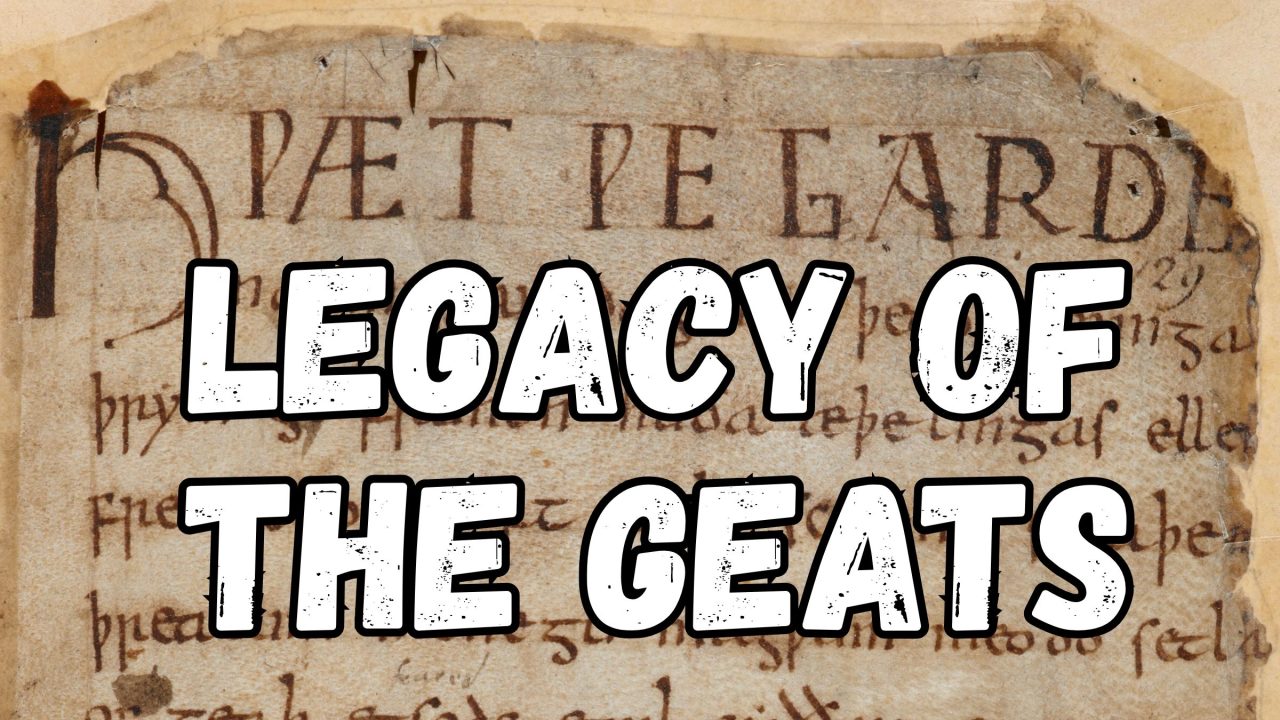
What happens to a people when history declares them finished? According to the final verses of Beowulf, the answer is grim: annihilation or absorption, swallowed whole by a stronger neighbor. But the story of the Geats — Beowulf’s own tribe — turns out to be far more complicated, and far more enduring, than the poem’s bleak epilogue suggests.
The question of who the Geats actually were, and where they lived, has occupied scholars for well over a century. Their identity sits at the crossroads of archaeology, linguistics, and medieval literature — and the debate is nowhere near settled. What is clear is that the memory of Beowulf’s people has not simply vanished. Depending on which scholarly thread you follow, it may still be very much alive in modern Sweden.
Written in Old English, Beowulf depicts events set in 6th-century Scandinavia. The poem is one of the oldest and most studied works of medieval literature in the English language — yet some of its most basic historical questions remain fiercely contested.
What the Poem Actually Says About the Geats’ Fate
Near the end of Beowulf, after the great hero dies in battle against a dragon, a member of his retinue delivers a chilling warning. The passage, quoted directly in the source scholarship, reads:
“So this bad blood between us and the Swedes, / this vicious feud, I am convinced, / is bound to revive; they will cross our borders / and attack in force when they find out / that Beowulf is dead…”
The implication is devastating. Without Beowulf to hold them together, the Geats face Swedish expansion, military defeat, and eventual erasure as a distinct people. The poem foreshadows their doom with unusual specificity — either elimination outright, or absorption into a Swedish dominion that has no interest in preserving Geatish identity.
But scholars argue this literary ending should not be mistaken for historical fact. The poem is not a chronicle. Its author — or authors — shaped the narrative with dramatic intent, and the fate of the Geats as a real historical group may have unfolded very differently from what the verses suggest.
The Long Debate Over Who the Geats Really Were
Identifying the Geats has never been straightforward. Theories have multiplied across generations of scholarship, and several have risen and fallen in academic credibility over the past 150 years.
One of the most notable false starts came in the late 19th and early 20th centuries, when Swedish intellectuals promoted the idea that Beowulf himself was a Jute — a member of the Jutish people from the Jutland peninsula in what is now Denmark. That theory has since been discredited by the broader scholarly community, though it serves as a reminder of how politically and nationally charged these debates can become.
Scholars have also raised the possibility that the Geats depicted in the poem may not correspond neatly to any single real-world tribe. The Geats of Beowulf could, in theory, represent an amalgamation or conflation of existing groups — whether through the poet’s misunderstanding, deliberate artistic choice, or the natural blurring that occurs when oral traditions pass through generations before being written down.
What Survives in Modern Sweden — and Why It Matters
Despite centuries of uncertainty, the identity of the Geats as a people distinct from the Swedes most likely survived — at least for some period after the events the poem describes. More strikingly, that identity remains conceptually alive in Sweden today, depending on which strand of the philological evidence one follows.
This is not a trivial point. It means that a tribe once declared doomed in a medieval poem may have left a genuine cultural and linguistic imprint that persisted long enough to be traceable in the modern era. The Geats are not simply a literary invention that faded with the manuscript — they represent a real historical community whose legacy is still being excavated by researchers.
The philological evidence — the study of language, texts, and their historical development — is described in the source scholarship as something of a “quagmire.” There is no single clean answer. But the scholarly consensus leans toward the Geats having a real geographic homeland and a real cultural continuity that the poem’s tragic ending does not fully account for.
Key Points in the Geats Debate at a Glance
| Topic | Detail |
|---|---|
| Poem’s setting | 6th-century Scandinavia |
| Language of Beowulf | Old English |
| Discredited theory | Late 19th/early 20th-century claim that Beowulf was a Jute from Jutland, Denmark |
| Promoted by | Swedish intellectuals of that era |
| Current scholarly status | Jute theory now discredited |
| Geatish identity today | Considered conceptually alive in modern Sweden by some scholars |
| Key scholarly challenge | Philological evidence described as a “quagmire” with no single clear answer |
Why This Story Reaches Beyond the Medieval Classroom
It would be easy to treat this as a niche academic argument — the kind of thing that matters only to specialists in Old English or Scandinavian archaeology. But the questions at the heart of the Geats debate are surprisingly universal.
How do peoples survive conquest, absorption, or political erasure? When does a community stop existing as a distinct group — and who gets to decide? These are questions that echo far beyond the 6th century. The Geats’ story, as scholars are still piecing it together, is a case study in how identity persists even when empires say it shouldn’t.
The fact that Geatish identity may still be traceable in modern Sweden — more than 1,400 years after the events Beowulf describes — suggests that the poem’s grim epilogue was, at the very least, premature.
What Researchers Are Still Working to Resolve
The debate is ongoing. Scholars continue to wrestle with the geographic location of the Geats’ homeland, the relationship between the literary Geats and real historical tribes, and the extent to which the poem’s account reflects actual 6th-century political dynamics rather than poetic license.
The possibility that the Geats were a composite or conflated people — assembled by the poet from fragments of multiple real groups — has not been ruled out. That uncertainty is part of what keeps the field active and genuinely contested.
What researchers broadly agree on is that dismissing the Geats as pure fiction, or accepting the poem’s ending as historical record, would both be mistakes. The truth, as usual, is more interesting than either extreme.
Frequently Asked Questions
Who were the Geats in Beowulf?
The Geats were the tribe of the hero Beowulf in the Old English poem of the same name. The poem depicts them as a Scandinavian people living in the 6th century, distinct from the neighboring Swedes.
What does Beowulf say happens to the Geats after his death?
A member of Beowulf’s retinue warns that the Swedes will revive their feud and attack, implying the Geats face either destruction or absorption into Swedish dominion.
Were the Geats a real historical people?
Most scholars believe the Geats were based on a real historical group, though the exact identification of that group remains debated and the philological evidence is complex.
What was the discredited Jute theory?
In the late 19th and early 20th centuries, some Swedish intellectuals argued that Beowulf was a Jute from the Jutland peninsula in modern Denmark. This theory has since been discredited by mainstream scholarship.
Does Geatish identity survive in modern Sweden?
According to current scholarship, Geatish identity as a concept distinct from Swedish identity is considered to remain alive in Sweden today, depending on which strand of philological evidence one follows.
Could the Geats have been a fictional or composite people?
Scholars have not ruled out the possibility that the Geats in the poem represent an amalgamation or conflation of real tribes, whether through poetic invention or the natural drift of oral tradition over time.


Leave a Reply