
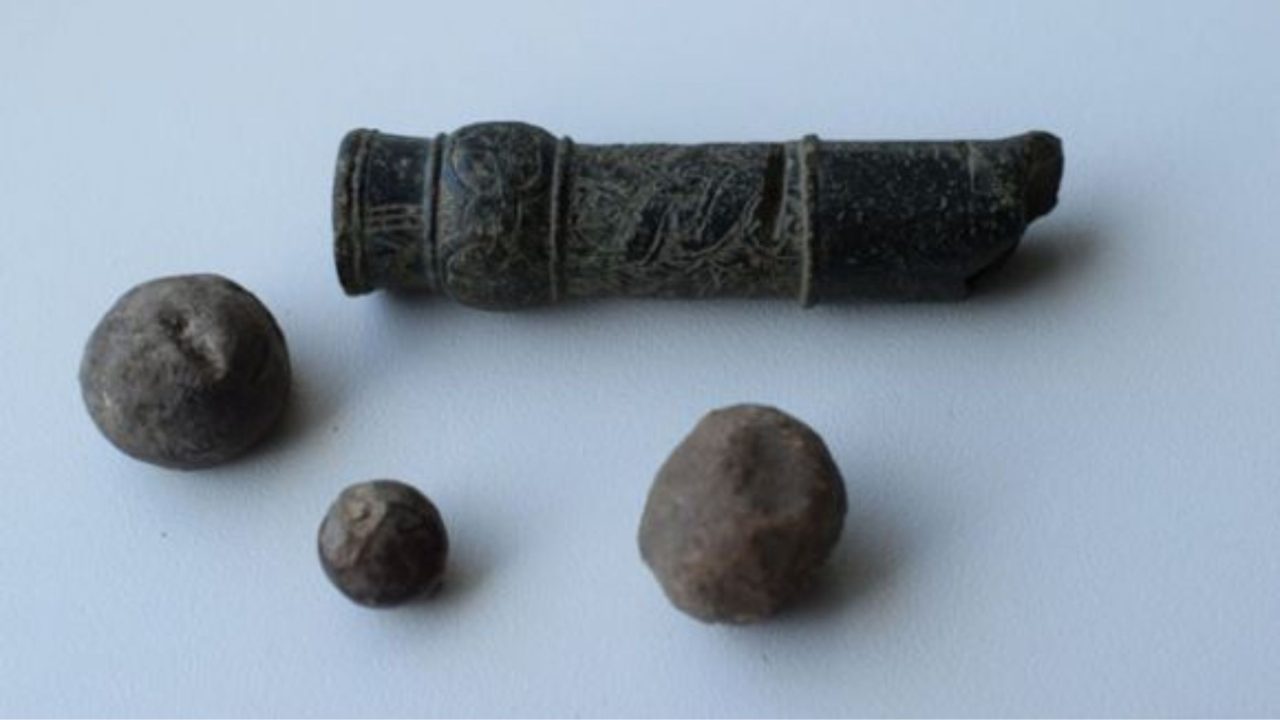
A tiny bronze fragment, just six centimetres long, could rewrite what we know about the history of handheld firearms in Europe. Archaeologists in northern Germany believe the object — now known as the Kletzke Hand Cannon — may date to around 1390, potentially making it older than the weapon currently recognised as the world’s oldest securely dated portable firearm.
That title has long belonged to the Tannenberg handgonne, held at the Germanisches Nationalmuseum in Nuremberg and dated to 1399. If the Kletzke fragment’s dating holds up under further scrutiny, it could push the known history of hand-held firearms back by nearly a decade — a significant shift in how historians understand the early spread of gunpowder weapons across medieval Europe.
The find was presented to specialists last month at the annual conference of the State Archaeology Department in Brandenburg an der Havel, drawing considerable attention from researchers focused on medieval military technology.
How the Kletzke Hand Cannon Was Found
The fragment was unearthed in 2023 during a systematic field survey carried out by the Lower Monument Protection Authority of Prignitz, a district in the state of Brandenburg. It was Matthias Dasse, a volunteer archaeological conservator, who physically recovered the object during that survey.
After the initial find, Gordon Thalmann, head of the monument authority, examined the bronze casting and identified it as part of an early firearm. That identification set off a chain of closer analysis that eventually brought the fragment to the attention of specialists at the Brandenburg an der Havel conference.
The piece appears to be the front portion of a medieval hand cannon. Despite its small size, it carries ornamental details — a feature that suggests it was crafted with some degree of care and skill, consistent with the kind of metalwork seen in other high-status objects from the late fourteenth century.
What Makes This Discovery So Significant
The Tannenberg handgonne is not just famous — it occupies a unique place in the history of weapons. Discovered in 1849 in the cistern of Burg Tannenberg in southern Hesse, it is widely regarded as the oldest surviving firearm in the world that can be dated with certainty. Its date of 1399 is considered secure, which is why it has served for so long as the benchmark for early portable firearms.
The Kletzke fragment, if its proposed date of around 1390 is confirmed, would be slightly earlier. That gap of roughly nine years might sound modest, but in the context of medieval archaeology — where securely dated objects from this period are exceptionally rare — it carries real weight.
Archaeologists are careful to note that the Kletzke date is not yet considered certain in the same way the Tannenberg date is. Further analysis will be needed before any firm conclusions can be drawn. Still, the possibility alone is enough to make this one of the more talked-about recent finds in medieval military archaeology.
Key Facts About Both Firearms at a Glance
| Detail | Kletzke Hand Cannon | Tannenberg Handgonne |
|---|---|---|
| Proposed / Confirmed Date | Around 1390 (proposed) | 1399 (securely dated) |
| Location Found | Northern Germany (Prignitz) | Burg Tannenberg, southern Hesse |
| Year Discovered | 2023 | 1849 |
| Current Status | Under specialist review | Held at Germanisches Nationalmuseum, Nuremberg |
| Fragment Size | Approximately 6 centimetres | Not specified in source |
| Material | Bronze | Not specified in source |
- The Kletzke fragment appears to be the front portion of a hand cannon
- It features ornamental details, suggesting skilled craftsmanship
- It was found during a systematic field survey, not a chance discovery
- The find was formally presented at the State Archaeology Department conference in Brandenburg an der Havel
Why This Matters Beyond the History Books
Finds like this one matter because they shift the physical evidence for how and when certain technologies moved across Europe. Hand cannons were among the earliest portable firearms — precursors to the pistols and rifles that would eventually transform warfare, law enforcement, and civilian life for centuries to come.
Understanding exactly when and where these weapons first appeared helps historians piece together the broader story of how medieval societies adapted to gunpowder technology. Each new securely dated example adds another data point to a picture that, even now, remains incomplete.
For the Prignitz region specifically, the discovery also carries local significance. It suggests that this part of northern Germany — not typically associated with cutting-edge medieval military technology — may have had earlier access to firearms than previously assumed.
The role of volunteer conservators like Matthias Dasse in making this kind of discovery is also worth noting. Systematic field surveys carried out with the involvement of trained volunteers have repeatedly produced finds that professional excavations might never have uncovered, simply due to the scale of ground that needs to be covered.
What Happens Next for the Kletzke Fragment
The fragment’s presentation at the Brandenburg an der Havel conference was an early step in what will likely be a longer process of analysis and verification. For the proposed date of around 1390 to carry the same weight as the Tannenberg handgonne’s 1399 date, specialists will need to subject the piece to more rigorous examination.
That process typically involves metallurgical analysis, stylistic comparison with other dated objects, and a careful look at the archaeological context in which the piece was found. The ornamental details on the fragment may prove particularly useful, since decorative styles can sometimes be cross-referenced with other datable objects from the same period.
Until that work is complete, the Kletzke Hand Cannon remains a compelling candidate for the title of Europe’s oldest known portable firearm — but not yet a confirmed one. Researchers will be watching closely as the analysis continues.
Frequently Asked Questions
What is the Kletzke Hand Cannon?
It is a small bronze fragment, approximately six centimetres long, believed to be the front portion of a medieval hand cannon. It was found in northern Germany in 2023 and may date to around 1390.
Who found the Kletzke fragment?
Matthias Dasse, a volunteer archaeological conservator, discovered the object during a systematic field survey conducted by the Lower Monument Protection Authority of Prignitz.
What is the Tannenberg handgonne and why does it matter here?
The Tannenberg handgonne, held at the Germanisches Nationalmuseum in Nuremberg and dated to 1399, is currently recognised as the oldest surviving firearm in the world that can be dated with certainty. The Kletzke fragment, if its proposed date of around 1390 is confirmed, could be slightly older.
Is the Kletzke Hand Cannon’s date confirmed?
Not yet. The date of around 1390 has been proposed by specialists, but further analysis will be required before it can be considered as securely dated as the Tannenberg handgonne.
Where was the discovery formally announced?
The artifact was presented to specialists at the annual conference of the State Archaeology Department in Brandenburg an der Havel.
What happens to the fragment now?
Further specialist analysis is expected, including examination of its metallurgy and ornamental details, to help confirm or refine the proposed date. This has not yet been completed or confirmed in available reporting.



Leave a Reply