
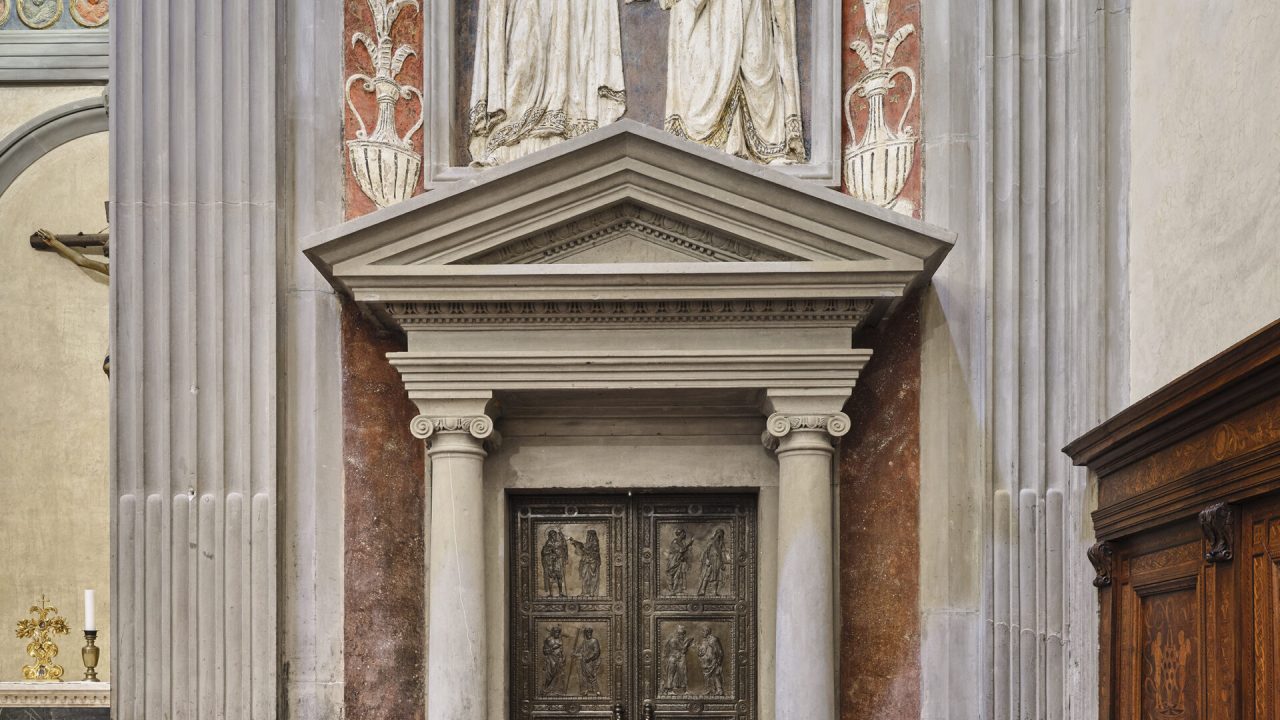
Five hundred and eighty years after they were cast, two of Donatello’s most ambitious bronze works are back where they belong — and the public can finally see them again. The Door of the Martyrs and the Door of the Apostles, created by the Renaissance master between approximately 1440 and 1442, have been reinstalled in the Old Sacristy of the Basilica of San Lorenzo in Florence following an extensive restoration project.
The return of these doors is not a minor footnote in art history. Commissioned by the Medici family at the height of their power and influence, the doors represent some of the most technically sophisticated bronze work produced during Donatello’s mature career. For anyone who cares about Renaissance art — or about what five centuries of craftsmanship actually looks like up close — this is a significant moment.
https://www.instagram.com/reel/DVb1cMeDZPC/
The doors were presented to the public last month, marking the end of a restoration effort that brought renewed attention to one of Florence’s most treasured, and sometimes overlooked, artistic monuments.
What Makes Donatello’s Bronze Doors So Remarkable
To understand why these doors matter, it helps to understand how they were made and what they were meant to do.
Each door was cast using the lost-wax technique — a demanding process in which a wax model is encased in a ceramic mold, melted away, and replaced with molten bronze. The result allows for an extraordinary level of surface detail, far beyond what carving alone could achieve. In the fifteenth century, mastering this method was a mark of the highest artistic ambition.
The panels are arranged as large relief compositions set within an architectural framework. Ionic columns support an entablature topped with a triangular pediment, giving each door the appearance of a miniature sculptural altarpiece. The design is both monumental and intimate — imposing in structure, yet detailed enough to reward close inspection.
Each door contains five large compartments, and each compartment depicts a pair of saints. The figures are not randomly chosen. Every selection reflects the religious and political priorities of the family that paid for them.
The Medici Connection — Why These Saints Were Chosen
The Medici family commissioned the doors, and their fingerprints are all over the iconography. The Door of the Martyrs includes saints such as Stephen, Lawrence, Cosmas, and Damian. The last two — Cosmas and Damian — were the patron saints of the Medici dynasty and appeared repeatedly across their artistic commissions throughout the fifteenth century. Their inclusion here was a deliberate act of dynastic branding as much as religious devotion.
The Door of the Apostles takes a broader theological scope. Its figures include John the Baptist, along with the Evangelists and the Fathers of the Church — a gathering of foundational Christian figures that would have carried enormous weight for fifteenth-century viewers.
Some figures across both doors have been identified with certainty by scholars. Others remain subjects of ongoing discussion, a reminder that even well-studied Renaissance works still hold open questions.
A Closer Look at What Each Door Contains
| Door | Theme | Identified Figures | Approximate Date |
|---|---|---|---|
| Door of the Martyrs | Martyred saints, Medici patrons | Stephen, Lawrence, Cosmas, Damian | c. 1440–1442 |
| Door of the Apostles | Apostles, Evangelists, Church Fathers | John the Baptist, Evangelists, Fathers of the Church | c. 1440–1442 |
- Both doors were cast using the lost-wax bronze technique
- Each door features five large compartments, each showing a pair of saints
- Architectural framing includes Ionic columns, an entablature, and a triangular pediment
- The doors are located in the Old Sacristy of the Basilica of San Lorenzo, Florence
- Cosmas and Damian, depicted on the Door of the Martyrs, were the Medici family’s patron saints
Why the Restoration Matters Beyond Florence
Restoration projects of this scale do more than clean old surfaces. They generate new technical knowledge about how Renaissance artists actually worked — what alloys they used, how they finished surfaces, where they made adjustments after casting. That information feeds into how conservators approach similar objects around the world.
The Opificio delle Pietre Dure, one of Italy’s leading conservation institutions, was involved in the restoration work. Their documentation of the process adds to a growing body of scientific understanding about Donatello’s bronze-working methods specifically.
For visitors to Florence, the reinstallation means that the Old Sacristy of San Lorenzo — already one of the most architecturally significant spaces in the city, designed by Filippo Brunelleschi — is now more complete than it has been in years. The doors were always part of that space. Seeing them back in position, in the context for which Donatello designed them, is a fundamentally different experience than viewing them in a conservation facility or a museum gallery.
What Comes Next for These Doors
With the restoration complete and the doors reinstalled, attention now turns to public access and continued scholarly study. The Basilica of San Lorenzo is an active site — both a functioning church and one of Florence’s major cultural destinations — so the doors will be visible to the tens of thousands of visitors who pass through the space each year.
Researchers are likely to continue working through questions of iconographic identification, particularly for figures that have not yet been confirmed with certainty. Restoration documentation often prompts new academic analysis, and the detailed technical records produced during conservation work frequently open new lines of inquiry about dating, workshop practice, and artistic intent.
For now, after more than half a millennium and an extensive modern restoration, Donatello’s bronze doors are home.
Frequently Asked Questions
When were Donatello’s bronze doors at San Lorenzo created?
The Door of the Martyrs and the Door of the Apostles were created by Donatello between approximately 1440 and 1442.
Who commissioned the doors?
The doors were commissioned by the Medici family, who were major patrons of the arts in fifteenth-century Florence.
Where are the doors now located?
Both doors have been reinstalled in the Old Sacristy of the Basilica of San Lorenzo in Florence, their original setting.
What technique did Donatello use to make the doors?
Donatello used the lost-wax casting technique, a sophisticated method that allows for highly detailed bronze relief work.
Which saints appear on the doors?
The Door of the Martyrs includes Stephen, Lawrence, Cosmas, and Damian. The Door of the Apostles includes John the Baptist, the Evangelists, and the Fathers of the Church, among others.
Why were Cosmas and Damian specifically included?
Cosmas and Damian were the patron saints of the Medici family and appeared frequently across Medici-commissioned artworks throughout the fifteenth century.

Leave a Reply