
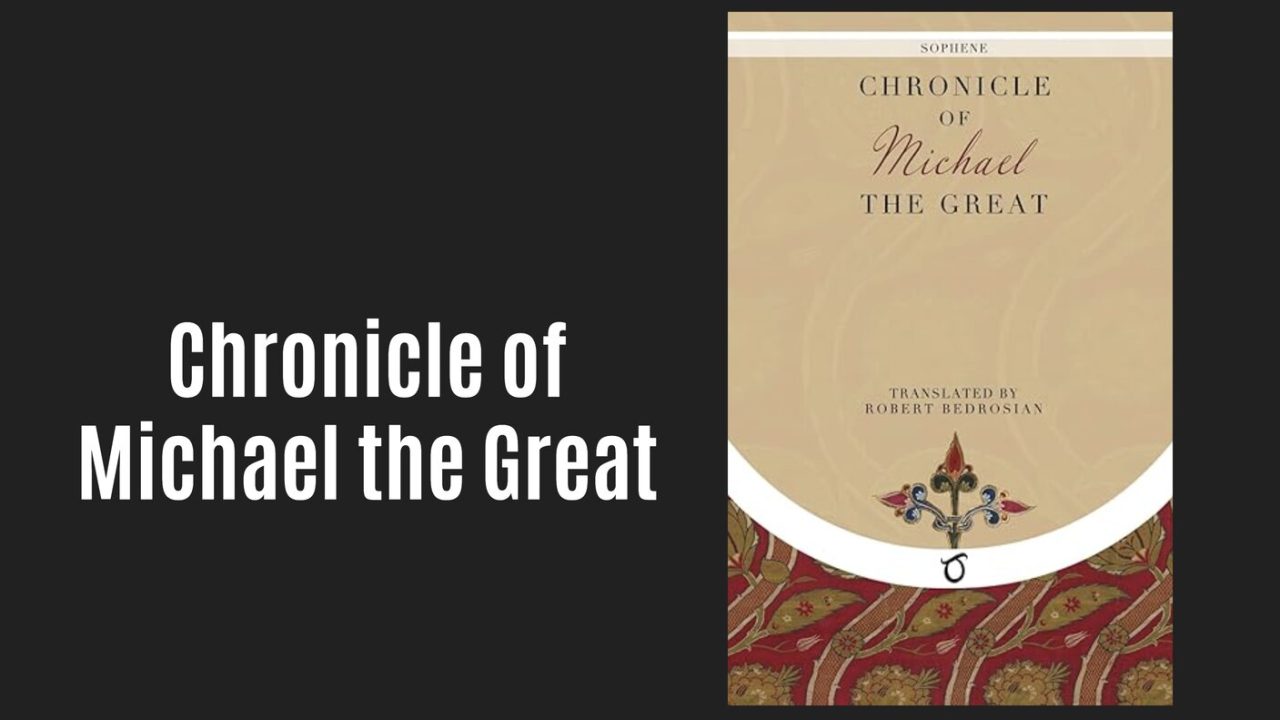
One of the most important Christian historical texts from the medieval Near East has just become significantly more accessible to English-speaking readers. The Chronicle of Michael the Great — a twelfth-century account covering centuries of history in the region — is now available in a new English translation published by Sophene Books, opening up a remarkable primary source to historians, students, and anyone curious about the medieval Middle East and the Crusades.
The chronicle was originally composed in Syriac by Michael the Great, who served as the Syriac Orthodox Patriarch of Antioch from 1166 to 1199. His work, covering events up to the year 1195, has long been regarded as one of the most significant Christian historical records from the Near East. For most English readers, it has remained largely out of reach — until now.
The Chronicle of Michael the Great, translated into English by Robert Bedrosian as a composite of the two main Classical Armenian editions of the text. Out today in paperback and hardback! pic.twitter.com/hiLLgjlrIN
— Sophene (@SopheneBooks) March 4, 2025
This new edition, translated by Robert Bedrosian and published under ISBN 978-1-923051-18-8, offers something genuinely useful: an accessible, affordable entry point into a text that specialists have valued for generations.
Who Was Michael the Great — and Why Does His Chronicle Matter?
Michael the Great is also known by two other names: Michael the Syrian and Michael Rabo. He held one of the most prominent positions in Eastern Christianity during the twelfth century, serving as Syriac Orthodox Patriarch of Antioch for more than three decades.
His chronicle is not a narrow ecclesiastical record. It spans a wide range of events across the medieval Near East, making it an essential source for understanding the region during a period that included the Crusades, shifting political powers, and the complex interactions between different Christian communities, Muslim rulers, and the Byzantine world.
Because the original text was written in Syriac — a language accessible to relatively few modern scholars — the chronicle has historically required specialist knowledge to consult directly. That barrier has made works like this new translation particularly valuable for researchers and readers who don’t have access to the original language.
What This Translation Actually Contains
This edition is based not on the Syriac original but on an Armenian version of the chronicle produced in the thirteenth century. That distinction matters, and the translation is transparent about it.
The Armenian version is an abridged text — meaning some material present in the original Syriac has been condensed or omitted. According to the translator’s note included in the book, the English translation presented is a composite text based on two main Classical Armenian versions of Michael’s Chronicle.
“Remarkably, Michael’s Chronicle was abridged twice in the 13th century, by two separate groups. The reasons for this retranslation are unclear, but the two translations are completely different in vocabulary, syntax, inclusion or exclusion of events, ordering of events, and style.”
That’s a striking detail. Two entirely separate Armenian abridgements were produced within the same century, and they differ not just in style but in which events they chose to include or leave out. Bedrosian’s translation draws on both, creating a composite that aims to offer readers the most complete picture the Armenian tradition can provide.
Historians seeking the fullest possible version of the chronicle will still need to consult the Syriac original. But for many readers — and for many research purposes — this translation will be more than sufficient.
Key Facts About the Chronicle of Michael the Great
| Detail | Information |
|---|---|
| Author | Michael the Great (also known as Michael the Syrian / Michael Rabo) |
| Author’s role | Syriac Orthodox Patriarch of Antioch |
| Patriarchate dates | 1166 to 1199 |
| Chronicle covers events up to | 1195 |
| Original language | Syriac |
| This edition translated from | Classical Armenian (abridged version) |
| Armenian abridgements produced | Twice, by two separate groups in the 13th century |
| Translator | Robert Bedrosian |
| Publisher | Sophene Books |
| ISBN | 978-1-923051-18-8 |
Who Will Benefit From This Book
The most obvious audience is anyone working in medieval Middle Eastern history or Crusades studies. Primary sources from this period and region, translated into accessible modern English, are not always easy to come by — and a text of this stature being made available in an affordable edition is genuinely significant for the field.
But the readership doesn’t have to be purely academic. Anyone with a serious interest in the history of Christianity in the Near East, the political landscape of the twelfth-century Levant, or the interactions between Eastern Christian communities and the wider medieval world will find this chronicle rewarding.
The affordability of this edition — noted explicitly in
- Historians of the medieval Middle East and Crusades
- Students of Eastern Christianity and Syriac Christian traditions
- Researchers studying Armenian historical literature
- General readers interested in medieval Near Eastern history
- Anyone seeking affordable access to a major primary source
The Translator’s Approach and Its Significance
Robert Bedrosian, who holds a PhD, is the scholar behind this translation. His decision to produce a composite text from both surviving Classical Armenian versions is a meaningful editorial choice — one that acknowledges the complexity of the transmission history while still giving readers the most complete version possible from the Armenian tradition.
The fact that the two Armenian abridgements differ so dramatically — in vocabulary, syntax, event selection, ordering, and style — raises fascinating questions about how medieval translators and scribes engaged with their source material. Why did two separate groups feel the need to abridge the same chronicle independently? What guided their choices about what to keep and what to cut?
For readers who want to go deeper, the Syriac original remains the authoritative version. But for the vast majority of English-speaking readers, this translation represents the most practical and accessible way to engage with one of the most important Near Eastern chronicles of the twelfth century.
Frequently Asked Questions
Who was Michael the Great?
Michael the Great, also known as Michael the Syrian and Michael Rabo, was the Syriac Orthodox Patriarch of Antioch from 1166 to 1199. He authored a major chronicle covering events up to 1195.
What language was the chronicle originally written in?
The chronicle was originally written in Syriac. This new English translation is based on a Classical Armenian version produced in the thirteenth century.
Is this a complete translation of the chronicle?
No. The Armenian version used as the basis for this translation is an abridged text. Historians seeking the full chronicle will still need to consult the original Syriac.
Why were there two separate Armenian versions?
The chronicle was abridged twice in the thirteenth century by two separate groups. The reasons for this are unclear, and the two versions differ significantly in vocabulary, style, and which events they include.
Who translated this edition?
The translation was produced by Robert Bedrosian, who holds a PhD. The book is published by Sophene Books.
Who is this book most useful for?
The book is described as a useful addition for anyone interested in medieval Middle Eastern history or the Crusades, and is noted as being more affordable than specialist alternatives.


Leave a Reply