
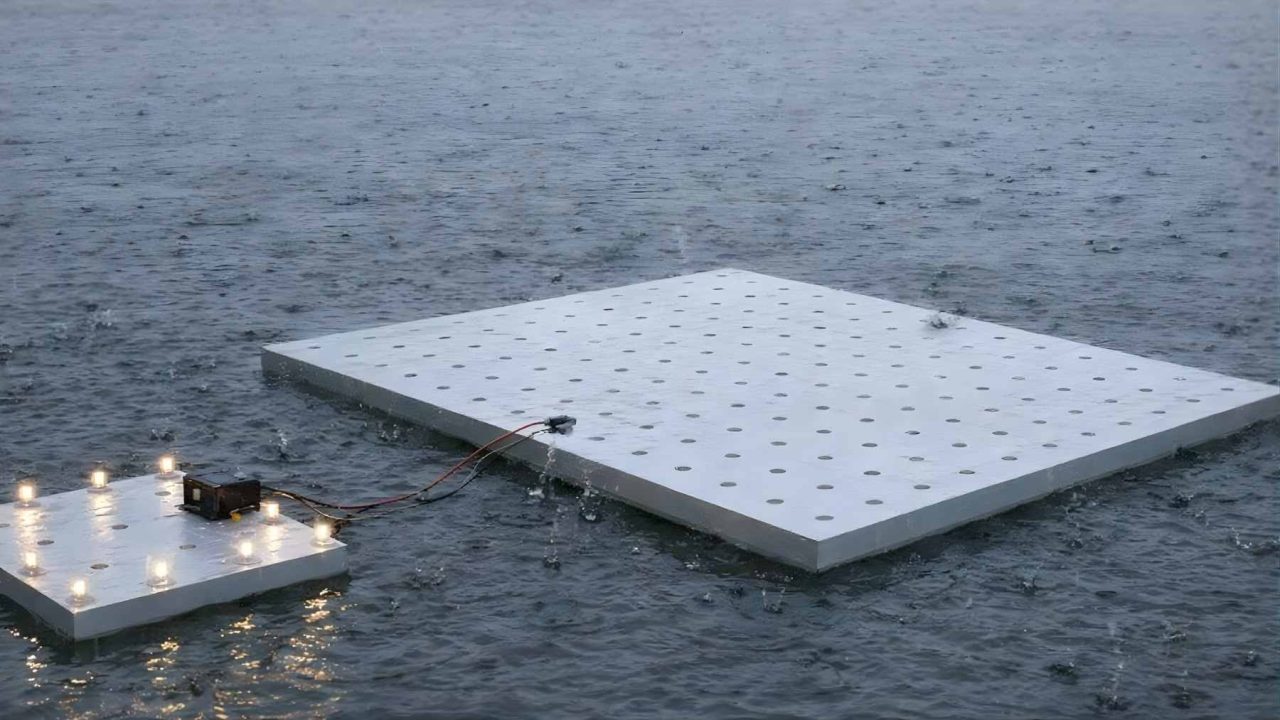
A panel roughly the size of a doormat just lit up 50 LEDs using nothing but falling raindrops — and the researchers behind it say that is only the beginning of what this technology could do.
Scientists at Nanjing University of Aeronautics and Astronautics in China have developed a floating device that converts the physical impact of rain into usable electricity. The system, called the Water-integrated Droplet Electricity Generator (W-DEG), was published in the journal National Science Review with an online publication date of August 4, 2025.
It is not a replacement for solar panels or wind turbines. But in a world where billions of low-power sensors need to run in wet, overcast environments, that distinction may matter less than you think.
What the W-DEG Actually Does
The core idea is straightforward even if the engineering behind it is not: when a raindrop hits the surface of the device, that physical impact is captured and converted into an electrical charge. String enough of those impacts together, and you have a usable power source.
The research team demonstrated this with a prototype assembled from 10 individual units combined into a single integrated device. That multi-unit setup covered approximately 3.2 square feet, or 0.3 square meters — roughly the footprint of a large doormat.
In controlled testing, a single unit from the system was able to keep 50 commercial LED lights illuminated under repeated droplet impacts. That is a meaningful benchmark. It shows the technology can deliver real, visible power output, not just a faint measurable charge detectable only in a laboratory setting.
The researchers also report that the headline performance metric for the system is voltage — though What the published findings do confirm is that the device is designed to float, which opens up applications on water surfaces where rain collection and energy generation can happen simultaneously.
Why Rain Power Is Worth Taking Seriously
At first glance, generating electricity from rain sounds more like a science fair project than a serious energy proposal. The honest answer is that it is not going to power your home anytime soon.
But that framing misses the actual opportunity. The researchers are not pitching this as a grid-scale solution. They are pointing to a specific and genuinely underserved problem: how do you power low-energy electronics in places where it rains frequently, the sky is often overcast, and solar panels perform poorly?
Water-quality sensors are one concrete example the team highlights. These devices need to operate continuously, often on rivers, lakes, or reservoirs — exactly the kind of wet, cloudy environments where rain is plentiful and sunlight is unreliable. A floating W-DEG unit could, in theory, harvest the energy it needs directly from the weather conditions that would otherwise make solar power impractical.
That is a genuinely useful niche, and it is the kind of application where even modest power output can be transformative.
Key Facts About the W-DEG at a Glance
- Developed at Nanjing University of Aeronautics and Astronautics, China
- Published in National Science Review, online August 4, 2025
- The device is called the Water-integrated Droplet Electricity Generator (W-DEG)
- A 10-unit integrated prototype covers 0.3 square meters (3.2 square feet)
- A single unit demonstrated powering 50 commercial LEDs under repeated droplet impacts
- The device is designed to float on water surfaces
- Intended use cases include low-power electronics such as water-quality sensors
- The system is positioned as a complement to solar and wind, not a replacement
| Feature | Detail |
|---|---|
| Device name | Water-integrated Droplet Electricity Generator (W-DEG) |
| Research institution | Nanjing University of Aeronautics and Astronautics |
| Publication | National Science Review (online August 4, 2025) |
| Prototype size (10-unit array) | 0.3 m² / approximately 3.2 sq ft |
| Demonstrated output | 50 commercial LEDs illuminated (single unit) |
| Design format | Floating device |
| Target application | Low-power sensors in wet, overcast environments |
Who This Technology Could Actually Affect
For most people, this research will not change anything about how they get electricity. The W-DEG is not heading to rooftops or power plants in its current form.
Where it could matter is in the growing world of environmental monitoring. Governments, water utilities, and research institutions deploy thousands of sensors across waterways to track pollution, temperature, and flow rates. Many of these sensors sit in remote locations where running a power line is expensive and replacing batteries is a logistical headache.
A self-powered floating sensor that draws energy from rainfall — the very weather event it may also be monitoring — solves a real infrastructure problem. It also fits a broader trend in energy research toward harvesting ambient energy from the environment rather than relying solely on stored or grid-connected power.
Researchers and engineers working on the Internet of Things, remote sensing, and environmental technology are likely watching this development closely. For anyone building systems that need to run reliably in wet climates, a lightweight add-on that turns rain into usable current is worth paying attention to.
Where This Research Goes From Here
The W-DEG is at the prototype stage. The 50-LED demonstration and the 10-unit integrated array represent controlled laboratory and test conditions, not deployed real-world infrastructure.
The next steps for this kind of technology typically involve durability testing in actual outdoor conditions, scaling experiments to understand how output changes with larger arrays, and eventually pilot deployments in the low-power sensor applications the researchers have identified as the most promising near-term use case.
What it does confirm is that the research has cleared a meaningful milestone: the system works at a scale visible to the naked eye, floating on water, powered entirely by falling rain.
That is not a footnote in clean energy research. It is a proof of concept that points toward a genuinely different way of thinking about where small amounts of power can come from — and why every rainstorm might eventually be seen as a resource rather than just weather.
Frequently Asked Questions
What is the W-DEG?
The W-DEG, or Water-integrated Droplet Electricity Generator, is a floating device developed by researchers at Nanjing University of Aeronautics and Astronautics that converts the physical impact of raindrops into electricity.
How much power can it generate?
In testing, a single unit was able to illuminate 50 commercial LED lights under repeated droplet impacts.
How large is the prototype?
A 10-unit integrated prototype covers approximately 0.3 square meters, or about 3.2 square feet — roughly the size of a large doormat.
Could this replace solar panels or wind turbines?
No. The researchers themselves describe this as a complement to solar and wind, not a replacement, best suited to powering low-energy electronics in wet and overcast environments where solar performs poorly.
What practical uses are researchers targeting?
The team highlights water-quality sensors as a primary use case — devices that need to run continuously on rivers, lakes, or reservoirs where rain is common and solar power is unreliable.
When will this technology be commercially available?
This has not yet been confirmed. The W-DEG is currently at the prototype and research stage, with the findings published in National Science Review in August 2025.

Leave a Reply