
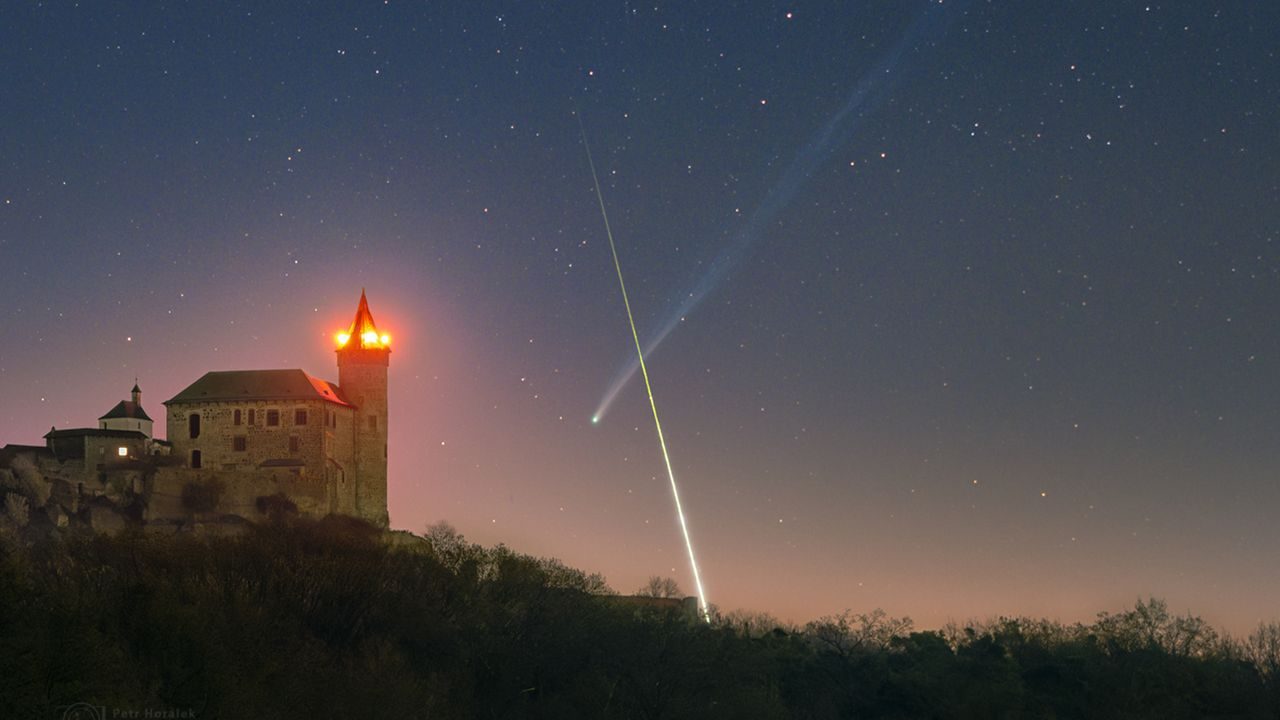
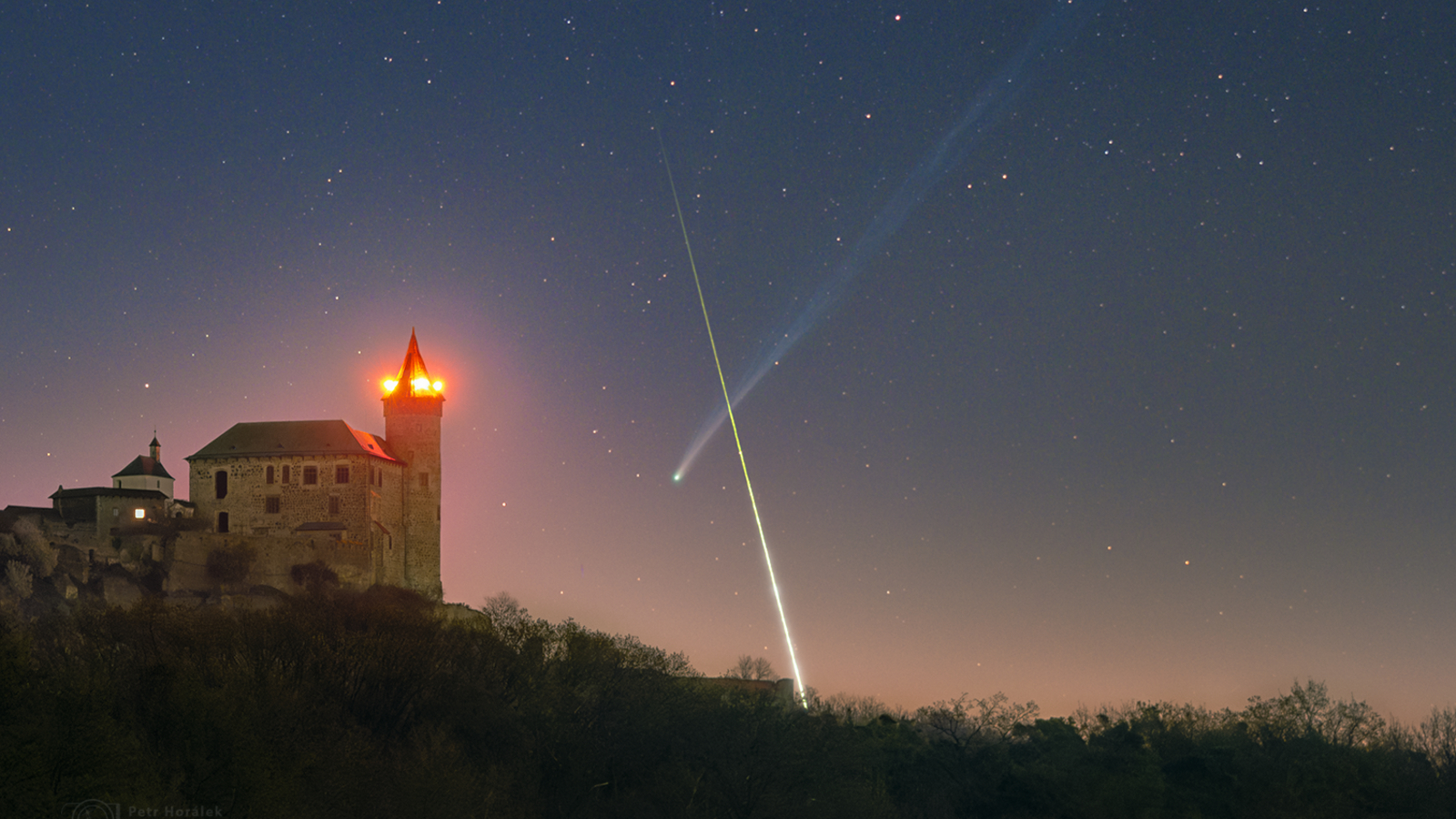
The odds of it happening were, by any reasonable calculation, astronomical. On the night of April 18, a blazing fireball meteor streaked across the sky at the precise moment a photographer had a camera pointed at one of the brightest comets visible from Earth — and the two celestial objects crossed paths in an almost perfect X over the ruins of a 500-year-old Czech castle.
The resulting photograph is the kind of image that stops you mid-scroll. Two rare cosmic events, captured in a single frame, forming a natural crosshair above the 15th-century fortress of Kunětická Hora. It’s the sort of shot that most astrophotographers spend entire careers hoping for and never get.
March is lighting up ☄️ This month has seen the most fireball sightings since 2012, with multiple bright meteors streaking across skies in the U.S. and Europe. https://t.co/U7KheegzaL pic.twitter.com/P5PPpZUMK1
— AccuWeather (@accuweather) March 26, 2026
Photographers Petr Horálek and Josef Kujal were the ones behind the lens that night — and what they captured has since been circulating widely as one of the most striking pieces of night sky photography in recent memory.
What Actually Happened Over That Czech Castle
The comet in question is Comet C/2025 R3 (PanSTARRS), a celestial visitor that has been generating serious excitement among astronomers and sky-watchers in recent months. Some observers have already floated the possibility that it could become what’s known as a “Great Comet of 2026” — a term reserved for comets that become bright enough to be seen with the naked eye and put on a genuinely spectacular show for people on the ground.
On the night of April 18, Horálek and Kujal had set up to photograph the comet’s lengthy, luminous tail stretching across the sky above Kunětická Hora, the ruins of a castle dating back to the 15th century in the Czech Republic. What they didn’t plan for — couldn’t have planned for — was a brilliant fireball meteor choosing that exact window of time to blaze across their frame.
The result was a near-perfect X shape: the comet’s tail running in one direction, the meteor’s streak cutting sharply across it. The castle ruins sat below the crossing point, framing the whole scene like something out of a fantasy film. Except it was completely real.
Why Comet C/2025 R3 (PanSTARRS) Is Already Turning Heads
Comets get labeled “great” only rarely, and the designation isn’t handed out lightly. A comet earns that title by becoming unexpectedly or exceptionally bright — bright enough to be visible without a telescope, sometimes even in daylight. The most famous recent example was Comet NEOWISE in 2020, which drew millions of people outside to look up for the first time in years.
Comet C/2025 R3 (PanSTARRS) has been described as a contender for that status in 2026. While comets are notoriously unpredictable — they can brighten dramatically or fizzle out entirely as they approach the sun — the early signals from this one have been enough to put it on the radar of serious amateur and professional astronomers alike.
The fact that it was already producing a tail dramatic enough to photograph over a castle at night says something about its current brightness and visibility. Astrophotographers don’t typically trek out to medieval ruins in the early hours of the morning for a comet that isn’t putting on a show.
The Numbers Behind a Once-in-a-Lifetime Shot
To understand just how unlikely this photograph was, it helps to think about what had to line up simultaneously. Consider the factors at play:
- A bright comet with a visible tail had to be in the sky — itself a relatively rare occurrence
- A fireball meteor, which is significantly brighter and rarer than an ordinary shooting star, had to appear during the same short exposure window
- The two objects had to cross at an angle that formed a recognizable X shape in the frame
- A photographer had to be present, pointed in exactly the right direction, at exactly the right moment
- All of this had to happen over a photogenic location — in this case, a 500-year-old castle ruin
| Element of the Shot | Detail |
|---|---|
| Date captured | April 18 (early hours) |
| Location | Kunětická Hora, Czech Republic |
| Castle age | 15th century (approximately 500 years old) |
| Comet photographed | Comet C/2025 R3 (PanSTARRS) |
| Second celestial event | Fireball meteor |
| Photographers | Petr Horálek and Josef Kujal |
| Shape formed in frame | Near-perfect X |
What This Means for Skywatchers Right Now
For anyone who enjoys watching the night sky, this photograph is a useful reminder that the current window is genuinely worth paying attention to. Comet C/2025 R3 (PanSTARRS) is reportedly bright enough to be captured in detailed astrophotography, and if early predictions hold, it could become significantly more visible as it continues its journey through the inner solar system.
Fireball meteors, meanwhile, are not tied to any particular season in the way that annual meteor showers are. They can appear on any clear night, which is part of what makes capturing one on camera such a matter of patience and luck. The fact that one appeared during this specific comet observation session is the kind of story that astrophotography communities tend to talk about for years.
For casual observers, the takeaway is simple: if you have access to dark skies and a clear night, now is a reasonable time to look up. You probably won’t get the X. But you might catch a glimpse of a comet that could be putting on its biggest show within the next year.
What Comes Next for Comet C/2025 R3 (PanSTARRS)
The comet’s potential “great comet” status hinges on what happens as it draws closer to the sun. Comets brighten as solar radiation heats their icy cores, releasing gas and dust that form the glowing tail — but they can also break apart or behave in unexpected ways under that same pressure.
Astronomers will continue monitoring C/2025 R3 (PanSTARRS) closely in the months ahead. If it maintains its current trajectory and brightness trend, 2026 could offer a genuine naked-eye comet event — the kind that only comes along a handful of times in a generation. Whether it delivers on that promise remains to be seen. But photographs like the one captured over Kunětická Hora are already making the case that this particular comet is worth watching.
Frequently Asked Questions
What comet appears in the viral photograph taken over the Czech castle?
The comet is Comet C/2025 R3 (PanSTARRS), which some observers have described as a potential “Great Comet of 2026.”
Who took the photograph of the comet and fireball meteor?
The image was captured by photographers Petr Horálek and Josef Kujal on April 18 over the ruins of Kunětická Hora castle in the Czech Republic.
What castle appears in the photograph?
The castle is Kunětická Hora, a 15th-century ruin located in the Czech Republic, making it approximately 500 years old.
What shape did the comet tail and meteor streak form in the image?
The two celestial objects crossed paths in a near-perfect X shape directly above the castle ruins.
Could Comet C/2025 R3 (PanSTARRS) become visible to the naked eye?
It has been described as a contender for “Great Comet of 2026” status, though comets are unpredictable and its ultimate brightness has not yet been confirmed.
Are fireball meteors common enough to photograph?
Fireball meteors are significantly rarer and brighter than ordinary shooting stars, making their appearance during a planned comet photography session an extraordinarily unlikely coincidence.


Leave a Reply