
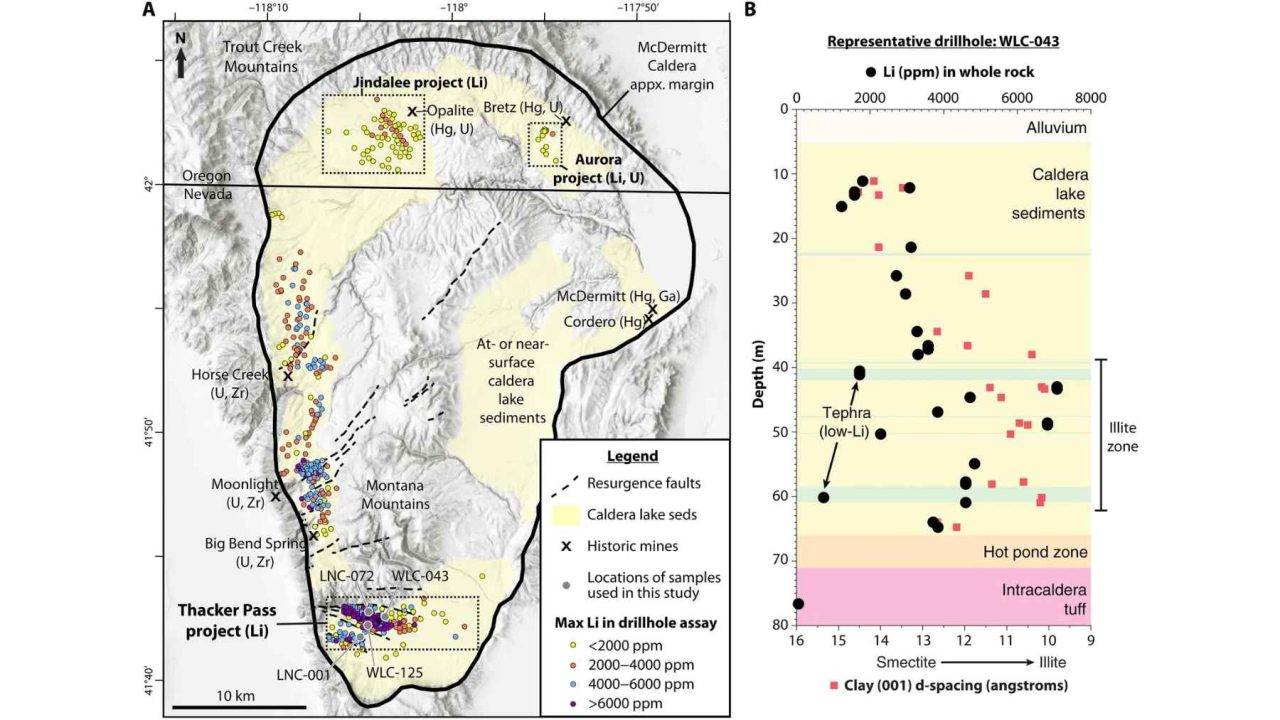
Beneath a long-dormant supervolcano on the Nevada-Oregon border sits what researchers believe could be the world’s largest lithium deposit — and it’s worth an estimated more than €400 billion. The catch? It’s buried under ancient volcanic clay, sits on contested land, and the headline number comes with a significant scientific asterisk.
The site is called the McDermitt Caldera, and a specific hotspot within it — Thacker Pass — has produced some of the most lithium-rich clay samples ever recorded. For anyone watching the global race to secure battery materials for electric vehicles and energy storage, this is a discovery that’s hard to ignore.
But the story behind the numbers is more complicated than the eye-catching valuation suggests. Scientists who published the findings are careful to distinguish between what’s been measured and what could realistically be mined. Those are very different things.
What Scientists Actually Found Beneath the Caldera
The McDermitt Caldera formed approximately 16.4 million years ago during a massive eruption connected to the Yellowstone hotspot track. The eruption was powerful enough to collapse the ground into a basin stretching roughly 28 miles by 22 miles. Over time, a lake filled that basin and deposited thick layers of volcanic ash and mineral-rich sediments, which eventually hardened into claystones.
What makes Thacker Pass unusual isn’t just the presence of lithium — it’s where the lithium is sitting. The mineral locking it in place is called illite, a type of clay. According to findings published in a 2023 paper in the journal Science Advances, illite samples at the site measured between 1.3% and 2.4% lithium by weight. That’s unusually high compared to most comparable deposits around the world.
Those concentrations are what pushed the overall tonnage estimate — and the associated valuation — into record-breaking territory. The site has been described as potentially the largest lithium deposit on the planet. Whether it stays that way after full geological assessment is another question entirely.
The Number Everyone’s Quoting — and Why It Needs Context
The €400 billion-plus figure attached to this deposit is striking. But the researchers behind the Science Advances study included a warning that often gets lost when the story travels through media cycles: the largest tonnage figure is a rough estimate, not a formal reserve.
There’s an important difference in geology between a “resource” and a “reserve.” A resource is a broad estimate of how much of a material might be in the ground. A reserve is a much more precise figure — what can actually be extracted economically, using current technology, under current conditions. The McDermitt figure is closer to the former.
That doesn’t make the discovery unimportant. It means the headline valuation should be treated as a ceiling, not a guaranteed outcome. Real-world mining projects regularly fall short of their initial estimates once detailed drilling, environmental review, and engineering assessments begin.
Key Facts About the McDermitt Caldera Lithium Deposit
| Detail | Data Point |
|---|---|
| Location | Nevada-Oregon border, USA |
| Site name | McDermitt Caldera / Thacker Pass |
| Caldera age | Approximately 16.4 million years old |
| Caldera size | Roughly 28 miles by 22 miles |
| Lithium-bearing mineral | Illite (a clay mineral) |
| Lithium concentration in illite | 1.3% to 2.4% by weight |
| Estimated deposit value | More than €400 billion |
| Research published | 2023, Science Advances journal |
| Geological origin | Yellowstone hotspot track eruption |
- The caldera was formed by a volcanic collapse, not a traditional cone-shaped eruption
- A lake that once filled the basin created the sediment layers now rich in lithium-bearing clay
- Thacker Pass sits in the southern portion of the caldera
- The deposit’s estimated tonnage has led some to describe it as the largest lithium resource ever identified
- The Science Advances study flagged that the big number is a rough estimate, not a certified reserve
Why This Matters Beyond the Price Tag
Lithium is the element at the heart of the global energy transition. It’s the key ingredient in the batteries that power electric vehicles, store solar and wind energy, and run the devices most people carry in their pockets every day. Demand has surged, supply chains are under pressure, and governments in the US and Europe are actively looking for domestic sources to reduce dependence on imports.
A deposit this large, sitting on American soil, would carry enormous strategic value — not just financial. It could reshape where the US sits in the global battery supply chain for decades.
But the researchers behind the Science Advances paper were direct about the complications. Any real mining operation at Thacker Pass would still have to answer hard questions about water use, land rights, and pollution risks. None of those are small issues in a region where water is scarce and the land carries significance beyond its mineral content.
Supporters of domestic lithium development argue that reducing reliance on foreign supply chains is a national security issue as much as an economic one. Critics point out that large-scale mining in ecologically sensitive or culturally significant areas carries real costs that don’t show up in a valuation estimate.
What Comes Next for Thacker Pass
The 2023 Science Advances paper represents an important scientific milestone, but it’s the beginning of a long process — not the end. Moving from a geological study to an operational lithium mine involves years of additional drilling, environmental impact assessments, regulatory approvals, and infrastructure development.
The gap between a promising geological find and a producing mine is where most projects either prove their worth or quietly disappear. The water, land, and pollution questions flagged by the researchers aren’t bureaucratic hurdles — they’re the kinds of issues that have delayed or derailed major mining projects before.
For now, the McDermitt Caldera remains one of the most talked-about mineral sites on the planet. Whether it becomes the cornerstone of American lithium production — or a cautionary tale about the distance between discovery and delivery — depends on answers that geology alone can’t provide.
Frequently Asked Questions
Where exactly is the world’s largest lithium deposit located?
It lies beneath the McDermitt Caldera on the Nevada-Oregon border, with the highest concentrations found at a site called Thacker Pass in the southern portion of the caldera.
How old is the McDermitt Caldera?
The caldera formed approximately 16.4 million years ago during a large eruption connected to the Yellowstone hotspot track.
What mineral contains the lithium at Thacker Pass?
The lithium is locked into a clay mineral called illite, which measured between 1.3% and 2.4% lithium by weight in the study samples — unusually high concentrations.
Is the €400 billion valuation confirmed?
The figure is based on a rough tonnage estimate, not a formally certified geological reserve. Researchers who published the findings in Science Advances explicitly noted this distinction.
What are the main obstacles to mining the deposit?
According to the research, any mining operation would still need to address significant questions around water use, land rights, and pollution risks before it could proceed.
When was the research published?
The findings were published in 2023 in the peer-reviewed journal Science Advances.

Leave a Reply