
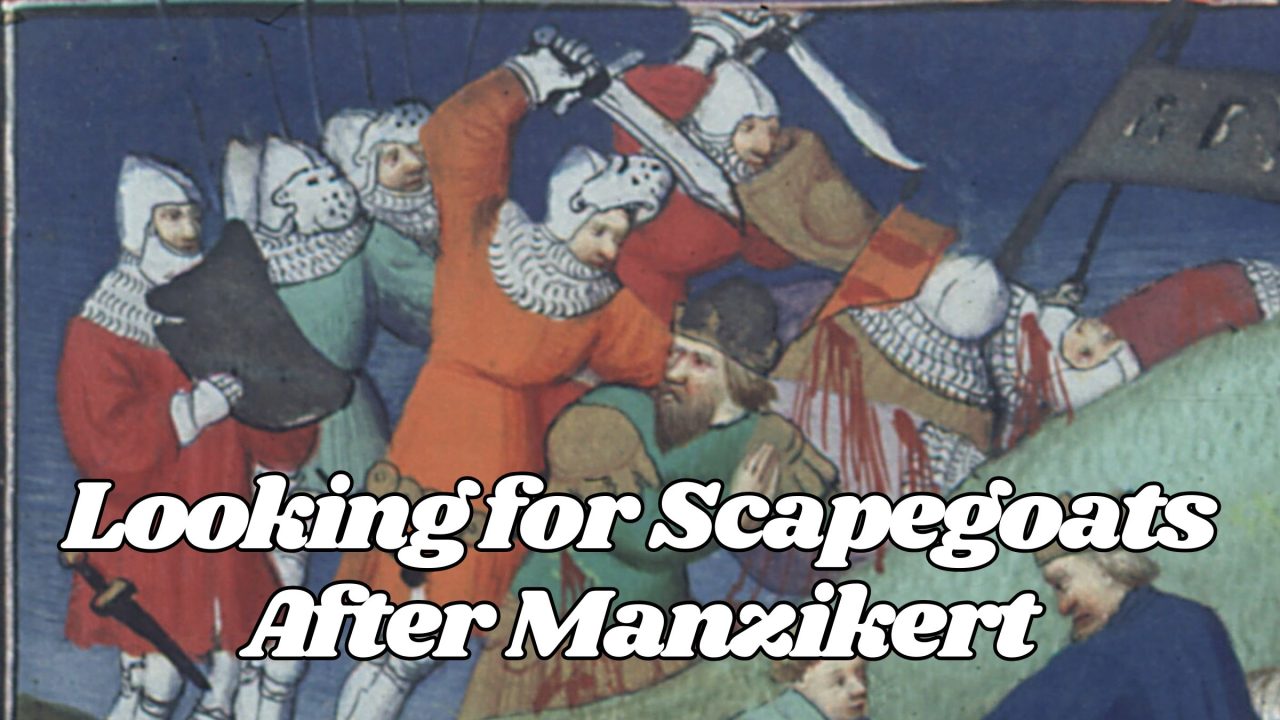
Did one of the most consequential military defeats in medieval history happen because of treachery — or because of a cascade of bad decisions made under pressure? That question has shadowed the Battle of Manzikert for nearly a thousand years, and historians are still arguing about the answer.
The battle, fought in 1071 between the Byzantine Empire and the Seljuk Turks, is often described as a turning point that cracked open Anatolia to Turkish settlement and set Byzantium on a long road to eventual collapse. But a closer look at the medieval sources, as scholar George Theotokis argues, reveals that the story of betrayal may say more about Byzantine political culture than about what actually happened on that battlefield.

Three commanders — Josef Trachaneiotes, Roussel of Bailleul, and Andronikos Doukas — have carried the weight of blame for centuries. Whether they deserve it is a far more complicated question than the dominant narrative suggests.
Three Men, One Catastrophe, and Centuries of Blame
The traditional account of Manzikert is damning. Trachaneiotes and Roussel of Bailleul, the story goes, disobeyed their emperor by failing to turn back and support him at a critical moment. Andronikos Doukas allegedly did something worse: he ordered a withdrawal precisely when his intervention could have prevented the encirclement and collapse of the imperial line.
Together, these three figures became the faces of Byzantine failure — men whose treachery, cowardice, or self-interest handed the Seljuks a victory they might not otherwise have won.
But as Theotokis points out, the credibility of these accusations depends entirely on which sources one chooses to trust. The medieval chroniclers who recorded these events were not neutral observers. Many wrote in a political environment where assigning blame served very specific purposes — protecting reputations, justifying power grabs, or settling old scores within the Byzantine court.
The search for betrayal, in other words, began almost immediately after the battle itself.
What Was Actually at Stake at Manzikert
To understand why the battle unfolded the way it did, it helps to understand what both sides were actually trying to accomplish — and those goals were not what most people assume.
Manzikert was the culmination of a prolonged struggle between Byzantium and the Seljuk Turks over eastern Asia Minor and northern Syria. But according to many scholars, Sultan Alp Arslan’s primary strategic concern at that moment was not Byzantium at all. His real target was the Shiʿa Fatimid Caliphate, and his ultimate ambition was a future campaign against Egypt.
From that perspective, the Turkish military operations of 1070 and 1071 that eventually led to Manzikert were preparation — a way of securing his position in Syria before turning his attention south and west. Byzantium was, in a sense, a problem that needed to be managed rather than a prize to be conquered.
That context matters enormously when evaluating how both sides made decisions before and during the battle. Neither army was operating with a single, clear objective. Both were navigating competing pressures, uncertain intelligence, and the fog of a campaign that had already stretched across multiple seasons.
The Accused: Who Were These Commanders?
| Commander | Alleged Action at Manzikert | Credibility of Accusation |
|---|---|---|
| Josef Trachaneiotes | Failed to return and support the emperor at a critical moment | Disputed — depends on source selection |
| Roussel of Bailleul | Also failed to return and support the emperor | Disputed — depends on source selection |
| Andronikos Doukas | Ordered a withdrawal when intervention could have prevented collapse | Disputed — political motivations of chroniclers noted |
What unites all three cases is the same problem: the accusations come from sources written after the fact, in a political climate where blaming these men served clear interests. Theotokis argues that the rush to identify traitors reflects a very human impulse — when an empire suffers a humiliating defeat, someone has to be responsible. A story of betrayal is far more satisfying, and far more politically useful, than a story of collective miscalculation.
Why This Debate Still Matters
It might be tempting to treat this as a purely academic dispute — historians arguing over sources that are nearly a thousand years old. But the questions at the heart of the Manzikert debate are ones that recur throughout military and political history: How do we assign responsibility for catastrophic failure? How much do we trust the accounts written by the winners, or by the survivors who had every reason to deflect blame?
The framing of Manzikert as a betrayal rather than a strategic miscalculation also shaped how Byzantines understood their own decline. If the empire lost because of traitors, the institution itself remained sound — the problem was individual treachery, not systemic weakness. That was a far more comfortable story to tell.
Theotokis’s analysis pushes back against that comfort. A closer reading of the medieval chroniclers, he argues, suggests that the battlefield decisions of 1071 were shaped by confusion, competing priorities, and the inherent chaos of medieval warfare — not a coordinated act of sabotage by disloyal commanders.
Reading the Sources Against the Grain
The methodological point here is as important as the historical one. Medieval chronicles were not journalism. They were written with audiences in mind, often decades after the events they described, and frequently by authors with strong ties to particular factions within Byzantine political life.
When multiple chroniclers converge on the same story of betrayal, that convergence is not necessarily evidence that the betrayal happened. It may simply reflect the fact that a particular narrative became politically dominant — and that later writers repeated it because it was the accepted version, not because they had independent evidence.
Separating those layers is exactly the kind of work historians like Theotokis are doing, and it’s producing a significantly more nuanced picture of what went wrong at Manzikert in August 1071.
Frequently Asked Questions
Who were the three commanders accused of betrayal at Manzikert?
The three men most frequently blamed are Josef Trachaneiotes, Roussel of Bailleul, and Andronikos Doukas, each accused of failing to support the Byzantine emperor at critical moments during the battle.
Was Sultan Alp Arslan primarily focused on defeating Byzantium?
Many scholars argue that Alp Arslan’s chief strategic concern was actually the Shiʿa Fatimid Caliphate, with the 1070–1071 operations intended to prepare the ground for a future campaign against Egypt rather than to conquer Byzantine territory.
Why do historians question the betrayal narrative?
The accusations against the three commanders come from medieval chroniclers writing after the battle in a politically charged environment, and the credibility of those accounts depends heavily on which sources one chooses to trust.
When did the Battle of Manzikert take place?
The battle was fought in 1071, marking what many scholars describe as the geopolitical high point of the prolonged contest between the Byzantine Empire and the Seljuk Turks over eastern Asia Minor and northern Syria.
What was the broader significance of Manzikert?
The battle is widely regarded as a turning point in Byzantine–Seljuk relations, though the full consequences unfolded over subsequent decades rather than as an immediate collapse.
Is the betrayal question definitively resolved?
No. Theotokis and other scholars argue the case for betrayal is far from certain, but the debate continues among historians who weigh the medieval sources differently.


Leave a Reply