
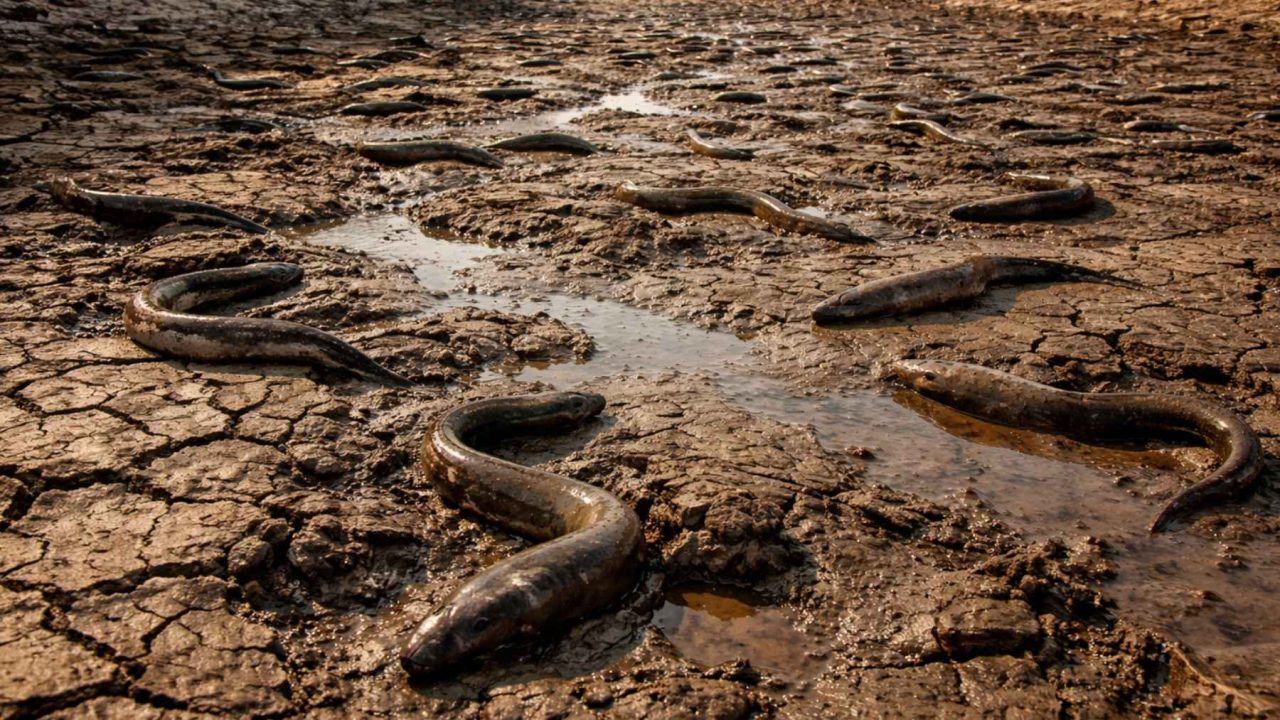
Two thousand European eels died just 11 miles from Valencia, Spain — after completing one of the most extraordinary migrations in the natural world. They had traveled roughly 4,350 miles from the Sargasso Sea, crossed the Atlantic, and navigated their way into the rivers of eastern Spain. Then, trapped in a drying riverbed, they cooked alive in water that reached 98.6°F and ran out of oxygen before anyone intervened.
It is the kind of story that sounds almost impossible until you understand how bad things have gotten for this species. The European eel is listed as Critically Endangered on the IUCN Red List, and what happened in the rivers near Valencia is not a freak accident. It is part of a pattern that ecologists say has been building for years.
Environmental group Acció Ecologista-Agró has been raising the alarm, pointing to the rivers Canyoles and Albaida as ground zero for a problem that combines drought, poor river management, and a near-total absence of emergency response.
What Actually Happened in the Rivers Near Valencia
Every summer, when rainfall drops off across eastern Spain, river levels fall. In a healthy system, that is manageable. But in the Canyoles and Albaida rivers, the situation has become extreme. Flowing stretches break apart into disconnected pools — isolated pockets of water surrounded by dry, exposed riverbed.
For eels, that is a death trap. They cannot move between pools once the connecting water disappears. They are stuck. And as temperatures rise and the pools shrink, two things happen simultaneously: the water heats up and the oxygen level drops. At 98.6°F, the conditions become lethal. That is the temperature at which these 2,000 eels died.
What makes this particularly striking is the sheer distance these animals had already covered. European eels are born in the Sargasso Sea — a region of the North Atlantic Ocean east of the Bahamas — and drift thousands of miles on ocean currents before finding their way into European rivers. The journey to Valencia would have covered approximately 4,350 miles. They made it almost all the way. They died 11 miles short of the city.
According to Acció Ecologista-Agró, no meaningful intervention took place. The river had effectively turned into a puddle, and no one stepped in to rescue the stranded fish or restore water flow in time.
The Bigger Crisis Behind This Fish Kill
The deaths near Valencia did not happen in isolation. Scientists have been warning for years that the European eel is in serious trouble across its entire range — not just in Spain. The IUCN’s Critically Endangered classification is the highest threat level before extinction in the wild, and it reflects decades of population collapse.
What is happening in the Canyoles and Albaida rivers illustrates exactly why the species is struggling. Drought reduces river flow. River management decisions — about water extraction, irrigation, and infrastructure — can make dry conditions dramatically worse. And when fish kills do occur, the absence of emergency protocols means animals that survived a 4,000-mile ocean crossing can die in a shallow pool without anyone attempting to save them.
Ecologists argue this is not just a conservation problem in the abstract. It is a management failure happening in real time, in rivers close to a major European city, involving a species that the scientific community has flagged as being on the edge.
Key Facts About the European Eel and This Incident
| Detail | Figure / Status |
|---|---|
| Number of eels that died | 2,000 |
| Distance traveled from origin | Approximately 4,350 miles |
| Origin of European eels | Sargasso Sea (North Atlantic) |
| Distance from Valencia at time of death | 11 miles |
| Water temperature at point of death | 98.6°F |
| Rivers affected | Canyoles and Albaida, eastern Spain |
| IUCN conservation status | Critically Endangered |
| Organization raising the alarm | Acció Ecologista-Agró |
- European eels are born in the Sargasso Sea and migrate to European freshwater rivers to grow and mature.
- When rivers dry into isolated pools, eels cannot move to safer water and become trapped.
- Falling oxygen levels combined with rising water temperatures create lethal conditions.
- The European eel’s Critically Endangered status reflects a long-term, range-wide population decline.
- Drought and river management decisions are identified as compounding factors in these deaths.
Why This Should Concern More Than Just Conservationists
It is easy to read a story like this and file it under “wildlife news.” But the conditions that killed these eels — rivers running dry, water temperatures spiking, no emergency response in place — are conditions that affect far more than fish.
Eastern Spain has faced intensifying drought pressure for years. When rivers like the Canyoles and Albaida shrink to puddles in summer, that reflects real stress on regional water systems. The eels are, in a sense, the most visible victims of a broader environmental shift that touches agriculture, drinking water, and the health of entire river ecosystems.
Advocates argue that the deaths of 2,000 critically endangered animals — animals that had survived one of the longest migrations on Earth — should have triggered an emergency response. The fact that it did not points to a gap between conservation policy on paper and what actually happens on the ground when a crisis unfolds in a drying riverbed.
What Needs to Happen — and What Ecologists Are Calling For
Acció Ecologista-Agró has framed this as a failure of inaction. The group points to the summer die-offs in the Canyoles and Albaida rivers as evidence that existing protections for the European eel are not being translated into practical, on-the-ground intervention when it matters most.
The broader scientific consensus, reflected in the eel’s IUCN listing, is that recovery will require action on multiple fronts: addressing drought impacts, reforming river management practices, and enforcing fishing regulations that account for the species’ precarious status.
Whether any of that changes following this incident remains to be seen. What is already clear is that the problem is not going away on its own. Summers in eastern Spain are not getting wetter, and rivers are not managing themselves.
Frequently Asked Questions
Why did the eels die near Valencia?
The eels became trapped in isolated pools when sections of the Canyoles and Albaida rivers dried up. Water temperatures reached 98.6°F and oxygen levels dropped to lethal levels, and no intervention took place in time.
How far had these eels traveled before they died?
The eels had traveled approximately 4,350 miles from their birthplace in the Sargasso Sea. They died just 11 miles from Valencia.
Are European eels endangered?
Yes. The European eel is listed as Critically Endangered on the IUCN Red List, the highest threat category before extinction in the wild.
Which organization is raising the alarm about this?
Acció Ecologista-Agró, an environmental group active in eastern Spain, has been highlighting the summer die-offs in the Canyoles and Albaida rivers as a serious conservation failure.
Is this a one-time event or part of a wider problem?
Ecologists describe this as part of a recurring pattern. The problem appears most clearly in summer, when low rainfall causes river sections to break into disconnected, shrinking pools where eels become stranded.
What would have saved the eels?
Ecologists suggest that emergency responses — such as rescuing stranded fish or maintaining minimum water flows — could prevent future die-offs, but specific protocols have not yet been confirmed as being in place.




Leave a Reply