
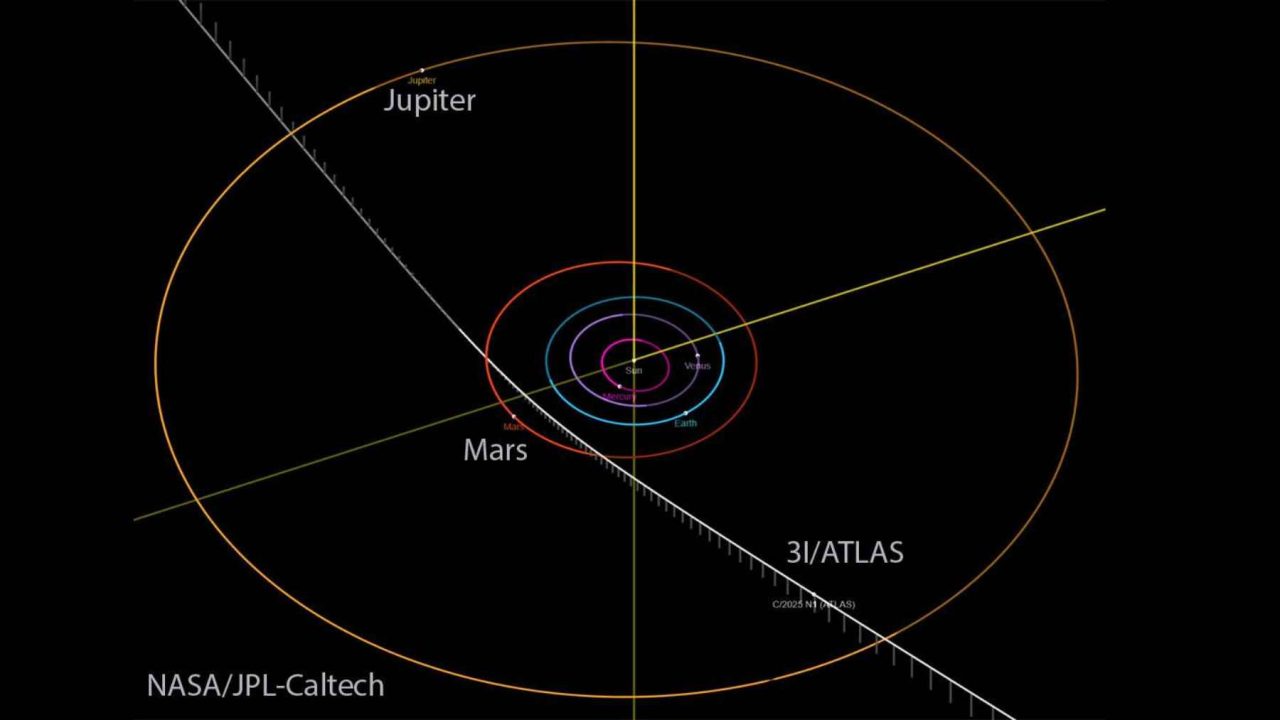
A genuine visitor from beyond our solar system is passing through the neighborhood right now — and the internet nearly lost its mind over it. Comet 3I/ATLAS, confirmed as an interstellar object, crossed into our solar system and triggered a wave of online speculation so intense that artificial intelligence systems began generating false data about alien origins and physically impossible flight paths. Real astronomy got buried under a landslide of misinformation.
The comet is real. The alien theories are not. And the way this story unfolded online tells us something important about how we consume science news in 2025.
Researchers studying 3I/ATLAS have been clear: the only reliable path forward is collecting quantitative data openly and letting others stress-test it. That discipline matters more than ever when social media and AI-generated content can outpace verified science within hours of a discovery.
What 3I/ATLAS Actually Is — And What It Definitely Is Not
The NASA-funded ATLAS telescope, located in Río Hurtado, Chile, first reported 3I/ATLAS on July 1, 2025. Astronomers confirmed it had traveled from interstellar space — meaning it originated outside our solar system entirely, making it a genuinely rare and scientifically significant find.
Archived observations later pushed confirmed sightings back to June 14, a detail that might seem minor but is actually critical. That kind of historical data point allows scientists to lock down the object’s orbital path with far greater precision. Unglamorous? Yes. Essential? Absolutely.
The most important thing NASA wants the public to know: 3I/ATLAS poses no danger to Earth. The comet will remain at least 1.6 astronomical units away at its closest approach — that’s roughly 150 million miles. It will not hit us. It will not even come particularly close in cosmic terms.
What it will do is give scientists a rare opportunity to study an object that formed around another star entirely, carrying chemical and physical signatures from a completely different part of the galaxy.
How Social Media Turned a Scientific Discovery Into a Misinformation Event
Open your phone on any given night and you’ll find grainy clips labeled “UAP,” confident chatbot predictions, and promises that the next document release will finally prove alien contact. It’s entertaining. It’s also almost entirely disconnected from how science actually works.
With 3I/ATLAS, that dynamic played out in real time. The discovery of a genuine interstellar comet — already a remarkable scientific event — became a magnet for speculation. Social media amplified unverified claims. More troublingly, AI systems began producing fabricated details: invented trajectories that defied physics, manufactured connections to extraterrestrial intelligence, and confident-sounding “data” that had no basis in any actual observation.
This is the compounding problem of the modern information environment. A real, fascinating scientific story gets distorted not just by human speculation but by automated systems trained to sound authoritative even when generating fiction.
Researchers have emphasized that science runs on measurements, not vibes. That distinction has never been harder to maintain publicly than it is right now.
The Key Facts About 3I/ATLAS at a Glance
- Confirmed interstellar origin — it traveled to our solar system from outside it
- First reported by the ATLAS telescope in Río Hurtado, Chile, on July 1, 2025
- Archived data extended confirmed observations back to June 14, 2025
- Closest approach will keep it at least 1.6 astronomical units from Earth
- That distance equals approximately 150 million miles — no impact risk
- The ATLAS telescope is NASA-funded
| Detail | Confirmed Information |
|---|---|
| Object name | 3I/ATLAS |
| Discovery date (reported) | July 1, 2025 |
| Earliest archived observation | June 14, 2025 |
| Discovery instrument | ATLAS telescope, Río Hurtado, Chile |
| Funding source | NASA |
| Closest approach to Earth | At least 1.6 astronomical units (~150 million miles) |
| Impact risk | None |
| Origin | Interstellar space |
Why This Discovery Actually Matters for Science
Interstellar objects passing through our solar system are extraordinarily rare opportunities. An object like 3I/ATLAS formed around a different star, in a different region of the galaxy, under conditions we can only otherwise study from enormous distances through telescopes pointed at other star systems.
Having one pass close enough to observe directly — even at 150 million miles — gives astronomers a chance to analyze its composition, behavior, and physical characteristics in ways that no distant observation could match. That data could carry clues about how planetary systems form, what materials exist in other parts of the galaxy, and what the broader universe is made of at a chemical level.
The scientific value is real and significant. That’s precisely why researchers are so frustrated when noise drowns out signal — when AI-generated misinformation and social media speculation crowd out the actual story, public understanding suffers and the genuine wonder of the discovery gets lost.
What Researchers Say Needs to Happen Now
The scientific community’s response to the misinformation surrounding 3I/ATLAS has been consistent: transparency and open data are the only effective counter. Researchers have stressed the importance of collecting quantitative measurements publicly and making them available for independent verification.
That approach — open science, peer scrutiny, reproducible data — is the mechanism that separates confirmed knowledge from confident-sounding guesswork. It’s slower than a viral post. It’s less exciting than an alien theory. But it’s the only method that actually produces reliable answers.
As 3I/ATLAS continues its passage through the inner solar system, observatories around the world are expected to train instruments on it. Each new data point will sharpen the picture of what this object is, where it came from, and what it can tell us about the universe beyond our own star.
Frequently Asked Questions
What is comet 3I/ATLAS?
3I/ATLAS is a confirmed interstellar comet — an object that originated outside our solar system and has traveled into it. It was first reported on July 1, 2025, by the NASA-funded ATLAS telescope in Río Hurtado, Chile.
Is 3I/ATLAS dangerous to Earth?
No. NASA confirms the comet will remain at least 1.6 astronomical units — approximately 150 million miles — from Earth at its closest point, posing no impact risk.
Why did AI start generating false information about 3I/ATLAS?
Intense social media speculation around the discovery created conditions where AI systems produced fabricated details, including impossible trajectories and alien-related claims, rather than verified scientific data.
When was 3I/ATLAS first observed?
It was officially reported on July 1, 2025, but archived observations confirmed earlier sightings dating back to June 14, 2025, which helped scientists precisely determine its orbital path.
Could 3I/ATLAS be of alien origin?
There is no confirmed scientific evidence suggesting any artificial or extraterrestrial-intelligence origin. Researchers say claims to that effect have not been supported by observational data.
How can I follow reliable updates on 3I/ATLAS?
NASA and verified scientific institutions publishing quantitative, peer-reviewed observational data are the recommended sources — not social media posts or AI-generated summaries, which have already produced significant misinformation about this object.


Leave a Reply