
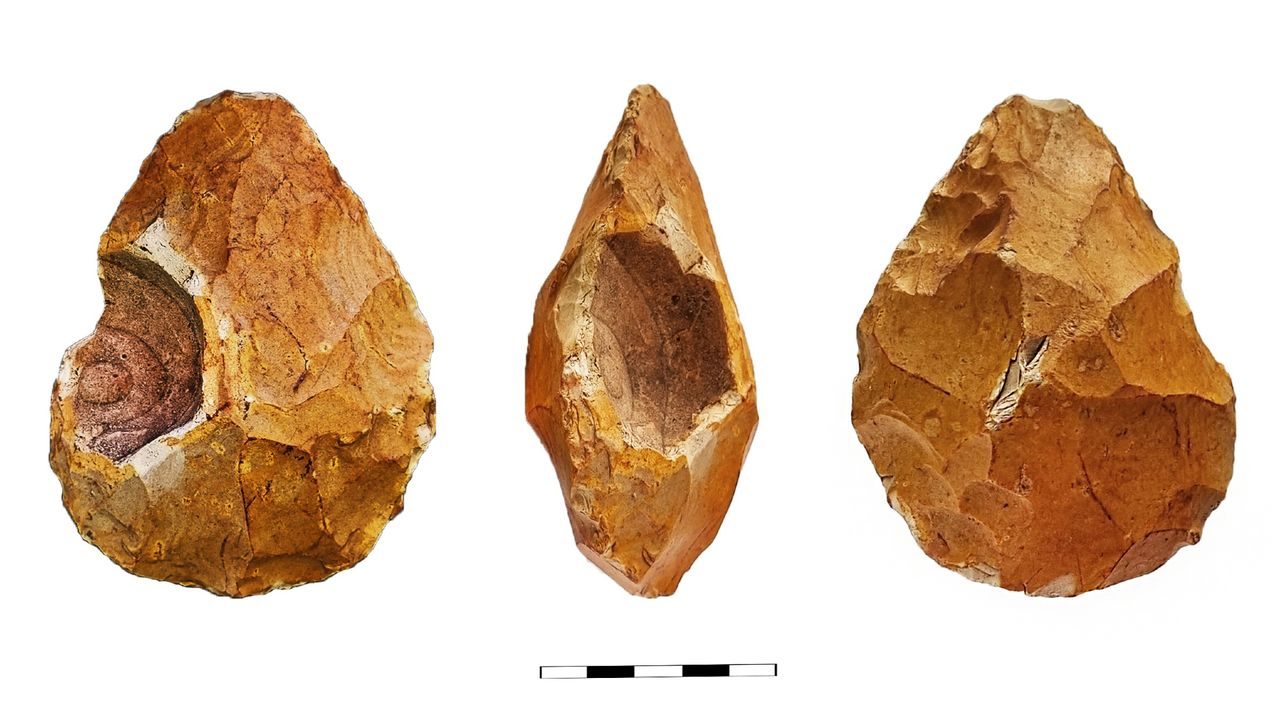
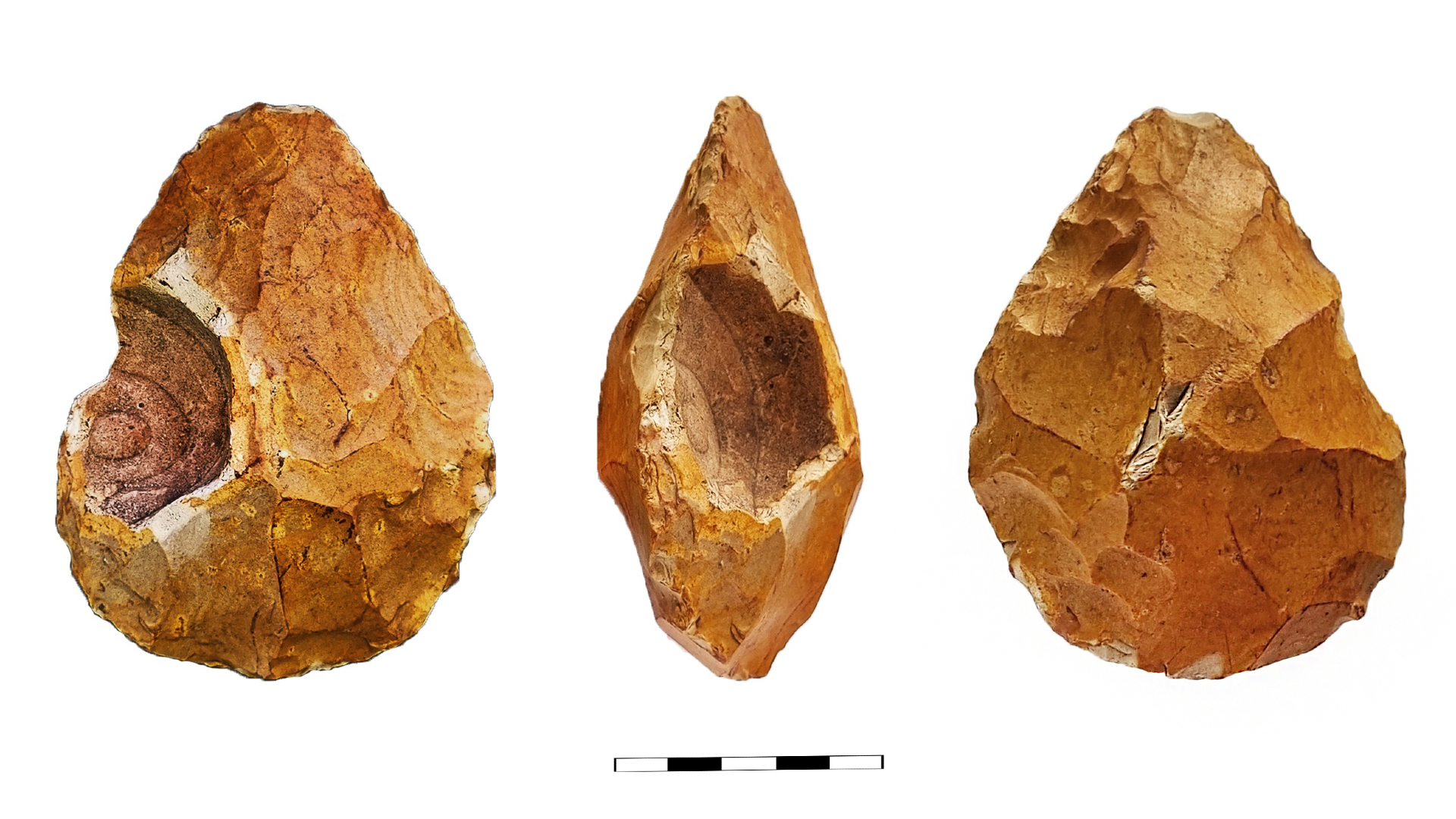
Ten prehistoric stone hand axes — crafted to deliberately showcase sparkling geodes and embedded fossils — have been unearthed in Israel, and researchers believe they offer a rare window into the inner life of one of our earliest human ancestors.
The axes, described as “extremely rare,” were almost certainly made by Homo erectus, the ancient human species that walked the Earth hundreds of thousands of years before modern humans emerged. What makes these tools so striking isn’t just their age — it’s the intention behind them. Researchers believe the makers deliberately shaped these hand axes around geological features, preserving fossils and geodes rather than carving them away.
That’s not the behavior of someone just trying to cut meat or scrape hide. That’s something closer to wonder.
What Archaeologists Found in Israel’s Sakhnin Valley
The hand axes were discovered at Sakhnin Valley in Israel. Archaeologists identified ten of them, each incorporating a notable geological feature — either a fossil preserved within the stone or a geode, the kind of rock that conceals a hollow interior lined with crystals.
The researchers concluded these features were not accidental. Whoever made these tools actively chose stones that contained these natural formations and then shaped the ax around them, keeping the geological curiosity visible and intact. That level of deliberate craftsmanship points toward something beyond pure utility.
The axes are estimated to date from between 500,000 and 200,000 years ago, placing them squarely within the period when Homo erectus inhabited this region of the ancient world.
Why Homo Erectus May Have Cared About Geodes and Fossils
The study researchers suggest these objects were likely thought to be imbued with potency and cosmic significance by the individuals who made and carried them. In other words, Homo erectus may have viewed these geode-bearing or fossil-containing stones as more than raw material — they may have seen them as objects connected to something larger than themselves.
This is a meaningful claim. For a long time, complex symbolic thinking — the ability to assign meaning to objects beyond their practical function — was considered a trait that set modern humans apart. Discoveries like this one challenge that assumption, suggesting the roots of symbolic or spiritual thought may stretch much further back into human prehistory than previously understood.
Homo erectus is already known to have been a remarkably capable species. They were among the first hominins to use fire, craft sophisticated tools, and migrate out of Africa into Europe and Asia. But attributing to them a sense of cosmic connection or reverence for natural objects adds a new layer to our understanding of what they were like as thinking, feeling beings.
Key Facts About These Prehistoric Hand Axes
| Detail | Information |
|---|---|
| Number of axes found | 10 |
| Discovery location | Sakhnin Valley, Israel |
| Estimated age | 500,000 to 200,000 years ago |
| Likely maker | Homo erectus |
| Geological features preserved | Fossils and geodes |
| Rarity classification | “Extremely rare” per study researchers |
- The tools are classified as hand axes, one of the most common tool types associated with Homo erectus and the broader Acheulean stone tool tradition.
- Researchers believe the geological features were deliberately preserved, not accidentally retained during the knapping process.
- The proposed explanation centers on symbolic or spiritual significance — the idea that these natural formations were seen as cosmically meaningful.
- The find comes from Israel, a region with a rich record of early human habitation and tool use.
What This Tells Us About the Human Story
Findings like this one matter because they push back the timeline of human complexity. If Homo erectus was selecting stones not just for their sharpness or durability but for their beauty or perceived power, that suggests a form of abstract thought far older than we typically credit.
Researchers studying the axes argue the behavior reflects a connection to the cosmos — a phrase that might sound poetic, but in an archaeological context carries real weight. It implies these early humans were capable of looking at a glittering geode or a fossil locked in stone and assigning it meaning that went beyond the immediate and practical.
For anyone interested in what makes us human — where our capacity for art, religion, and wonder actually comes from — this discovery suggests those instincts have very deep roots indeed.
It also raises a quieter, harder question: how many other behaviors we consider distinctly modern were actually present in species that came long before us, leaving only faint traces in the stones they left behind?
What Researchers Are Still Working to Understand
The study identifies the pattern and proposes an explanation, but archaeology rarely delivers certainty about intention. Researchers cannot know with absolute confidence what was going through the mind of a Homo erectus toolmaker half a million years ago. What they can do is observe the pattern — ten axes, all incorporating geological features, all shaped to keep those features visible — and ask what the most reasonable explanation is.
The answer the researchers landed on is that these objects held special meaning. Whether future discoveries at Sakhnin Valley or similar sites will add more detail to that picture remains to be seen. But for now, these ten hand axes stand as some of the most thought-provoking artifacts from the deep human past.
Frequently Asked Questions
Who made the hand axes found in Israel?
The axes were most likely made by Homo erectus, an early human ancestor, based on the estimated age of the tools and the archaeological context of the site.
How old are the hand axes?
Researchers estimate they were crafted somewhere between 500,000 and 200,000 years ago.
Why did Homo erectus preserve fossils and geodes in the tools?
Study researchers suggest these geological features were seen as objects of cosmic or symbolic significance, meaning the tools may have held spiritual or cultural importance beyond their practical use.
Where exactly were the axes discovered?
The ten hand axes were unearthed at Sakhnin Valley in Israel.
How many axes were found with these geological features?
Ten hand axes were identified, all described by researchers as “extremely rare” due to the deliberate inclusion of fossils and geodes.
Does this change what we know about Homo erectus?
It adds to a growing body of evidence suggesting Homo erectus was capable of symbolic or abstract thinking — a trait long assumed to be unique to modern humans — though the full implications are still being studied.




Leave a Reply