
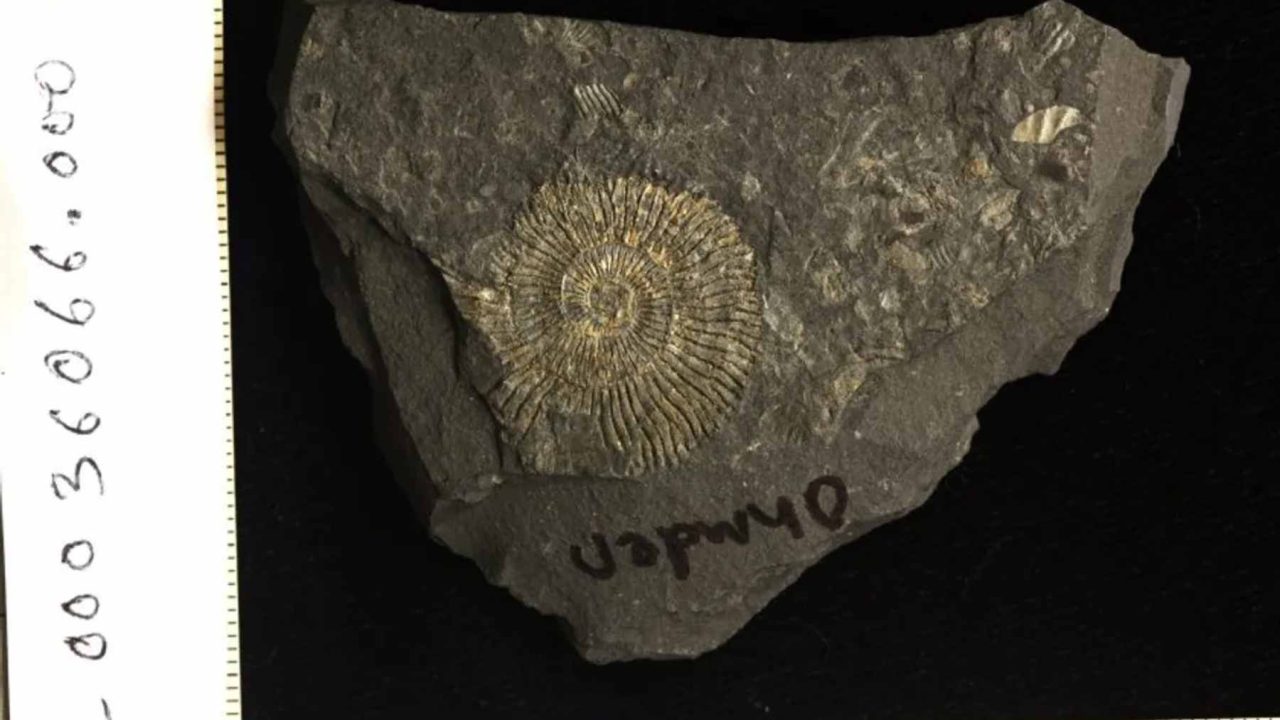
Crack open a slab of black shale in southwestern Germany, and something almost impossible catches your eye — a fossil shell, 183 million years old, gleaming like a freshly polished coin. It looks metallic. It looks like gold. And for decades, most people assumed they knew exactly what they were seeing.
They were wrong.
New research into fossils from Germany’s famous Posidonia Shale has overturned a long-standing assumption about what gives these ancient Jurassic specimens their distinctive golden shine. The answer turns out to be far more chemically interesting — and scientifically valuable — than anyone had previously appreciated.
The Fossil That Fooled Collectors and Scientists Alike
The Posidonia Shale of southwestern Germany is one of the most celebrated fossil sites in the world. Preserved within its dark, dense layers are the remains of creatures that lived during the Early Jurassic period, roughly 183 million years ago. Among the most visually striking finds are ammonite shells that appear to be coated in metal — catching light with a warm, golden shimmer that makes them look almost manufactured.
For years, the widespread explanation was straightforward: pyrite. Also known as fool’s gold, pyrite is an iron sulfide mineral with a well-documented tendency to form in low-oxygen sediment environments — exactly the kind of conditions that the Posidonia Shale represents. The metallic sheen on these fossils seemed to confirm it. Collectors catalogued them as pyritized specimens. Some scientific interpretations followed the same logic.
It made intuitive sense. Pyrite looks convincingly metallic when it reflects light, and it forms readily in the oxygen-poor seafloor conditions that are thought to have existed when these animals died and settled into the ancient mud.
But detailed laboratory analysis has now complicated that picture significantly.
What the Lab Work Actually Found
When researchers examined these fossils more closely, the chemistry told a different story. According to the findings, the golden sheen on the fossil shells themselves comes primarily from phosphate minerals — not pyrite. The pyrite is certainly present in these specimens, but it is concentrated in the surrounding rock matrix, not in the shells producing the metallic glitter.
In practical terms, what looks like fool’s gold is actually something closer to a chemical illusion — a phosphate-driven optical effect that mimics the appearance of a pyritized fossil without actually being one.
That distinction matters more than it might seem at first glance.
| Feature | Previous Assumption | New Finding |
|---|---|---|
| Source of golden sheen | Pyrite (iron sulfide) in the fossil shell | Phosphate minerals within the fossil itself |
| Location of pyrite | Assumed to be coating the shell | Found concentrated in the surrounding rock |
| Fossil age | 183 million years (Early Jurassic) | 183 million years (confirmed) |
| Formation site | Posidonia Shale, southwestern Germany | Posidonia Shale, southwestern Germany |
| Environmental record | General indicator of low-oxygen conditions | Precise chemical record of ancient ocean oxygen levels |
Why This Changes More Than Just the Label
The reclassification of these fossils is not just a matter of getting the mineralogy right. It has real implications for how scientists read the environmental record preserved inside these ancient rocks.
Phosphate minerals preserve information differently than pyrite does. Researchers now believe these fossils carry a surprisingly precise chemical record of how oxygen behaved in the ancient sea during the Early Jurassic period. That kind of data is difficult to obtain and enormously useful for understanding past ocean conditions.
The Posidonia Shale itself is already known as a window into a world defined by oxygen-depleted waters — conditions that helped preserve soft tissue and fine skeletal detail in remarkable ways. But if the phosphate chemistry in these shells encodes a more granular picture of those oxygen fluctuations, it means scientists may be able to extract environmental data from specimens that were previously treated primarily as aesthetic collector’s pieces.
There is also a broader lesson here about assumption. The visual similarity between phosphate-mineralized shells and pyritized ones is close enough that even experienced eyes can be fooled. It is a reminder that in paleontology, what something looks like and what it actually is can diverge in ways that only careful lab analysis can resolve.
The Posidonia Shale and Why It Keeps Surprising Researchers
The Posidonia Shale has been a source of extraordinary fossils for well over a century. Its dark, oxygen-poor sediments created conditions ideal for preservation — not just of hard shells, but sometimes of soft tissues, skin impressions, and stomach contents. Ichthyosaurs, marine reptiles, fish, and countless invertebrates have all emerged from these layers in exceptional condition.
The shale’s low-oxygen depositional environment is central to why preservation is so good, and it is also why pyrite forms so readily in the surrounding matrix. Sulfur-reducing bacteria thrive in those conditions, and pyrite is a byproduct of their activity. That context made the pyrite assumption about the golden shells seem all the more reasonable for so long.
Reassessing even well-studied formations like this one continues to yield surprises. The chemistry of fossilization is more varied and more nuanced than early classifications often captured, and modern analytical techniques are giving researchers tools to revisit old specimens with fresh eyes.
What Comes Next for These Fossils
The immediate implication is that collections containing these “golden ammonites” — whether in museums, universities, or private hands — may need to be reexamined with updated chemical analysis in mind. Specimens catalogued as pyritized may in fact carry phosphate mineralogy, which changes both their scientific classification and the type of environmental data they can yield.
More broadly, researchers are likely to look more carefully at whether similar misidentifications exist in other fossil-bearing shale formations around the world. The Posidonia Shale is exceptional, but it is not unique in its depositional chemistry, and the same optical confusion between phosphate and pyrite could have occurred elsewhere.
For now, the next time someone cracks open a black rock in southwestern Germany and sees something that looks like gold, the honest answer is: look closer. The real story is almost always more interesting than the obvious one.
Frequently Asked Questions
What gives Jurassic fossils from the Posidonia Shale their golden appearance?
Research now indicates the golden sheen comes primarily from phosphate minerals within the fossil shells themselves, not from pyrite as was widely assumed.
Where is the pyrite actually located in these specimens?
According to the findings, pyrite is concentrated in the rock matrix surrounding the fossils, rather than in the shells producing the metallic glitter.
Why does the distinction between pyrite and phosphate matter scientifically?
Phosphate minerals preserve a more precise chemical record of ancient ocean oxygen levels, making these fossils potentially more valuable as environmental data sources than previously recognized.
How old are the fossils from the Posidonia Shale?
The fossils are approximately 183 million years old, dating to the Early Jurassic period.
Where is the Posidonia Shale located?
The Posidonia Shale is found in southwestern Germany and is one of the world’s most celebrated fossil sites, known for its exceptional preservation conditions.
Does this discovery mean all golden-looking fossils have been misidentified?
This has not been confirmed beyond the Posidonia Shale specimens described in this research, though scientists may now look more carefully at similar formations elsewhere for comparable misidentifications.


Leave a Reply