
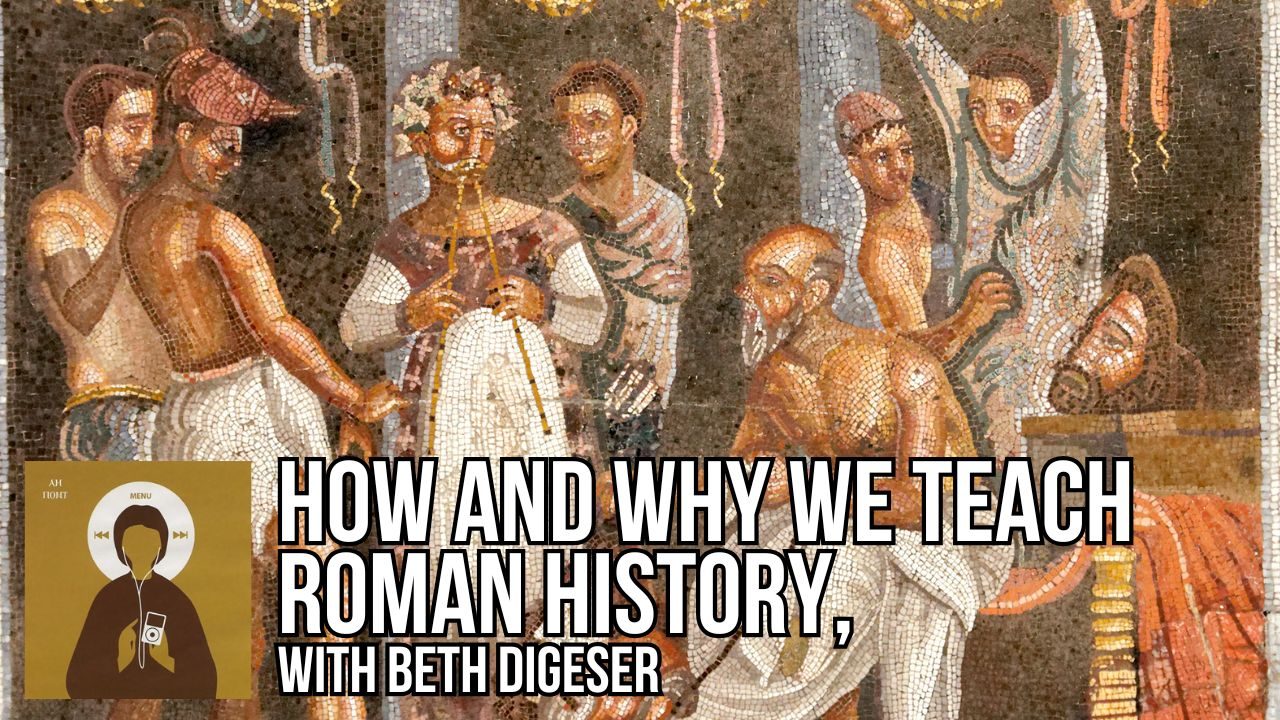
Why do we still teach Roman history — and are the reasons we give actually good ones? It’s a question that sounds simple but opens into something much more complicated the moment you start pulling at the threads.
That’s the territory explored in a recent episode of the podcast Byzantium & Friends, hosted by Anthony Kaldellis, a Professor at the University of Chicago. His guest was Elizabeth DePalma Digeser, a Professor at the University of California, Santa Barbara, whose research centers on Late Roman Antiquity — specifically the reigns of emperors Diocletian and Constantine.
Their conversation moves through questions of pedagogy, historical relevance, and the way Rome keeps getting reinvented to speak to whatever the present moment seems to need. It’s a conversation that any teacher, student, or curious reader of ancient history would find worth their time.
The Problem With “Influence” as a Justification for Teaching Roman History
One of the central tensions the conversation addresses is the standard justification many educators reach for when defending Roman history on a syllabus: Rome matters because of its influence on the modern world. Roads, law, language, empire — the familiar list.
But Digeser and Kaldellis push back on that framing. The “influence” argument has real limits. It can reduce a complex, living civilization to a kind of origin story for Western institutions, which flattens both Rome itself and the cultures it interacted with. It also quietly implies that Rome’s value is borrowed — that it only matters insofar as it explains something else.
That’s a shaky foundation for a serious historical education, and the conversation makes clear that scholars in the field are actively looking for better frameworks.
How Rome Gets Reinvented for Every Era
One of the more striking observations in the discussion is how consistently Rome has been reshaped to serve present concerns. This isn’t a modern phenomenon — it’s been happening for centuries. Political movements, empires, republics, and ideological projects of all kinds have reached back to Rome and found something useful there.
The podcast discussion touches on what scholars have begun calling “Global Rome” — a framework that tries to move beyond the traditional Eurocentric lens and situate Rome within broader patterns of world history. This approach looks at Rome not just as the ancestor of European civilization but as one node in a much larger network of trade, culture, and political exchange spanning Asia, Africa, and the Mediterranean world.
This reframing matters for teaching because it changes who the history is for. A Global Rome isn’t just relevant to students tracing European heritage — it becomes a story about interconnected civilizations, migration, economics, and cross-cultural contact that resonates far more widely.
Why Late Antiquity Poses Special Challenges in the Classroom
Digeser’s own research sits at a particularly complex intersection: the reigns of Diocletian and Constantine, two emperors who together defined one of the most dramatic transformations in Roman — and world — history. From that vantage point, she looks both backward into the classical Roman period and forward into what scholars call Late Antiquity.
Late Antiquity — roughly the third through seventh centuries CE — is a period that resists easy categorization. It’s neither the Rome of Julius Caesar nor the medieval Europe of kings and cathedrals. It’s something in between and something entirely its own: a world of religious upheaval, shifting political structures, mass migration, and the gradual transformation of Roman institutions into new forms.
Teaching this period presents specific challenges. Students often arrive with expectations shaped by popular culture — gladiators, togas, the Senate — and Late Antiquity doesn’t fit that image. The Christianity of Constantine, the administrative reforms of Diocletian, the pressures on the frontiers — these require students to revise what they think they already know about Rome.
That revision, the podcast suggests, is actually part of the value. Encountering a Rome that doesn’t match the simplified version forces genuine historical thinking.
Key Themes From the Conversation at a Glance
| Theme | Core Question | Why It Matters for Teaching |
|---|---|---|
| Limits of “influence” | Is Roman history only valuable as a source for modern institutions? | Encourages deeper engagement beyond origin-story framing |
| Rome’s reinvention | How has Rome been reshaped to serve different political and cultural agendas? | Teaches critical awareness of how history gets used |
| Global Rome | Can Rome be taught outside a Eurocentric framework? | Broadens relevance to a more diverse student body |
| Late Antiquity | How do we teach a period that defies easy categorization? | Challenges assumptions and builds genuine historical thinking |
| Pedagogy and purpose | What are we actually trying to accomplish by teaching Roman history? | Forces educators to articulate clearer goals |
Who This Conversation Is Really For
On the surface, this is a conversation between two academics — Kaldellis at the University of Chicago and Digeser at UC Santa Barbara — about how to structure university courses. But the questions they raise extend well beyond the lecture hall.
Anyone who has ever wondered why ancient Rome still shows up in political rhetoric, in legal philosophy, in architecture, in the language of empire and republic — this conversation speaks to that curiosity directly. It asks not just what Rome was, but what we keep making it mean, and whether those meanings are honest ones.
For teachers at any level, the discussion offers a useful challenge: before you explain Rome to your students, ask yourself why you’re doing it. The answer shapes everything that follows.
The episode is part of the Byzantium & Friends podcast, hosted by Kaldellis, and is available through Podbean, Spotify, and Apple Podcasts. The original episode listing appears on Medievalists.net.
Frequently Asked Questions
Who are the scholars featured in this podcast conversation?
The episode features Anthony Kaldellis, a Professor at the University of Chicago who hosts Byzantium & Friends, in conversation with Elizabeth DePalma Digeser, a Professor at the University of California, Santa Barbara.
What does Elizabeth DePalma Digeser specialize in?
Her research focuses on Late Roman Antiquity, with particular attention to the reigns of emperors Diocletian and Constantine.
What is the “Global Rome” framework mentioned in the discussion?
It is an approach to Roman history that moves beyond a Eurocentric perspective, situating Rome within broader networks of world history involving Asia, Africa, and the wider Mediterranean world.
Why do the scholars question the “influence” argument for teaching Roman history?
They suggest it reduces Rome to merely an origin story for Western institutions, which limits genuine historical understanding and narrows the reasons for studying the civilization.
Where can I listen to the Byzantium & Friends podcast?
The podcast is available through Podbean, Spotify, and Apple Podcasts.
What makes Late Antiquity particularly challenging to teach?
The period — covering roughly the third through seventh centuries CE — resists easy categorization and often conflicts with the simplified popular-culture image of Rome that students bring to the classroom.
Leave a Reply