
About 35 light years from Earth — roughly 206 trillion miles away — a planet sits locked in a state that makes our own world look impossibly calm. Its surface is not rock. It is not ocean. It is an endless, permanent sea of molten magma, laced with sulfur, and it may have been burning that way for billions of years.
That planet is called L 98-59 d, and according to a peer-reviewed study published March 16, 2026 in Nature Astronomy, it represents something astronomers have not formally classified before: a new category of hellish world that does not fit neatly into any existing label.
The research, led by a team at the University of Oxford, argues that L 98-59 d is not a typical super-Earth, not a water world, and not a hydrogen-wrapped rocky core. It is something stranger — and studying it could change how scientists think about planetary atmospheres and the conditions that allow them to survive.
Why L 98-59 d Breaks the Usual Categories
When astronomers discover a small planet beyond our solar system, they tend to sort it into one of a few familiar boxes. Rocky world. Ocean planet. Mini-Neptune wrapped in gas. L 98-59 d keeps slipping out of all of them.
The planet orbits a red dwarf star and measures about 1.6 times Earth’s radius — approximately 6,400 miles across. That puts it firmly in what scientists call the “super-Earth” size range. But its mass and density tell a very different story about what is actually inside it.
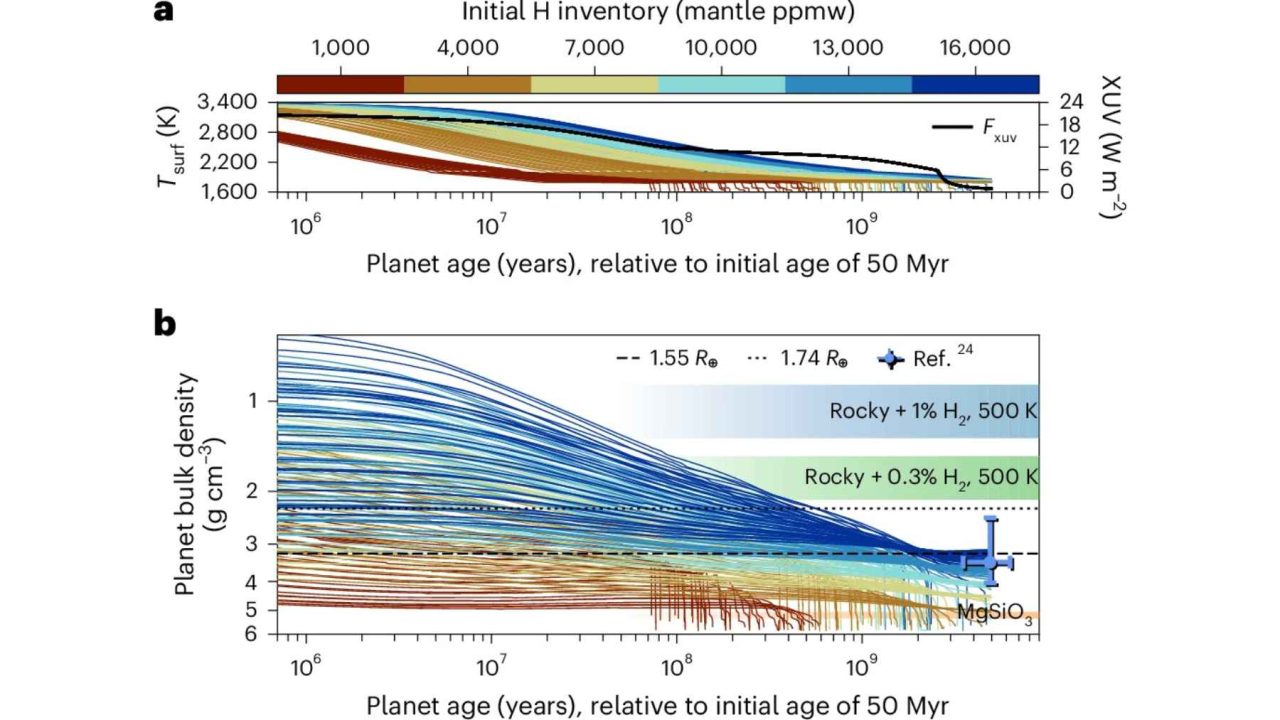
Measurements place it at roughly 1.64 Earth masses and 1.627 Earth radii. The resulting density is unusually low. One estimate puts it at just 2.2 grams per cubic centimeter (about 137 pounds per cubic foot). A separate analysis explored in the same paper suggests 3.45 grams per cubic centimeter (around 215 pounds per cubic foot). Either figure is far too low for a planet made primarily of rock and iron.
Low-density small planets usually get explained one of two ways: they either have a thick hydrogen atmosphere puffing them up, or they are rich in water — the so-called “ocean world” model. The Oxford-led team argues L 98-59 d fits neither explanation. Instead, they point to something far more dramatic: a planet with enormous sulfur reserves embedded inside a global, permanent ocean of molten rock.
What a Permanent Magma Ocean Actually Means
The term “magma ocean” sounds like a temporary geological event — the kind of thing a young planet goes through before it cools and solidifies. On Earth, that cooling happened billions of years ago. On L 98-59 d, the researchers argue, it never did.
A permanent global magma ocean means the entire surface of the planet remains molten, indefinitely. There is no crust forming and breaking apart. No tectonic cycle as we understand it. Just an unbroken expanse of liquid rock, potentially stretching across the entire world.
What makes this scientifically significant — beyond the sheer strangeness of it — is what the researchers say that magma ocean does for the planet’s atmosphere. The sulfur locked inside the molten rock, according to the study, may interact with the planet’s atmosphere in ways that help keep that atmosphere stable over billions of years. That is a meaningful finding, because one of the central questions in planetary science is why some planets hold onto their atmospheres and others lose them to space.
The Numbers Behind the Discovery
| Measurement | Value | Comparison |
|---|---|---|
| Distance from Earth | ~35 light years | ~206 trillion miles |
| Planet radius | 1.627 Earth radii | ~6,400 miles across |
| Planet mass | ~1.64 Earth masses | Slightly larger than Earth |
| Density (estimate 1) | 2.2 g/cm³ | ~137 lbs per cubic foot |
| Density (estimate 2) | 3.45 g/cm³ | ~215 lbs per cubic foot |
| Host star type | Red dwarf | Small, cool star |
| Study published | March 16, 2026 | Nature Astronomy |
The two density estimates reflect genuine uncertainty in the measurements — a common challenge when studying planets dozens of light years away. But crucially, both figures point in the same direction: this planet is far less dense than a simple rock-and-metal composition would predict, which is what drives the magma ocean hypothesis in the first place.
Why This Matters Beyond One Strange Planet
It would be easy to treat L 98-59 d as a curiosity — an exotic outlier too distant and too alien to tell us anything useful. The researchers clearly believe otherwise.
Planets orbiting red dwarf stars are among the most common in the galaxy. They are also among the most studied, because their small, dim host stars make it easier for telescopes to detect planets and analyze their atmospheres. If a distinct class of sulfur-rich, magma-ocean worlds exists around red dwarfs, that has real consequences for how scientists model planetary habitability and atmospheric evolution across the universe.
The finding also raises pointed questions about how we categorize exoplanets at all. The “super-Earth” label, applied to any rocky planet larger than ours but smaller than Neptune, has always been a rough shorthand. L 98-59 d suggests the category may be masking enormous internal diversity — worlds that look similar from the outside but are fundamentally different underneath.
What Researchers Are Looking at Next
The study published in Nature Astronomy represents a characterization of what L 98-59 d might be, based on available mass and radius data. The next step for researchers will likely involve more detailed atmospheric observations — the kind that next-generation telescopes are increasingly capable of providing.
If the planet does maintain a stable atmosphere sustained in part by its magma ocean and sulfur chemistry, that signature may be detectable. Confirming or refuting the magma ocean model will require more data, but the hypothesis is now formally in the scientific literature, peer-reviewed and available for other teams to test.
For now, L 98-59 d stands as a compelling argument that our map of what planets can be is still far from complete.
Frequently Asked Questions
What is L 98-59 d?
L 98-59 d is an exoplanet orbiting a red dwarf star approximately 35 light years from Earth. It measures about 1.6 times Earth’s radius and is the subject of a March 2026 study in Nature Astronomy.
What makes L 98-59 d different from other super-Earths?
Unlike most low-density small planets, which are explained as water worlds or hydrogen-wrapped rocky cores, the Oxford-led research team argues L 98-59 d hosts a permanent global ocean of molten magma rich in sulfur.
Who conducted this research?
The study was led by a team at the University of Oxford and published in the peer-reviewed journal Nature Astronomy on March 16, 2026.
Why is the planet’s density so significant?
Its density — estimated between 2.2 and 3.45 grams per cubic centimeter — is too low to be explained by a standard rock-and-iron composition, which is what led researchers toward the magma ocean and sulfur hypothesis.
Could this planet support life?
A permanent global magma ocean would represent an extreme environment, but the study focuses on atmospheric stability rather than life potential.
How do scientists study a planet 35 light years away?
Researchers use measurements of the planet’s mass and radius — gathered through telescope observations — to calculate density and infer what the interior composition is likely to be.


Leave a Reply