
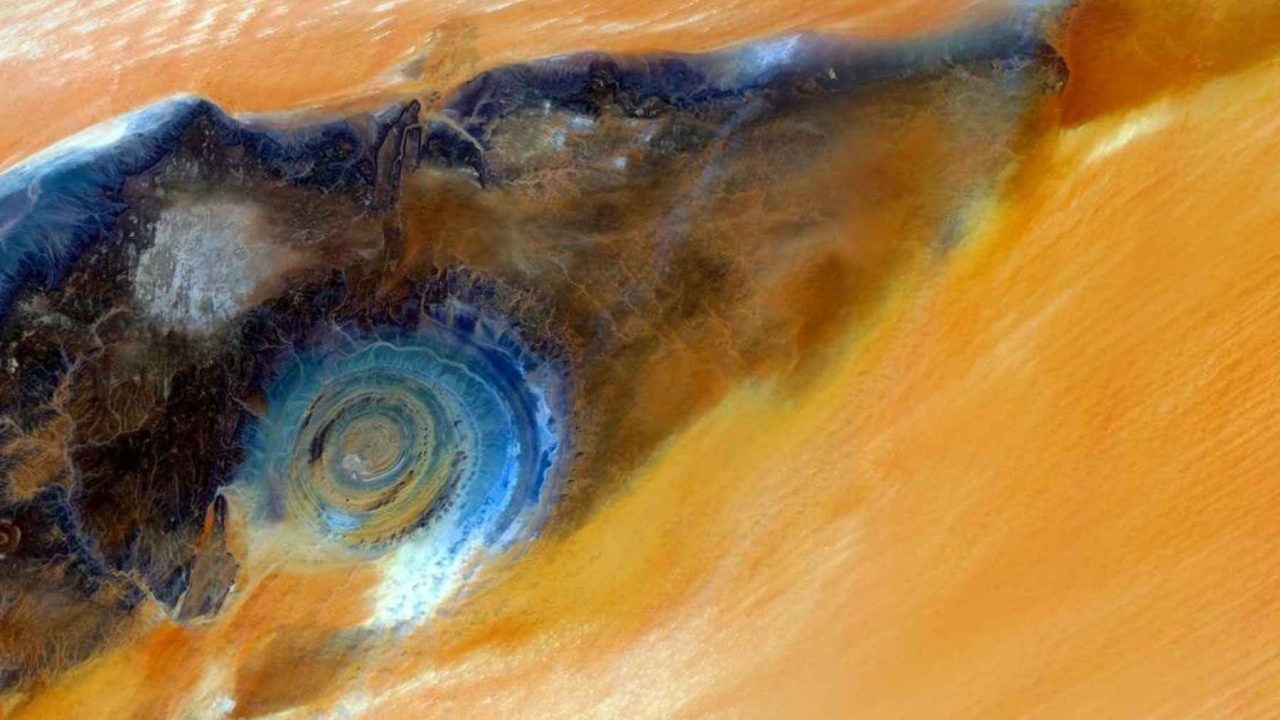
It looks like a giant eye staring back at you from space — a near-perfect bull’s-eye of concentric rings stamped into the sand of the Sahara Desert, stretching roughly 25 miles across. Astronauts have been noticing it since the earliest days of human spaceflight. And for a long time, plenty of people assumed something catastrophic from the cosmos must have caused it.
They were wrong. NASA’s Earth Observatory has highlighted the Richat Structure in Mauritania — commonly known as the “Eye of the Sahara” — and the agency is clear: this is not a meteor impact crater. The real explanation is quieter, slower, and in many ways more fascinating than a space rock collision.
What you’re looking at is the result of geology and time working together over millions of years. And the International Space Station has given us one of the most striking views of it yet.
What the Eye of the Sahara Actually Is
The Richat Structure sits in Mauritania, in the western Sahara. From ground level, it barely registers as anything unusual. From orbit, it’s one of the most visually arresting features on Earth’s surface — a series of circular ridges so symmetrical they look almost engineered.
For decades, the leading theory was that a meteorite impact had punched this shape into the desert. The circular form, the raised ridges, the sheer scale — it all seemed to point toward a violent extraterrestrial origin. That theory has since been set aside.
According to NASA, what actually happened is this: the ground in this region was pushed upward over geological time, forming a dome. Then erosion — wind, water, and the slow grinding work of time — wore away the softer rock layers at different rates, gradually revealing the harder underlying rings. The result is a geological dome that erosion etched into concentric ridges, not a crater blasted from above.
The surrounding dunes visible in imagery from the International Space Station also tell their own story, mapping the winds that continuously reshape the desert around this ancient structure.
Why Astronauts Have Always Been Drawn to It
The Eye of the Sahara has served as a navigational landmark since the earliest human missions to space. The Sahara is enormous — it can look surprisingly featureless from orbit, a vast ocean of sand and rock with few reliable reference points. The Richat Structure breaks that monotony decisively.
NASA notes that astronauts have been drawn to the structure since those earliest missions, precisely because of how dramatically it stands out against the otherwise uniform desert landscape. There is nothing else quite like it visible from that altitude.
Its value as a landmark has only grown as more crews have passed over it aboard the International Space Station. The feature is large enough, and distinct enough, that it reads clearly even from hundreds of miles up.
The Numbers Behind the Eye of the Sahara
One interesting detail in NASA’s coverage is a slight variation in how the structure’s size is described. Different NASA imagery and reporting place the feature at slightly different measurements, which the agency itself acknowledges is not a cause for concern.
| Measurement Reference | Approximate Size |
|---|---|
| NASA Earth Observatory (primary description) | About 25 miles (approximately 40 km) across |
| Broader NASA imagery estimates | Approximately 28–30 miles (roughly 45–48 km) across |
| Location | Mauritania, western Sahara Desert |
| Common nickname | The “Eye of the Sahara” |
| Confirmed origin | Uplifted geological dome, shaped by erosion |
| Previously assumed origin | Meteor impact (now ruled out by NASA) |
As NASA points out, that size discrepancy is simply a reminder that natural features don’t have clean edges. Where exactly the structure “ends” depends on what you’re measuring and how. Either way, you’re looking at one of the largest and most visually striking geological formations on the planet’s surface.
What This Tells Us About Reading Earth From Space
The Richat Structure is a useful reminder of how orbit changes the way we understand our own planet. Features that are invisible or meaningless at ground level become legible from space in ways that reshape our understanding of geology, climate, and history.
The dunes surrounding the Eye, for example, aren’t just background detail in a photograph. They are a real-time record of wind patterns — showing how the Sahara is constantly in motion, constantly being remade by the forces moving across it. From the International Space Station, those patterns become visible in a single glance.
This is part of why NASA’s Earth Observatory program continues to focus attention on features like the Richat Structure. It’s not just about spectacular imagery, though the imagery is genuinely spectacular. It’s about using the vantage point of orbit to read Earth’s surface as a living document of geological and environmental processes.
The Eye of the Sahara has been sitting in the Mauritanian desert for millions of years. It took human spaceflight to finally let us see it properly — and ongoing space station observations continue to reveal new detail about how the desert around it keeps changing.
Frequently Asked Questions
What is the Eye of the Sahara?
The Eye of the Sahara, formally known as the Richat Structure, is a large circular geological formation in Mauritania featuring concentric rings visible from space.
Was the Richat Structure caused by a meteor impact?
No. NASA confirms the structure is not a meteor impact crater. It is an uplifted geological dome that was gradually shaped into concentric rings by erosion over millions of years.
How big is the Eye of the Sahara?
NASA describes it as approximately 25 miles across, though broader measurements from other NASA imagery place the full feature closer to 28 to 30 miles wide, depending on how it is measured.
Where exactly is the Richat Structure located?
It is located in Mauritania, in the western Sahara Desert.
Why have astronauts always paid attention to it?
NASA notes that astronauts have been drawn to the Richat Structure since the earliest human space missions because it stands out dramatically against the otherwise featureless Sahara Desert, making it a reliable visual landmark from orbit.
Can the Eye of the Sahara be seen from the International Space Station?
Yes. NASA’s Earth Observatory has highlighted imagery of the structure captured from the International Space Station, where it appears as a striking bull’s-eye pattern in the desert below.




Leave a Reply