
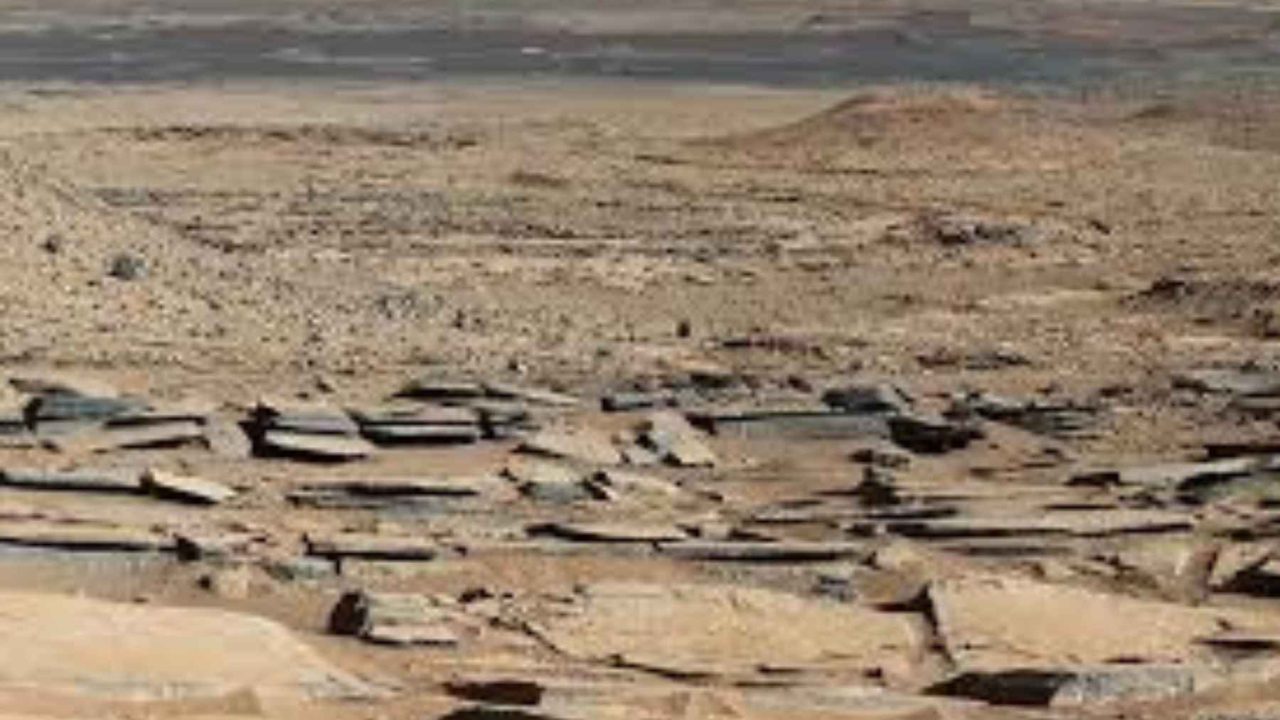
A wide, flat band circling the edge of Mars’s northern lowlands — described by researchers as looking like the ring left behind when a bathtub drains — may be the strongest geological evidence yet that an ancient ocean once covered roughly one-third of the Red Planet’s surface.
The findings, published in a paper released on April 15, 2026, have reignited one of planetary science’s longest-running debates: did Mars once hold a vast body of liquid water, and if so, what happened to it?
The answer, researchers suggest, may have been sitting in plain sight all along — written not in a thin line of ancient shoreline, but in the broad, durable geology beneath it.
The ‘Bathtub Ring’ That Could Rewrite Mars History
When you drain a bathtub, a faint ring of residue is left behind at the waterline. Scale that image up to the size of a planet, and you have a rough idea of what scientists say they’ve found on Mars.
Researchers described a long, continuous band of unusually flat terrain marking the transition between the Martian northern lowlands and the higher ground surrounding them. That feature, they argue, is not just a topographical curiosity — it’s the remnant of what was once a continental shelf, the broad underwater ramp that forms where land eases gradually into a sea.
If that interpretation holds up, the ocean it bordered would have been enormous — covering approximately one-third of Mars’s total surface area.
The distinction between a shelf and a simple shoreline is more important than it might sound. A thin waterline, like footprints in sand, can be erased over billions of years by wind erosion, volcanic activity, and shifting terrain. A continental shelf, by contrast, is a much larger landform. Bigger geological targets survive longer. That’s precisely why researchers believe this feature may have endured when other evidence did not.
Why This Discovery Matters More Than Previous Claims
The idea of an ancient Martian ocean is not new. Scientists have proposed it for decades, and evidence has accumulated slowly — ancient river deltas, mineral deposits consistent with prolonged water exposure, and traces of what appear to be old coastlines. But each piece of evidence has faced serious challenges, and no single finding has settled the argument.
What makes the shelf hypothesis potentially more compelling is durability. Previous attempts to identify Martian shorelines focused on narrow features that could plausibly be explained by other geological processes. A shelf, by its nature, is harder to dismiss. It represents a sustained, large-scale geological environment — the kind that forms over long periods of time and leaves a deeper imprint on the landscape.
Researchers note that a long-lived ocean would not just leave water behind. It would leave geology behind — thick layers of mud and sand capable of storing a detailed record of what conditions were like and what happened as the water eventually disappeared.
What the Geology Actually Shows
The key feature identified in the April 2026 paper is a belt of terrain that appears unusually flat relative to the surrounding landscape, located precisely where a continental shelf would be expected if the northern lowlands once held a large ocean.
On Earth, continental shelves are the gently sloping underwater plains that extend from coastlines before the ocean floor drops away sharply. They are not the visible waterline at a beach — they are the wide, submerged ramp beneath it. That ramp, over geological time, accumulates sediment and develops a distinctive flat profile that persists long after the water above it is gone.
The Martian feature described by researchers shares those characteristics: a broad, flat band sitting at the edge of the northern lowlands, at the exact elevation where an ancient ocean’s shelf would have formed.
| Feature | Description | Significance |
|---|---|---|
| Bathtub ring / shelf band | Wide, flat terrain circling Mars’s northern lowlands | Potential remnant of an ancient continental shelf |
| Estimated ocean coverage | Approximately one-third of Mars’s surface | Would represent a planet-scale body of water |
| Paper publication date | April 15, 2026 | Most recent research contributing to this hypothesis |
| Shelf vs. shoreline durability | Shelf survives erosion and volcanic activity longer | Makes this evidence harder to explain away than prior claims |
The Deeper Question This Evidence Raises
If Mars once held an ocean covering a third of its surface, the implications stretch well beyond geology. Liquid water, sustained over long periods, is one of the foundational conditions associated with the potential emergence of life. A large, persistent northern ocean would mean Mars once had not just water, but a water cycle — evaporation, precipitation, rivers feeding back into the sea.
That’s a very different planet from the frozen, arid world we observe today. And the sedimentary layers that a long-lived shelf would have produced could, in theory, preserve chemical or even biological signatures from that era — if any existed.
Researchers point out that the thick sediment layers associated with a continental shelf environment are exactly the kind of geological record worth targeting in future missions. They don’t just mark where water was. They store what happened while it was there.
What Comes Next for Mars Ocean Research
The April 2026 paper adds significant weight to the ancient ocean hypothesis, but it does not settle it. Competing explanations for Mars’s northern lowland geology — including volcanic processes and glacial activity — have not been ruled out entirely, and the scientific community will need further data to build consensus.
Future Mars missions focused on subsurface drilling or detailed sediment analysis in the northern lowlands could provide the kind of direct evidence that remote observation cannot. The shelf feature identified in this research gives scientists a more precise target to study — a region where the geological record of a potential ancient ocean would be most concentrated and best preserved.
For now, the bathtub ring on Mars stands as one of the most compelling arguments yet made for a wet ancient Red Planet — a planet-sized watermark left behind by an ocean that may have vanished billions of years ago.
Frequently Asked Questions
What is the “bathtub ring” on Mars?
It is a wide, flat band of terrain that circles the edge of Mars’s northern lowlands, described by researchers as resembling the ring left behind when a bathtub drains — but on a planetary scale.
How much of Mars could the ancient ocean have covered?
According to the April 2026 research paper, the proposed ancient ocean may have covered approximately one-third of Mars’s total surface area.
When was this research published?
The paper describing the shelf feature and its implications was released on April 15, 2026.
Why is a continental shelf more convincing evidence than a shoreline?
A narrow shoreline can be erased over billions of years by erosion and volcanic activity, while a broader continental shelf is a larger landform that survives longer and leaves a more durable geological record.
Does this confirm that Mars had an ocean?
Not definitively — the research presents strong geological evidence, but competing explanations have not been fully ruled out and further data is needed to reach scientific consensus.
Why would the shelf layers matter for future missions?
Researchers note that a long-lived ocean would leave thick layers of mud and sand in shelf regions — sediment that could store a detailed record of ancient Martian conditions, and potentially evidence relevant to questions about past habitability.


Leave a Reply