
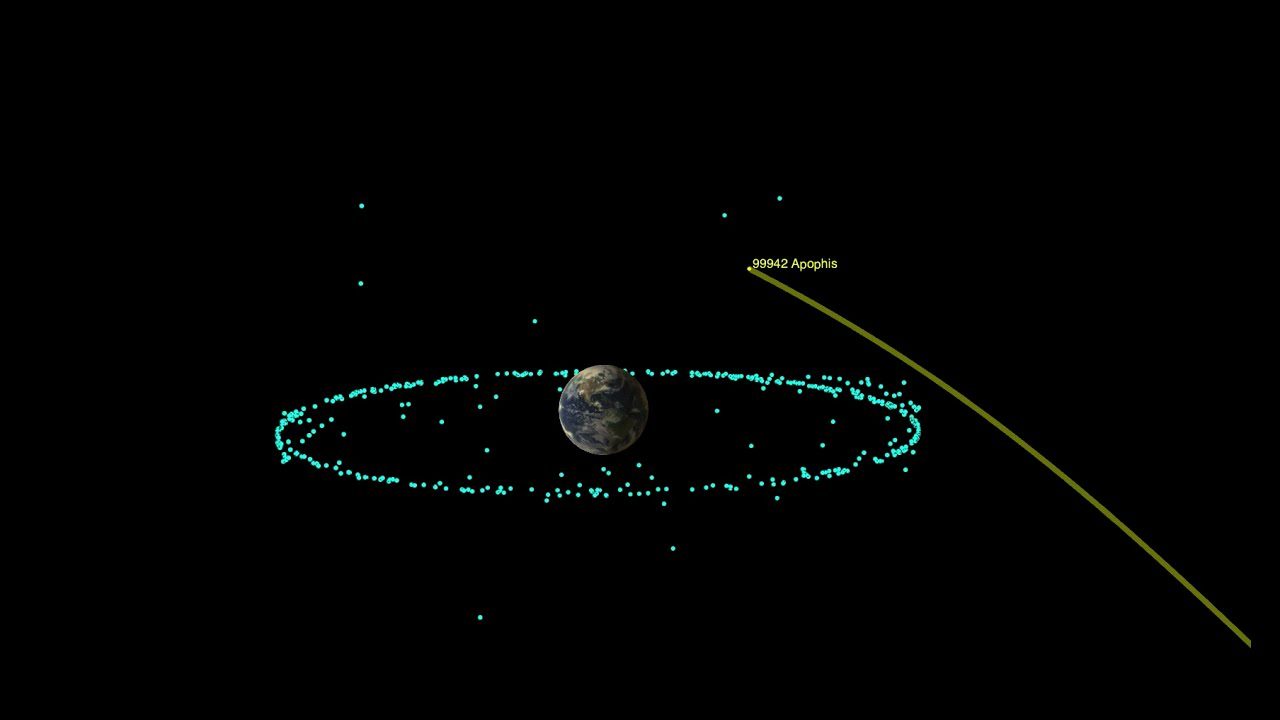
On April 13, 2029, a space rock the size of four NFL football fields will pass closer to Earth than many of the satellites orbiting overhead right now — and you may be able to watch it happen with your own eyes.
Asteroid 99942 Apophis, nicknamed the “God of Chaos,” will sweep within approximately 20,000 miles of Earth’s surface during its flyby. That puts it well inside the belt of geosynchronous satellites that power GPS, weather forecasting, and television broadcasts. And yet, according to both NASA and the European Space Agency (ESA), there is zero impact risk. This is a rare cosmic event, not a catastrophe in the making.
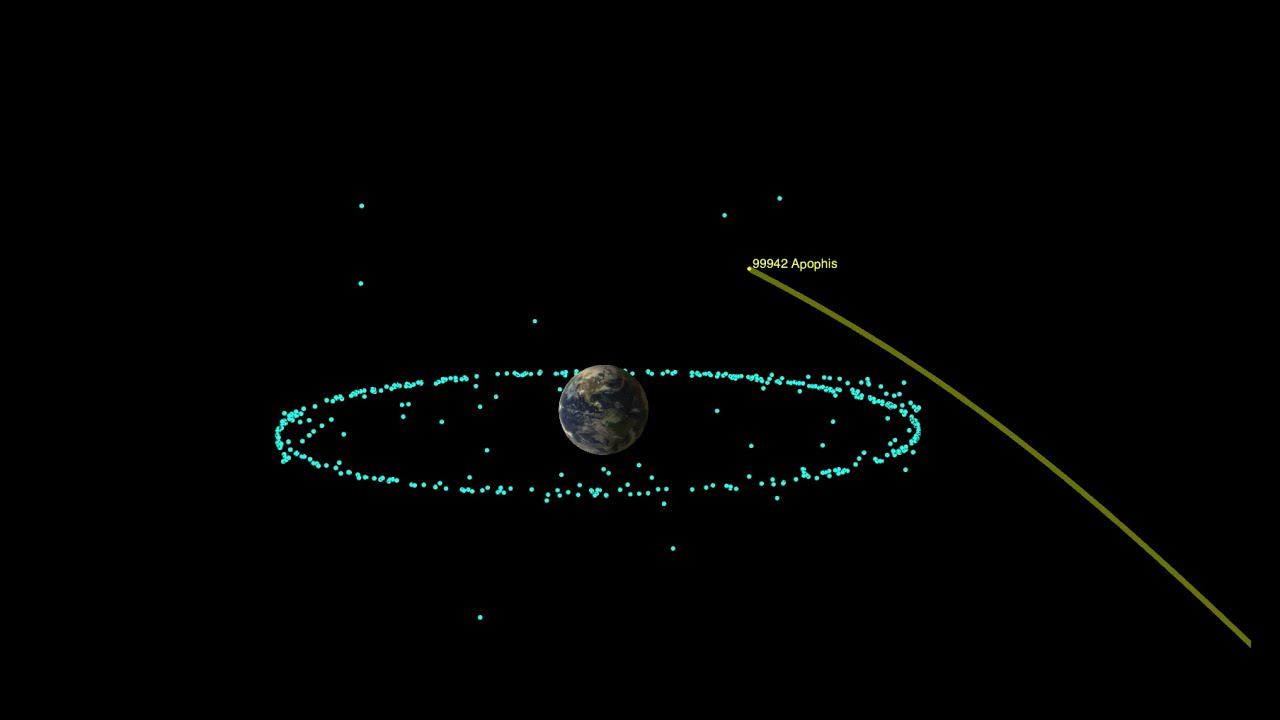
What makes this moment truly unusual is that you won’t need any special equipment to witness it. Under clear, dark skies, Apophis should be visible to the naked eye from parts of Europe, Africa, and Asia — the Eastern Hemisphere broadly, weather permitting. That kind of accessibility for an asteroid flyby simply doesn’t happen often.
What Apophis Actually Is — and Why Scientists Are Excited
Apophis was first discovered in 2004, and its early days in the scientific record were anything but calm. Initial calculations suggested a small but unsettling chance that the asteroid could strike Earth. That possibility captured public attention and gave the asteroid its ominous nickname, drawn from the ancient Egyptian god of chaos and darkness.
Over the years, as astronomers refined their measurements and tracked Apophis more precisely, those fears faded. NASA and ESA now confirm there is no impact risk from this flyby — or from the asteroid’s projected path for at least the next century. What remains is something far more useful than a disaster scenario: an extraordinary natural laboratory passing right through Earth’s backyard.
The asteroid is not a small pebble. NASA puts its mean diameter at roughly 1,115 feet, with its longest dimension stretching to approximately 1,480 feet. That’s a substantial object, and its close approach gives scientists a chance to study a near-Earth asteroid at a distance that simply isn’t possible from the ground under normal circumstances.
How Close Is 20,000 Miles, Really?
It helps to put the distance in perspective. The Moon sits about 239,000 miles from Earth on average. Geosynchronous satellites — the ones that maintain a fixed position above a point on Earth’s surface — orbit at roughly 22,236 miles up. Apophis will pass closer than that.
| Object | Distance from Earth |
|---|---|
| Moon (average) | ~239,000 miles |
| Geosynchronous satellites | ~22,236 miles |
| Apophis flyby (April 13, 2029) | ~20,000 miles |
That gap is close enough to make the event scientifically significant and visually observable — two things that rarely line up at the same time for an asteroid of this size.
Where and How to Watch the Apophis Flyby
NASA notes that the flyby will be visible from the Eastern Hemisphere, which includes Europe, Africa, and Asia. Observers in those regions with clear skies on the night of April 13, 2029, stand the best chance of catching it without any equipment at all.
Don’t expect a Hollywood spectacle, though. Because Apophis will be moving quickly across the sky, it will likely appear as a faint point of light — similar to a dim star — drifting steadily rather than sitting still like the planets do. The motion is what will give it away.
A few practical tips based on what NASA has indicated:
- Get away from city lights. Light pollution is the biggest obstacle for naked-eye observation of faint objects, and stepping away from streetlights can make a real difference.
- Find a clear, dark horizon. The darker your surroundings, the better your chances of picking up a faint moving point.
- Weather permitting is a genuine caveat. Cloud cover could block the view entirely, so having a backup location or being flexible about where you observe from is worth considering.
- Binoculars or a small telescope will improve the experience significantly, even if they’re not strictly required.
Why This Flyby Matters Beyond the View
For the scientific community, Apophis 2029 is not just a photo opportunity. A near-Earth asteroid passing this close — and this slowly relative to some flybys — offers a chance to study its composition, structure, and behavior in ways that distant observation cannot match.
Multiple space agencies have been planning missions and observation campaigns around this event for years. The proximity means ground-based telescopes will be able to gather detailed data, and any spacecraft in the right position could potentially make close-range observations as well.
There is also a longer scientific question in the background: how does Earth’s gravity affect an asteroid during a close pass? Apophis will experience significant gravitational forces during the flyby, and scientists are interested in how that might alter its rotation, surface, or trajectory going forward. The 2029 event is, in that sense, both an ending and a beginning — the end of decades of uncertainty about impact risk, and the beginning of a new phase of detailed study.
What Comes After April 13, 2029
The good news for anyone who misses the 2029 flyby — or simply wants more — is that Apophis will continue to be tracked closely. The data gathered during and after the close approach will sharpen predictions about the asteroid’s future path for generations of scientists to come.
For the general public, the 2029 event may represent something rarer still: a genuine reminder that space is not just an abstraction. On that April night, a mountain-sized rock will slide silently past our planet, closer than the satellites bouncing signals to your phone, visible to anyone standing under a clear sky in the right part of the world.
That’s not a threat. It’s a front-row seat to the solar system in motion.
Frequently Asked Questions
Will Apophis hit Earth in 2029?
No. Both NASA and ESA have confirmed there is no impact risk from the 2029 flyby.
How close will Apophis pass to Earth?
Apophis will pass approximately 20,000 miles above Earth’s surface, which is closer than many satellites in geosynchronous orbit.
Can I see Apophis without a telescope?
Yes, under clear, dark skies, Apophis should be visible to the naked eye from parts of Europe, Africa, and Asia in the Eastern Hemisphere, weather permitting.
How big is the Apophis asteroid?
NASA puts its mean diameter at about 1,115 feet, with its longest dimension at approximately 1,480 feet — roughly the length of four NFL football fields.
When exactly is the Apophis flyby?
The close approach is scheduled for April 13, 2029.
Will Apophis be a threat after 2029?
NASA and ESA have confirmed no impact risk from this flyby; detailed tracking data gathered during the 2029 event will further refine predictions about its future path, but no confirmed threat has been identified.



Leave a Reply