
What if nearly everything we thought we knew about the large-scale structure of the universe was built on an assumption that isn’t quite right? That’s the unsettling question now sitting at the center of modern cosmology, after physicists developed a new testing method and found tentative signs that one of the field’s most foundational frameworks may have cracks in it.
The framework in question is nearly a century old. Known as Friedmann-Lemaître-Robertson-Walker (FLRW) cosmology, it underpins virtually every major model of how the universe behaves at its largest scales. And according to new research, it may not fully hold up against real observational data.
The findings are being described as mild but intriguing — not a definitive overturning of cosmology as we know it, but a signal worth taking seriously. As one of the study’s co-authors put it, researchers observed “a surprising violation of an FLRW curvature consistency test, hinting at new physics beyond the standard model.”
The 100-Year-Old Model Now Under Scrutiny
FLRW cosmology is named after the four mathematicians and physicists who developed its mathematical foundations in the early 20th century. At its core, the model rests on a single sweeping assumption: that the universe, when viewed at large enough scales, looks essentially the same in every direction and from every location. Cosmologists call this the assumption of homogeneity and isotropy — or more simply, that the universe is uniform.
This assumption has been enormously useful. It simplifies the equations governing the universe’s expansion and forms the backbone of what scientists call the standard cosmological model. For decades, it has matched observations well enough that most researchers accepted it without serious challenge.
But “matching observations well enough” is not the same as being definitively proven. And that distinction is exactly what this new research is probing.
How Researchers Built a New Way to Test the Universe
The team developed a novel method for testing whether FLRW cosmology actually holds in practice. Their approach combines two distinct sources of observational data: observations of distant exploding stars (supernovae, which serve as cosmic distance markers) and large-scale galaxy surveys that map how matter is distributed across the universe.
By cross-referencing these two datasets, the researchers were able to probe whether the universe’s behavior matches what FLRW mathematics predicts — specifically, whether a key geometric property called curvature behaves consistently across different measurements.
When they applied this method to real observational data, the results showed mild but notable deviations from standard model predictions. The deviations weren’t enormous — they’re not claiming the entire framework collapses — but they were statistically interesting enough to warrant serious attention.
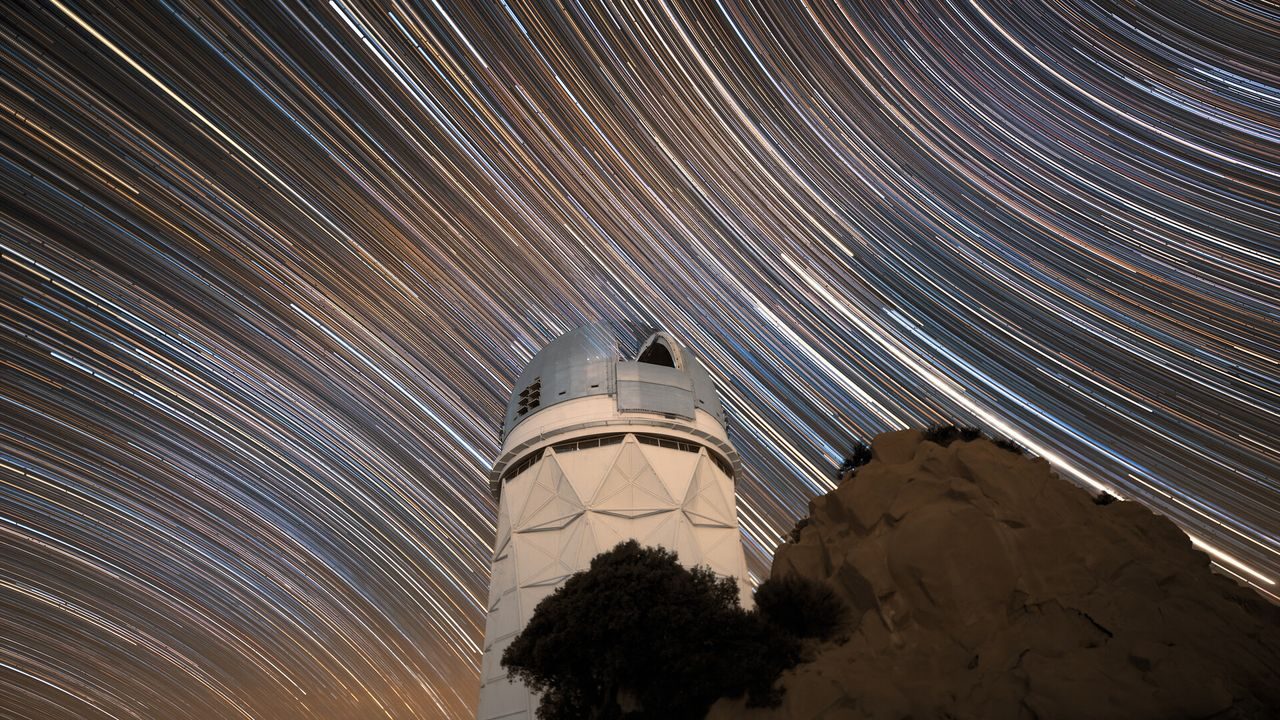
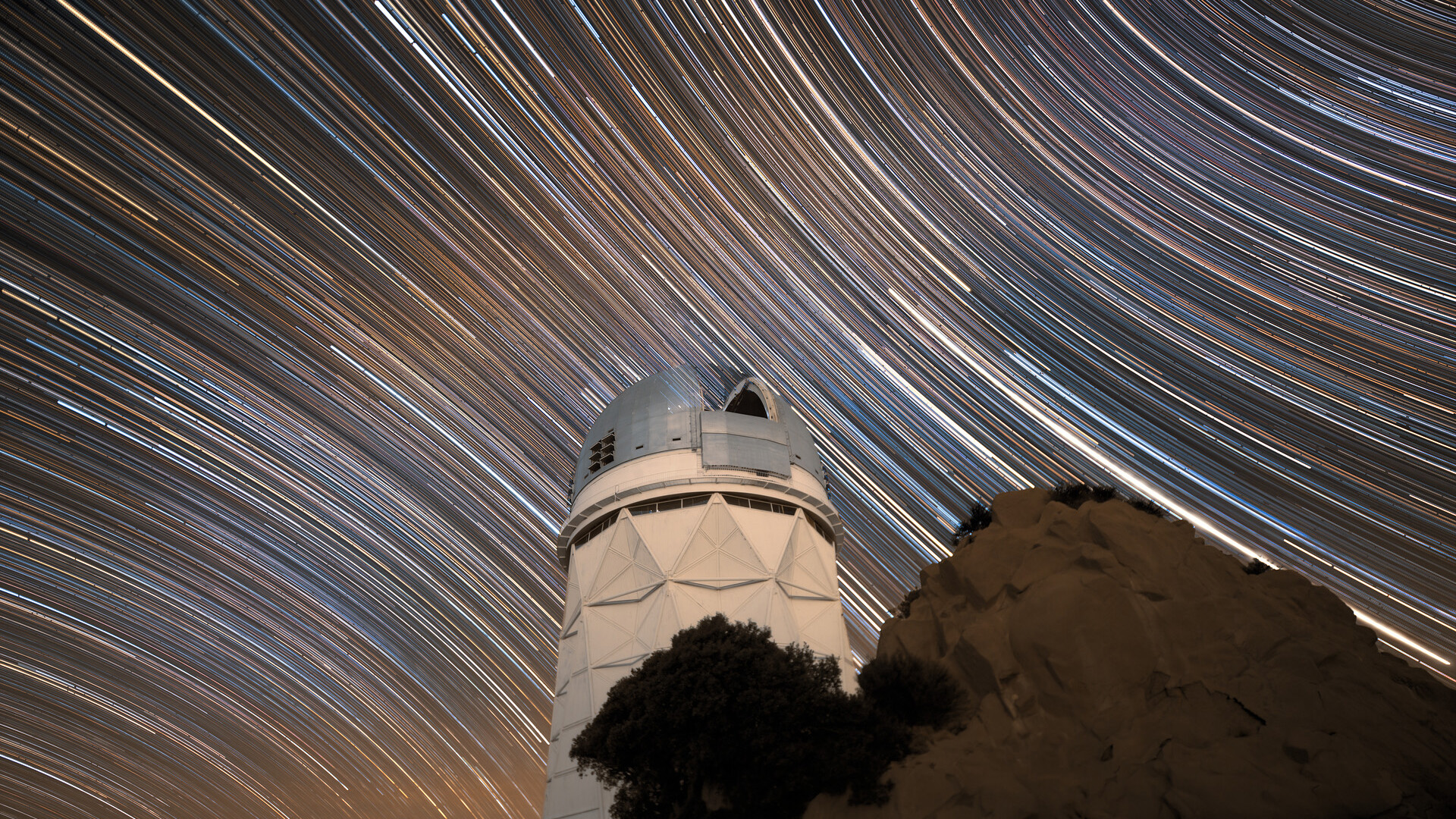
One of the key datasets feeding into this research comes from the Dark Energy Spectroscopic Instrument (DESI), housed inside the Nicholas U. Mayall 4-meter Telescope at Kitt Peak National Observatory in Arizona. DESI is in the process of creating one of the largest maps of the universe ever assembled, and its data is revealing subtle inconsistencies in the nature of space-time that more limited surveys may have missed.
What the Data Actually Shows
| Element | Detail |
|---|---|
| Framework being tested | Friedmann-Lemaître-Robertson-Walker (FLRW) cosmology |
| Age of the model | Nearly 100 years |
| Core assumption being challenged | That the universe is uniform (homogeneous and isotropic) at large scales |
| Data sources used | Distant supernovae observations and large-scale galaxy surveys |
| Key instrument involved | Dark Energy Spectroscopic Instrument (DESI) at Kitt Peak, Arizona |
| Nature of findings | Mild but intriguing deviations from standard model predictions |
| Named co-author | Asta Heinesen, physicist at Niels Bohr Institute (Copenhagen) and Queen Mary University |
- The research specifically flagged a violation of an FLRW curvature consistency test — meaning the geometric behavior of space doesn’t perfectly match what the model predicts.
- The deviations are described as tentative, not conclusive — further data and analysis will be needed to confirm or rule them out.
- The findings point toward the possibility of new physics beyond the standard cosmological model, though what that physics might look like remains an open question.
Why This Matters Beyond the Physics Department
It might be tempting to treat this as an abstract academic debate — equations on a whiteboard, interesting to specialists but irrelevant to daily life. That would be a mistake.
The FLRW model doesn’t just describe the universe’s geometry. It underlies our entire understanding of dark energy, the mysterious force thought to be accelerating the universe’s expansion. It shapes how scientists interpret the age of the universe, the distribution of galaxies, and the fate of everything that exists. If the model has meaningful errors baked into it, the ripple effects through cosmology would be substantial.
More practically, findings like these drive the construction of next-generation telescopes and instruments. DESI itself represents a major scientific investment precisely because researchers know that existing models need to be stress-tested against the best available data. These results suggest that investment is already paying off in unexpected ways.
Study co-author Asta Heinesen, a physicist at the Niels Bohr Institute in Copenhagen and Queen Mary University, is among the researchers now pushing the field to take these deviations seriously rather than dismissing them as noise.
What Comes Next for Cosmology
The researchers are careful to frame their findings as a starting point, not a conclusion. The deviations observed are real enough to report, but the scientific community will need to see them replicated across additional datasets and tested with alternative methods before any consensus shifts.
DESI is still in the process of completing its galaxy map — one of the most ambitious observational projects in the history of astronomy. As more data flows in, the statistical picture will sharpen. Either the deviations will grow more pronounced and harder to explain away, or they’ll fade as larger samples smooth out the signal.
Either outcome matters. If the deviations persist, cosmologists will face the genuinely exciting — and genuinely difficult — task of figuring out what new physics could explain them. If they disappear, the exercise will still have strengthened the evidentiary foundation beneath FLRW cosmology in a way that wasn’t possible before this testing method existed.
For now, the universe remains slightly more mysterious than it was before the analysis was run. Which, for physicists, is exactly the kind of result worth chasing.
Frequently Asked Questions
What is FLRW cosmology?
It is a nearly 100-year-old mathematical framework that models the universe as uniform and consistent at large scales, forming the foundation of the standard cosmological model.
What did researchers actually find?
They found mild but intriguing deviations from FLRW predictions when applying a new testing method to real observational data, including what they described as a surprising violation of an FLRW curvature consistency test.
Does this mean the standard model of cosmology is wrong?
Not conclusively — the findings are described as tentative and will need to be confirmed by further data and independent analysis before any firm conclusions can be drawn.
What is DESI and why is it relevant?
DESI is the Dark Energy Spectroscopic Instrument, located at Kitt Peak National Observatory in Arizona, and it is building one of the largest maps of the universe ever created — providing key data for this research.
Who conducted this research?
The study’s co-authors include Asta Heinesen, a physicist at the Niels Bohr Institute in Copenhagen and Queen Mary University, among others not named in the available source material.
What happens if these findings are confirmed?
Confirmation would suggest the existence of new physics beyond the standard cosmological model, though what that physics specifically involves has not yet been determined.


Leave a Reply