
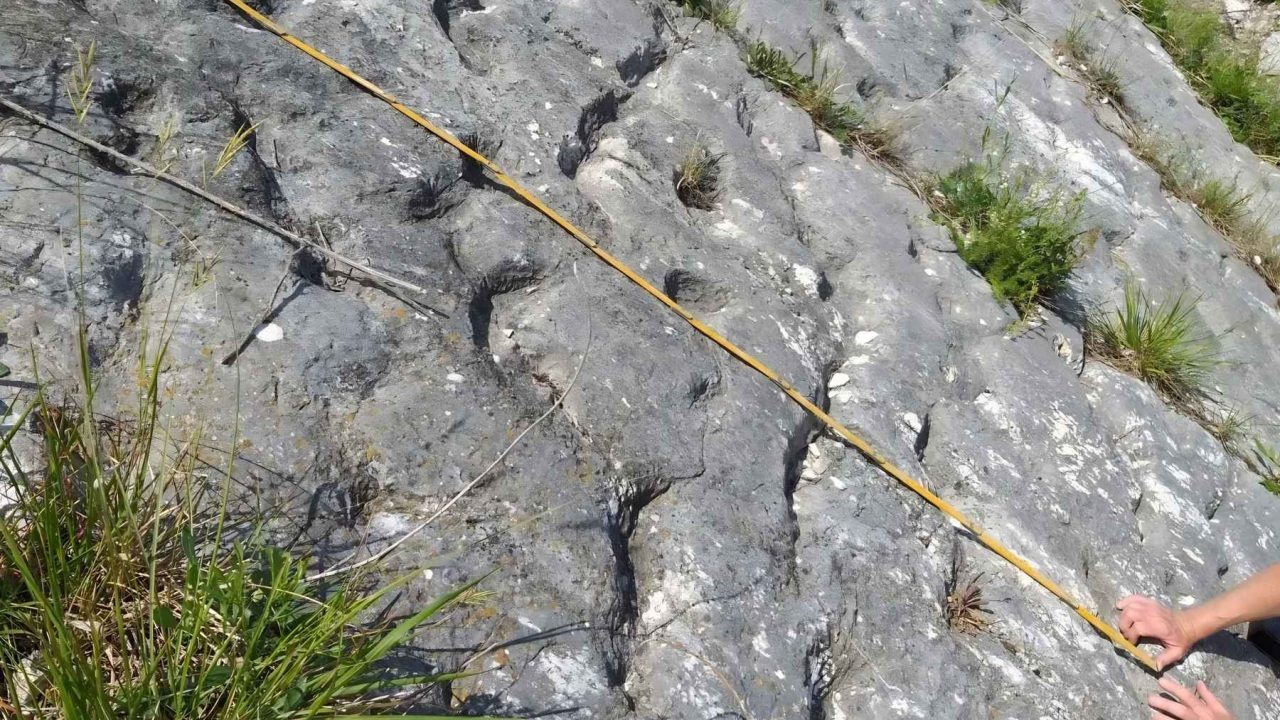
Seventy-nine million years ago, something spooked a large group of marine reptiles so badly that their frantic scramble across the seafloor left permanent marks in the mud — marks that are still visible today, etched into a pink limestone cliff above the Adriatic Sea in central Italy.
What climbers originally noticed as an odd pattern of overlapping grooves on a rock face has turned out to be one of the most unusual fossil discoveries in recent memory: a snapshot of mass panic, frozen in stone, most likely caused by an underwater earthquake during the Cretaceous period.
The find is remarkable not just for what it preserves, but for how it was found — by accident, by people who were there to climb, not to dig.
How Rock Climbers Accidentally Found a 79-Million-Year-Old Stampede
The story starts in 2019, on the cliffs near Ancona in Italy’s Conero Regional Park. Free climbers scaling the pale limestone face noticed something unusual about one particular rock slab. Instead of the smooth surface they expected, the wall was covered in overlapping hollows — dense, repeating impressions that looked almost like a herd of animals had thundered across soft ground.
It was strange enough that the climbers stopped and took photographs. They then contacted a fellow climber who also happened to be a geologist: Paolo Sandroni. Recognizing that this might be something significant, Sandroni reached out to Alessandro Montanari at the Coldigioco Geological Observatory.
That connection triggered a full scientific investigation of the site. What began as a curious observation by non-scientists had opened the door to a discovery that researchers would spend years analyzing.
What the Grooves in the Cliff Actually Record
The grooves preserved in the limestone are interpreted by researchers as trace fossils — not the remains of animals themselves, but the physical evidence of their movement. In this case, the marks appear to record the flipper or limb impressions of large marine reptiles, most likely sea turtles, moving urgently across the Cretaceous seafloor.
The leading explanation for what caused this sudden mass movement is an underwater earthquake. The theory holds that seismic activity shook the seafloor, triggering a panicked response from the animals foraging or resting in the area. The resulting rush of creatures across the soft sediment left tracks that were subsequently buried, compressed, and — over tens of millions of years — turned to stone.
The cliff where these marks now appear was once that ancient seafloor. Geological uplift over millions of years brought it above sea level, eventually placing it in the path of modern-day climbers looking for a challenging route above the Adriatic.
Key Facts About the Discovery at a Glance
| Detail | Information |
|---|---|
| Location | Cliffs near Ancona, Conero Regional Park, central Italy |
| Estimated age of tracks | 79 million years |
| Geological period | Cretaceous |
| Rock type | Pink limestone |
| Year discovered by climbers | 2019 |
| Animals believed responsible | Large marine reptiles, most likely sea turtles |
| Suspected trigger for movement | Underwater earthquake |
| Key researchers involved | Paolo Sandroni (geologist/climber); Alessandro Montanari, Coldigioco Geological Observatory |
- The tracks were not found during a formal excavation — they were spotted by recreational climbers on an active climbing route
- The surface of the slab was described as packed with overlapping hollows, resembling a herd running across mud
- The site sits within Conero Regional Park, a protected natural area on Italy’s Adriatic coast
- Researchers developed a detailed geological case to support the earthquake-panic interpretation
Why This Discovery Matters Beyond the Spectacle
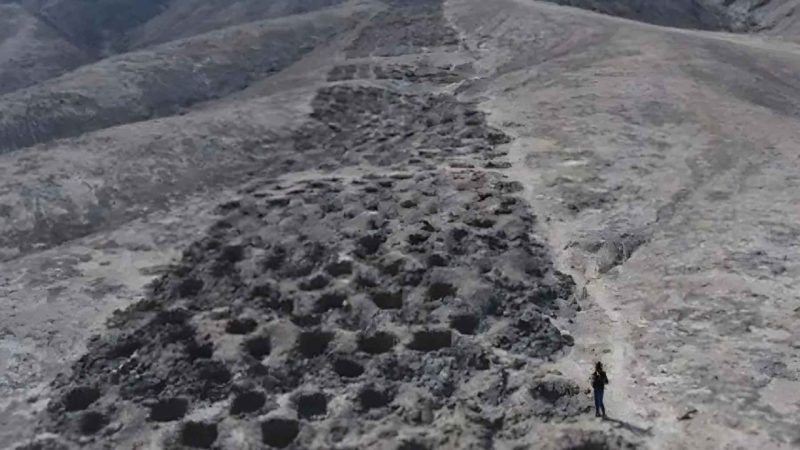
Fossil footprints and trace fossils are always valuable, but what makes this site particularly striking is the scale and apparent simultaneity of the tracks. This wasn’t one animal passing through. Researchers describe what looks like hundreds of animals moving at once — a crowd scene from the deep past.
Trace fossils that record behavioral responses to environmental events are rare. Most fossils capture anatomy — bones, shells, teeth. Finding evidence of how animals actually behaved in a moment of stress, and having a plausible geological explanation for what triggered that behavior, puts this discovery in a different category.
It also raises broader questions about how seismic events shaped animal behavior in prehistoric marine environments — questions that paleontologists are now in a position to investigate more seriously thanks to this site.
For the general public, the discovery is a reminder that significant scientific finds don’t always come from professional expeditions. Sometimes they come from someone with a good eye and a phone camera, scaling a cliff for the joy of it.
What Researchers Are Working to Confirm
The investigation into the Conero cliff site is ongoing. While the earthquake-triggered stampede interpretation has a geological case behind it, scientists continue to analyze the tracks in detail to strengthen or refine that conclusion.
Researchers are working to confirm the specific species responsible for the tracks, the precise nature of the seismic event, and the broader environmental context of the site during the Cretaceous period. The Coldigioco Geological Observatory remains central to that work.
The site’s location within a regional park also raises questions about preservation and public access — how to protect a fossil surface that happens to be on a popular climbing route. Those practical decisions are likely to be part of the conversation as the scientific profile of the discovery grows.
Frequently Asked Questions
Where exactly were the tracks discovered?
The tracks were found on a cliff face near Ancona, within Conero Regional Park in central Italy, above the Adriatic Sea.
How old are the fossil tracks?
Researchers estimate the tracks are approximately 79 million years old, dating to the Cretaceous period.
What animals made the tracks?
Scientists believe the tracks were most likely made by large marine reptiles, with sea turtles identified as the most probable candidates.
What caused the animals to move in such large numbers?
The leading explanation is an underwater earthquake that shook the Cretaceous seafloor, triggering a mass panicked response from the animals in the area.
Who discovered the tracks and how?
Free climbers noticed the unusual surface pattern in 2019 and photographed it. They contacted geologist and fellow climber Paolo Sandroni, who then reached out to Alessandro Montanari at the Coldigioco Geological Observatory, sparking the formal investigation.
Is the scientific investigation complete?
Not yet. Researchers continue to analyze the site and are working to confirm details including the specific species involved and the precise nature of the event that caused the mass movement.



Leave a Reply