
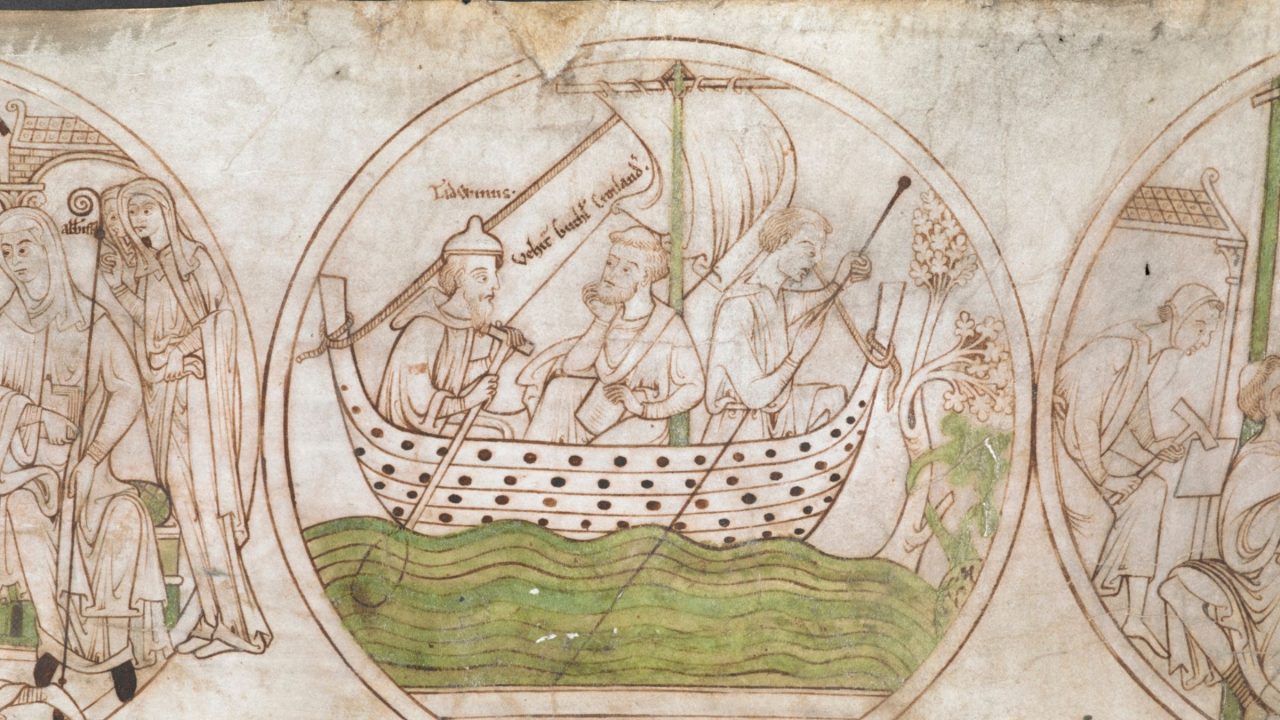
What if the images hanging in medieval churches were never truly silent? A new academic study suggests that when pilgrims and worshippers gazed upon sacred religious art in medieval England, their minds may have filled with imagined sounds — winds howling, hammers striking, animals crying out, and demonic noises echoing through their imagination. The experience of viewing holy imagery, the research argues, was far more than a visual one.
The study, published in the journal Religions and authored by researcher Britton Elliott Brooks, centers on the Harley Roll — a medieval English scroll depicting the life of Saint Guthlac. Brooks argues that medieval religious images were designed, whether consciously or not, to trigger immersive, multisensory responses in their viewers, blending what the eyes saw with what the mind heard, remembered, and felt.
It’s a striking reframe of how we think about medieval art. For centuries, scholars have largely treated these images as visual objects. This research pushes back on that assumption in a compelling way.
The Sensory World of the Medieval Shrine
To understand why this research matters, it helps to picture what visiting a medieval saint’s shrine actually felt like. These were not quiet, contemplative spaces in the way modern museums might be. They were overwhelming environments built to engage every human sense at once.
“Spiced incense on the air, song reverberating off stone, flare of light on gold, the hope of the divine brushing human skin, healing body and soul. It is hard to overstate the intense sensory experience of medieval English saint’s shrines. From the lowly stone marker to the bejewelled and towering reliquary, the sacred centres of saint’s cults were locations of physical, mental, and spiritual immersion. They were environments structured to shape multisensory engagement with their respective saint, with one of the most important sensory avenues being sound.”
That passage, drawn directly from the study, captures the atmosphere that Brooks believes shaped how medieval people experienced not just shrines themselves, but the religious images connected to them. Sound was not a backdrop — it was a central part of how faith was felt and understood.
The argument is that sacred imagery didn’t exist in isolation from this sensory environment. Viewers came to these images already primed by sound, smell, light, and emotion. The images, in turn, could reactivate those sensory memories — making the act of looking at a scroll or a painting a deeply immersive mental experience.
What the Harley Roll Research Actually Found
The Harley Roll is a medieval English scroll that tells the story of Saint Guthlac, an Anglo-Saxon hermit who became one of England’s most venerated saints. The scroll format itself is significant — it was meant to be unrolled and viewed in sequence, almost like an early form of narrative art.
Brooks’ research examines how the imagery within the Harley Roll may have been crafted to evoke specific imagined soundscapes. Pilgrims and worshippers viewing the scroll, the study suggests, would have mentally “heard” the scenes playing out before them — not because the images contained literal sound, but because their minds were trained by religious culture, memory, and sensory experience to supply it.
The types of imagined sounds the research identifies as potentially evoked by the images include:
- Winds and environmental noise from scenes set in the natural world
- Hammering sounds connected to physical or spiritual conflict
- Animal cries depicted within the narrative scenes
- Demonic noises associated with spiritual struggle and temptation
This wasn’t passive viewing. It was active, imaginative engagement — the kind of deep mental participation that medieval religious culture actively encouraged.
How This Changes Our Understanding of Medieval Religious Images
The broader implication of Brooks’ study is that scholars and modern audiences have been underestimating the experiential richness of medieval religious art. Treating these images as purely visual objects strips away a layer of meaning that their original audiences would have taken for granted.
| Element of Study | Detail |
|---|---|
| Researcher | Britton Elliott Brooks |
| Publication | Journal: Religions |
| Primary source examined | The Harley Roll (medieval English scroll) |
| Subject of the scroll | Life of Saint Guthlac |
| Core argument | Medieval religious images evoked imagined soundscapes in viewers |
| Disciplines combined | Medieval studies and sound studies |
| Sounds identified as evoked | Winds, hammering, animal cries, demonic noises |
The study combines medieval studies with sound studies — a pairing that reflects a growing academic interest in what researchers call “sensory history,” the idea that to understand the past, we need to reconstruct not just what people saw and thought, but what they smelled, heard, and physically felt.
For medieval audiences, the line between image and experience was far more porous than we might assume today. Religious art wasn’t decoration. It was a tool for spiritual immersion.
Why This Still Resonates Today
There’s something genuinely surprising about the idea that people standing before a painted scroll in medieval England were having what we might now describe as an almost cinematic experience — one where the visuals triggered an internal soundtrack.
Modern neuroscience has actually documented similar phenomena, where viewing images associated with strong memories or emotions can trigger sensory responses in the brain. Medieval religious communities may have been engineering this effect long before anyone had the language to describe it scientifically.
The Harley Roll study invites a rethinking of how we approach historical art more broadly. When we look at a medieval image today — in a museum, a textbook, or a digital archive — we are seeing only a fraction of what its original viewers experienced. The sound, the incense, the candlelight, the communal prayer: all of that formed part of the meaning. Strip it away, and the image becomes something quieter and smaller than it was ever meant to be.
Brooks’ research is a reminder that the past was loud, layered, and sensory in ways that flat reproductions rarely capture.
Frequently Asked Questions
What is the Harley Roll?
The Harley Roll is a medieval English scroll that depicts the life of Saint Guthlac, an Anglo-Saxon saint. It is the primary source examined in Britton Elliott Brooks’ study on sound and medieval religious imagery.
Who conducted this research?
The study was authored by researcher Britton Elliott Brooks and published in the academic journal Religions.
What kinds of sounds did medieval viewers supposedly “hear” when looking at religious images?
According to the research, viewers may have mentally experienced winds, hammering, animal cries, and demonic noises while viewing the imagery in the Harley Roll.
Why were medieval shrines considered so sensory?
The study describes medieval saint’s shrines as environments deliberately structured to engage sight, sound, smell, touch, and emotion simultaneously — with sound identified as one of the most important sensory elements.
What academic fields does this study combine?
Brooks’ research brings together medieval studies and sound studies to examine how sacred imagery functioned as a multisensory experience for its original audiences.
Does this research change how historians view medieval art?
The study argues that treating medieval religious images as purely visual objects misses a crucial layer of meaning — that these images were designed to trigger immersive, multisensory responses including imagined sound.



Leave a Reply