
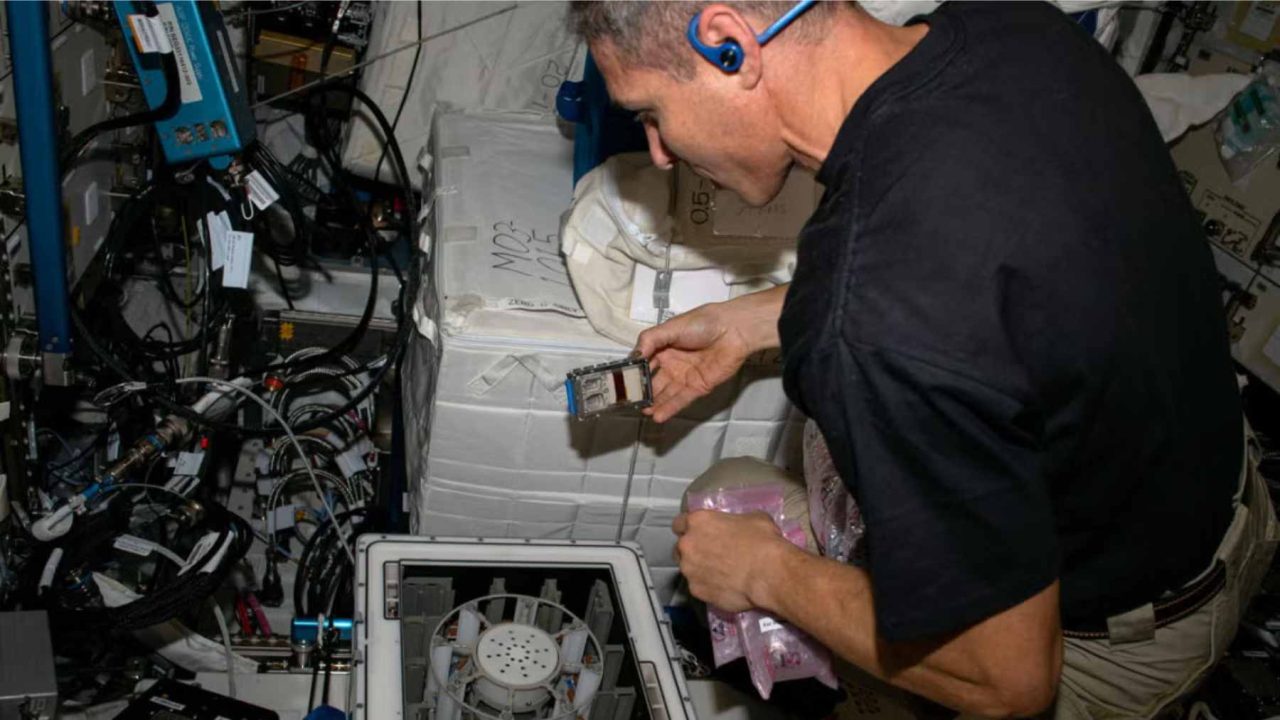
What if the future of space mining doesn’t involve massive drilling rigs, laser cutters, or robotic excavators the size of buildings — but instead fits inside a container you could pack your lunch in? That’s not a thought experiment anymore. NASA-supported researchers have demonstrated that living microbes can extract metals from meteorite material while floating in orbit, and the device they used to do it is roughly the size of a Tupperware box.
The experiment, known as BioAsteroid, represents one of the most unconventional ideas in space resource science. It’s early-stage, proof-of-concept work — but it signals a genuine shift in how scientists are thinking about keeping astronauts supplied on long missions without hauling everything from Earth.
It also raises a question worth sitting with: if bacteria can mine asteroids in microgravity, what else might living organisms be capable of beyond our atmosphere?
The BioAsteroid Experiment: What Actually Happened
The BioAsteroid project was designed by research teams at Cornell University and the University of Edinburgh. The in-orbit portion of the experiment was carried out aboard the International Space Station at the end of 2020, with NASA astronaut Michael Scott Hopkins performing the hands-on steps in space while parallel control experiments ran simultaneously on Earth.
The core idea was straightforward but ambitious: place bacteria and fungi in contact with actual meteorite material inside a small, sealed container, then observe whether those microbes could extract metals from the rock while living in microgravity conditions.
They could.
Lead author Rosa Santomartino described it as “probably the first experiment of its kind on the International Space Station on meteorite.” The results were published in 2026 in the peer-reviewed journal npj Microgravity, giving the scientific community a formal record of what microbial mining in orbit looks like in practice.
The fact that Earth-based controls were run alongside the space experiment is significant. It allowed researchers to compare how the microbes performed in microgravity versus normal gravity — a critical baseline for understanding whether space conditions meaningfully change the biology involved.
Why Microbes Instead of Machines?
Space mining has traditionally been imagined as a hardware problem. You need drills, you need power, you need robots sturdy enough to survive the vacuum of space and the brutal temperatures of an asteroid surface. All of that is expensive, heavy, and complex.
Microbial mining flips the logic. Microbes are small, they reproduce on their own, and they’ve been extracting metals from rock on Earth for billions of years. Biomining — using bacteria to leach valuable metals from ore — is already used in terrestrial mining operations. The BioAsteroid experiment asks whether that same biological process can be transplanted to space.
If it can, the implications for long-duration missions are real. Astronauts traveling to Mars or operating a lunar outpost need metals for construction, repairs, and manufacturing. Reducing how much raw material needs to be launched from Earth’s surface — one of the most expensive parts of any space mission — could make those missions significantly more viable.
Researchers also noted that the work carries lessons for sustainability back on Earth, where conventional mining carries heavy environmental costs.
Key Facts About the BioAsteroid Mission
| Detail | Information |
|---|---|
| Experiment name | BioAsteroid |
| Designing institutions | Cornell University and University of Edinburgh |
| In-orbit location | International Space Station (ISS) |
| When conducted | End of 2020 |
| Astronaut involved | Michael Scott Hopkins (NASA) |
| Lead author | Rosa Santomartino |
| Published | 2026, journal npj Microgravity |
| Materials tested | Bacteria, fungi, and meteorite material |
| Device size | Approximately the size of a Tupperware container |
- The experiment was supported by NASA funding
- Parallel control experiments were run on Earth at the same time
- It is described as “probably the first experiment of its kind on the ISS on meteorite”
- Both bacteria and fungi were used as the biological agents
What This Could Mean for Future Space Missions
The BioAsteroid results don’t mean we’re months away from asteroid mines staffed by microbes. This is proof-of-concept science — it demonstrates that the process is possible in space conditions, not that it’s ready to be deployed at scale.
But the direction it points is meaningful. Space agencies and private companies are already seriously exploring asteroid mining as a way to access rare metals without depleting Earth’s reserves. The challenge has always been the cost and complexity of doing it. A biological approach — compact, self-sustaining, and requiring far less heavy machinery — could eventually change that calculation.
For long-haul missions specifically, the ability to extract useful metals from asteroid material encountered along the way would represent a significant shift in how missions are planned and resourced. Right now, everything an astronaut needs has to be packed before launch. Microbial mining could eventually allow crews to source some materials from their environment rather than carrying all of it with them.
Researchers also pointed to sustainability applications on Earth. The same microbial processes studied in orbit could inform cleaner, lower-impact metal extraction techniques for terrestrial mining — an industry that currently carries enormous environmental costs in land use, water contamination, and carbon emissions.
What Comes Next for Space Microbial Mining
The 2026 publication in npj Microgravity marks the formal scientific record of what BioAsteroid found, but it’s the beginning of a research conversation rather than the end of one. Follow-on experiments would need to test whether the process scales, which specific metals are most effectively extracted, and how microbial performance changes under different space conditions.
The gap between a Tupperware-sized proof of concept and an operational space mining system is enormous. But every major technology in space exploration started somewhere small. The BioAsteroid experiment has at least established that biology — not just machinery — belongs in the conversation about how humanity will access resources beyond Earth.
Frequently Asked Questions
What is the BioAsteroid experiment?
BioAsteroid is a NASA-supported experiment designed by Cornell University and the University of Edinburgh that tested whether bacteria and fungi could extract metals from meteorite material while aboard the International Space Station.
Who conducted the experiment in space?
NASA astronaut Michael Scott Hopkins performed the in-orbit steps of the experiment aboard the ISS at the end of 2020.
Where were the results published?
The results were published in 2026 in the peer-reviewed journal npj Microgravity, with lead author Rosa Santomartino overseeing the research.
Why use microbes instead of traditional mining equipment?
Microbes are compact, self-replicating, and already capable of extracting metals from rock on Earth — making them a potentially lighter and lower-cost alternative to heavy drilling or robotic machinery in space.
Is this technology ready to use on real space missions?
No — BioAsteroid is early-stage, proof-of-concept research. It demonstrates the process is possible in microgravity, but significant further development would be required before any operational application.
Does this research have any applications on Earth?
Researchers noted that the work also carries lessons for sustainability on Earth, where microbial mining techniques could potentially offer cleaner alternatives to conventional metal extraction methods.

Leave a Reply