
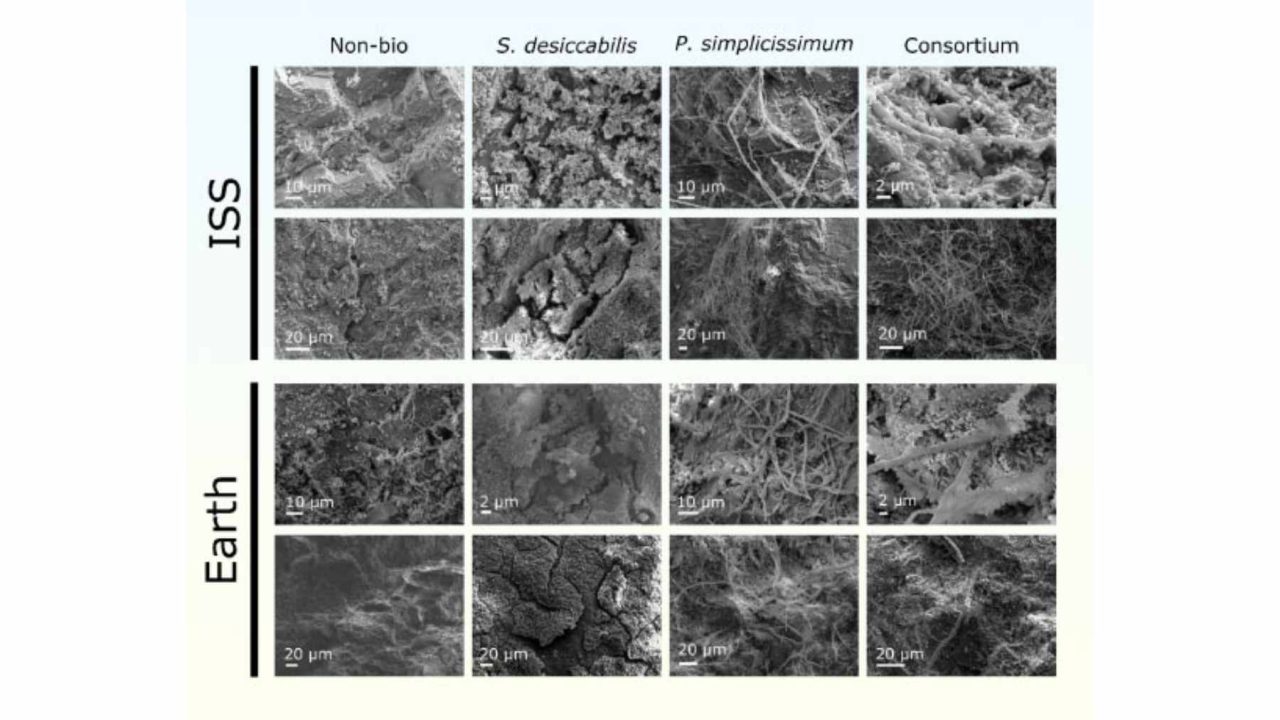
Four hundred kilometers above Earth, inside a small reactor no larger than a shoebox, a microscopic fungus is doing something that engineers with drills and chemicals have struggled to do efficiently for decades — pulling valuable metals out of rock.
That is the striking reality behind a NASA-supported experiment called BioAsteroid, which ran aboard the International Space Station and produced results that researchers are calling an early but meaningful proof of concept. The experiment showed that living microorganisms — specifically a fungus and a bacterium — can extract precious metals including palladium and platinum from meteorite material, even in the weightless environment of low Earth orbit.
It sounds like the premise of a science fiction novel. But the science is real, and the implications stretch far beyond space exploration.
What the BioAsteroid Experiment Actually Did
The BioAsteroid project worked with a common type of space rock known as an L-chondrite — one of the most frequently found meteorite varieties. Small reactors were installed inside ESA’s KUBIK incubators aboard the station, allowing the team to compare how the biological extraction process performed under microgravity conditions versus what would happen on Earth.
NASA astronaut Michael Scott Hopkins handled crew tasks for the flight experiment, making him one of the few humans ever to assist in what could fairly be described as off-world biological mining.
The organisms used weren’t exotic or genetically engineered. They were the kind of fungus and bacterium that researchers already work with in Earth-based laboratory settings. What was new was proving they could function — and extract — in the conditions of orbit.
The metals targeted, palladium and platinum, aren’t chosen at random. Both are tied directly to technologies that reduce pollution and underpin major global industries. Catalytic converters in vehicles, fuel cells, electronics manufacturing — these all depend on a reliable supply of platinum-group metals that are notoriously difficult and environmentally costly to obtain through conventional mining.
Why Biomining in Space Matters More Than You Might Think
The concept of using living organisms to extract metals — known as biomining — already exists on Earth in limited forms. Certain bacteria are used to help process low-grade ore at some mining operations. But the BioAsteroid results push that idea into entirely new territory.
For future deep-space missions, the ability to extract useful materials from asteroids or other space rocks without carrying heavy chemical processing equipment could be transformative. Every kilogram launched into space costs an enormous amount of fuel and money. A biological system that is lightweight, self-sustaining, and capable of pulling metals from raw rock is exactly the kind of resource-efficient solution that long-duration space missions need.
But the implications don’t stop at the edge of the atmosphere. Researchers note that the findings also hint at cleaner extraction strategies that could eventually reduce the reliance on harsh chemicals in Earth-based mining operations. Platinum and palladium extraction currently comes with a significant environmental footprint. A biological alternative — even a partial one — could shift that equation.
Key Facts About the BioAsteroid Mission
| Detail | What We Know |
|---|---|
| Experiment name | BioAsteroid |
| Location | International Space Station (approx. 400 km above Earth) |
| Meteorite type used | L-chondrite (common meteorite variety) |
| Organisms used | A fungus and a bacterium |
| Metals extracted | Palladium and platinum |
| Equipment used | Small reactors in ESA’s KUBIK incubators |
| NASA crew involvement | Astronaut Michael Scott Hopkins |
| Current status | Early proof of concept |
- The experiment tested performance under microgravity conditions, comparing results to Earth-based equivalents.
- Palladium and platinum are both critical to pollution-reducing technologies and major industrial sectors.
- Conventional methods of obtaining these metals carry a heavy environmental cost.
- The biological approach does not rely on the harsh chemicals typically used in metal extraction.
The Real-World Consequences for Mining and the Environment
If you’ve ever driven a car with a catalytic converter, used a smartphone, or benefited from cleaner air in a city — you’ve indirectly depended on platinum-group metals. The global demand for these materials is significant and growing, particularly as hydrogen fuel cell technology expands.
The problem is that getting them out of the ground is messy. Current extraction methods involve strong acids, toxic byproducts, and large-scale land disruption. Researchers working in the biomining field have long argued that biological alternatives could offer a more sustainable path, but the challenge has always been scaling the process and proving it works in varied conditions.
That’s part of what makes the BioAsteroid results notable. The experiment didn’t just show that organisms can extract metals in a lab on Earth — it showed they can do it in the genuinely alien environment of orbital spaceflight. That’s a meaningful validation of the underlying science, even at an early stage.
Supporters of the research point to evidence suggesting that if biological extraction can be refined and eventually scaled, it could reshape both how we think about resource use in space and how we approach the environmental costs of mining here at home.
What Comes Next for Space-Based Biomining
The BioAsteroid results represent a proof of concept, not a finished technology. The gap between demonstrating that a fungus can pull platinum from a meteorite fragment in a small orbital reactor and actually deploying a biomining system on an asteroid mission is enormous — and researchers are clear about that.
The next steps would likely involve understanding exactly how the organisms perform across different microgravity intensities, different rock compositions, and longer time periods. There are also engineering questions about how such a biological system would be contained, maintained, and scaled on a future spacecraft or surface mission.
Still, the fact that this experiment ran in real orbital conditions — not just a simulated environment on Earth — gives the scientific community something concrete to build on. Space agencies and research institutions will be watching whether follow-up experiments can deepen the results and move the concept closer to practical application.
The next frontier of mining may not involve a single drill or a drop of acid. It might just be alive.
Frequently Asked Questions
What is the BioAsteroid experiment?
BioAsteroid is a research project that ran aboard the International Space Station, using a fungus and a bacterium to extract valuable metals from meteorite material in microgravity conditions.
Which metals were extracted during the experiment?
The experiment successfully extracted palladium and platinum from L-chondrite meteorite material while in orbit approximately 400 kilometers above Earth.
Who was the NASA astronaut involved?
NASA astronaut Michael Scott Hopkins handled crew tasks for the BioAsteroid flight experiment aboard the International Space Station.
What is biomining and why does it matter?
Biomining uses living organisms to extract metals from rock, offering a potential alternative to harsh chemical processes. Researchers suggest it could reduce the environmental footprint of metal extraction both in space and on Earth.
Is this technology ready to be used on real asteroid mining missions?
Not yet. The BioAsteroid results are described as an early proof of concept, meaning significant further research and development would be needed before any practical deployment.
Why are palladium and platinum specifically important?
Both metals are critical to pollution-reducing technologies and major industries, including catalytic converters and fuel cells, but obtaining them through conventional mining carries a significant environmental cost.


Leave a Reply